 Yu Siang Teo · · 8 min read
Opinion: Uproar over Uber’s wait-time charge reveals the pitfalls of designs that overpromise
Yu Siang is a star contributor for Tech in Asia and publishes exclusive, high-value content that serves the Asian tech community. Read more from star contributors here.
On October 3, Uber Singapore announced that it will be imposing a wait-time charge on riders who are more than three minutes late for their rides.
Wait-time charges are not a new concept; Grab, Uber’s main competitor in Singapore, has been charging this for some time. (To be fair, Grab only starts imposing the late charge after five minutes, and its fees aren’t subject to surge pricing, unlike Uber’s.) However, this recent Uber announcement caused an uproar.
Most comments on Uber’s Facebook post came from angry riders who demanded that the same be done to drivers—that their fares should be reduced if a driver turns up more than three minutes late.

Source: Uber Singapore’s Facebook page.
Some also pointed out that Uber drivers tended to indicate that they have arrived at the pickup point prematurely, causing longer waiting times than necessary for riders.
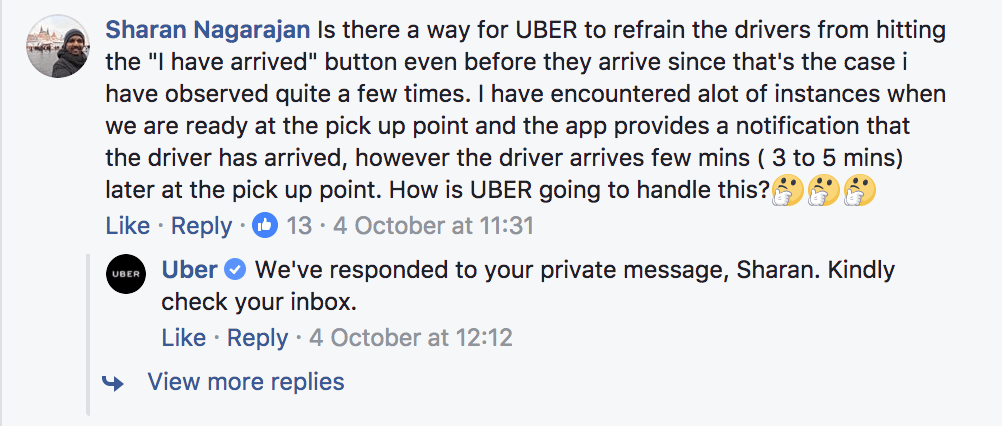
Source: Uber Singapore’s Facebook page.
It’s easy to see how errant riders and drivers contributed to Uber’s current unpleasant situation; it’s all about psychology and selfishness, after all. Riders who request for an Uber before they’re ready to leave are hoping to ensure that their driver is there the moment they reach their pickup point. Conversely, drivers who indicate that they’ve arrived way too early are gaming the system to ensure that their riders are already at the pickup point when they eventually arrive. In both cases, the irresponsibility of humans resulted in at least one party’s unpleasant waiting experience.
What’s harder to spot, though, is that design has a part to play, too. You see, in an attempt to create an automagical car-riding experience, Uber’s (and Grab’s) design deliberately overpromises what it can do. And overpromises, as we know, lead to under-delivery and frustration.
To see how this happens, let’s look at two crucial parts of the Uber/Grab car-riding experience:
- When the app tells you how far away your driver is
- When the app notifies you that your driver has arrived
Examining these key experience points would make clear the gaps between what the design communicates vs the reality of the app’s underlying technology.
“Your driver is five minutes away!”
After you’ve booked a ride on Uber or Grab, the app gives you really useful information about when your driver will arrive.
“Your driver has arrived!”
When designs overpromise
Could we give honesty a try?





Stay updated on the go with our mobile app.
Get latest insights with smoother, more personalized experience through TIA mobile app.









📅 Upcoming Events
22 October 2026
Payoneer x CSPN Summit 2026