Jeffrey Towson · · 6 min read
How bike-sharing is scaling so fast and for free
From the beginning of the China bike-sharing phenomenon, I have been struck by how quickly these companies have become so pervasive. Just think of how often you see a Mobike or Ofo bike in China. You see these brightly-colored bikes literally thousands of times every day on the street, in the park, near the subway, and so on. I sometimes count how long it takes for me to see another of these bikes. I rarely make it to 10 seconds.
In part one, I argued that the startling power of these businesses follows from their deployment of “wild assets” in huge numbers. In this part, I dig into how their usage has grown so fast.
What does it take to scale a bike-sharing company?
I spoke with Chris Martin, Mobike’s vice president for international expansion, about how bike usage grows in a city vs the number of bikes deployed. And it turns out it is pretty complicated, as the growth depends on a few things:
- The city itself: Is it flat or hilly? What is the geographic size? What is the population size? What is the population’s economic level?
- The degree of local competition: Is it an open market or are there already significant competitors?
- Public transportation systems: According to the 2017 Kleiner Perkins/Hillhouse Capital Internet Trends report, 50 percent of bike rides in China are going to the subway or back (see their chart below).
- Mobile payment adoption
- Other factors: Government support, consumer adoption rates, and so on.
One thing is clear. These bikes grow organically and rapidly in their usage, and this growth requires virtually no marketing spend or support from headquarters. It is an amazing phenomenon that is driven almost entirely by the bikes (i.e. the wild assets) themselves.
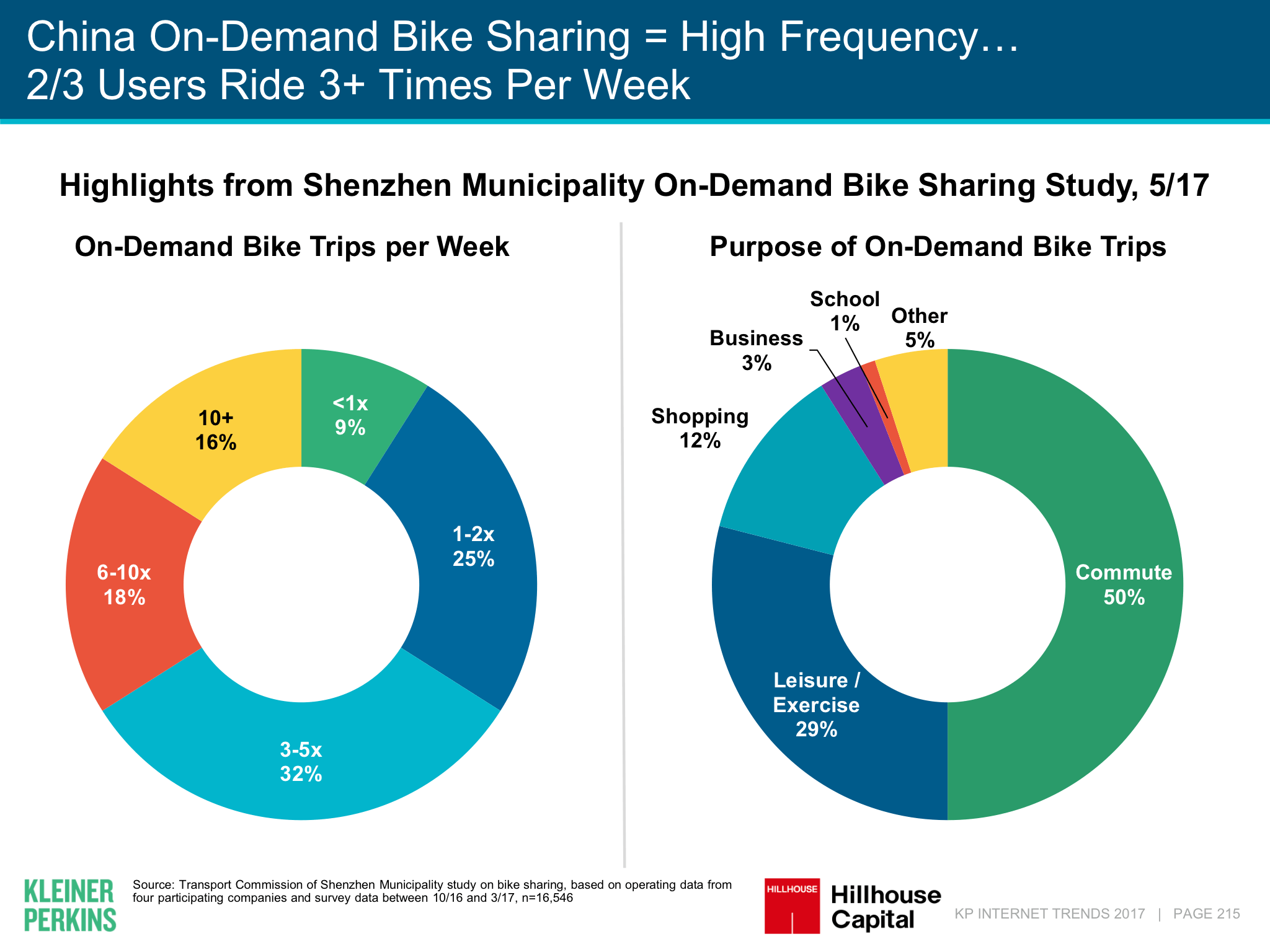
Photo credit: Kleiner Perkins.
It is worth discussing in detail how usage actually grows in a city.
For bike-sharing, the process typically begins with deploying a small number of bikes. For example, when launching in Manchester, Mobike started by placing about 1,000 bikes on the downtown streets. They did this as part of an official launch day when they also had a promotional event. But basically, it involves deploying a small number of bikes, getting the word out to some degree, and then simply waiting.
What happens next is important. Eventually, curious people walk up and check out the unusual bikes. When these bikes are in public spaces, like downtown sidewalks, people notice them as they walk by. They stand out on a sidewalk in a way a new product on a store shelf does not.
A few daring customers (i.e. the early adopters) see the bikes, stop, and download the app on their smartphone. They register and pay the deposit successfully and then just scan the QR code on the bike, hop on, and ride off.
The important factor in this process is that the bikes themselves attract the users, get them to download the app, and then deliver the service to them. The marketing, sales, and delivery of the service are all done by the asset on the sidewalk. This was my definition of a “wild asset” in part one. Attribute two of my definition was that the asset can market, sell, and/or deliver its product or service mostly on its own.
And while a stationary bike in a public space gets noticed, a moving one is much better. Virtually everyone on the street notices the early adopters riding around town on these bikes. So then other people download the app and try unlocking a bicycle themselves. Word of mouth is important at this stage.
Usage then starts to increase naturally and organically, attracting middle-class customers. As usage increases, Mobike deploys more bikes, and the self-selling process repeats itself. So, more bikes mean more marketing and more sales. The service quickly appeals to the mass market, used by virtually every demographic within a city.
Below is a chart from Mobike of usage vs the number of bikes deployed for a typical Chinese city with 8 million people. Note that it is fairly linear and not exponential like that of social media.
My definition for assets in the wild
Better than WeChat and Coca-Cola?
Conclusion





Stay updated on the go with our mobile app.
Get latest insights with smoother, more personalized experience through TIA mobile app.