
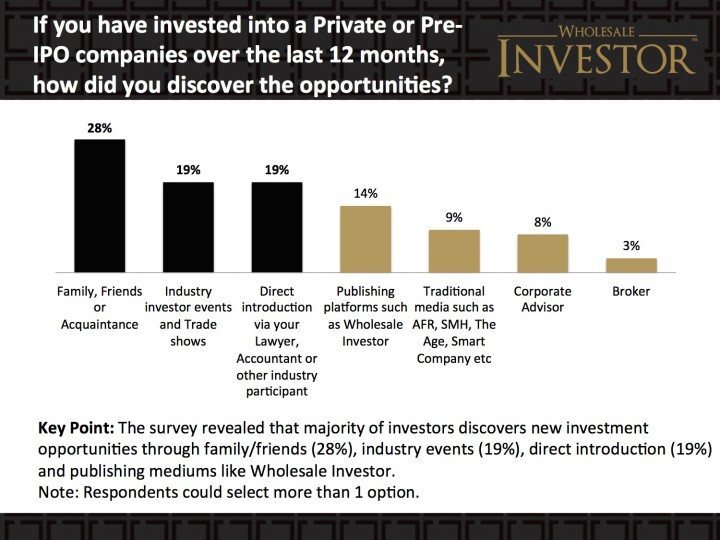
Wholesale Investor recently released its annual Investor Sentiment Index. One of the insights from the report which struck me was the heavy reliance still placed by Australian investors on their networks for generating deal-flow:
Disrupting the disruptors
This Crunchbase piece suggests that there is a growing disconnect between the traditional processes relied upon by early-stage investors and the sheer volume of and data on startups. It notes that the modus operandi of Venture Capital (VC) firms has not really evolved over the last 20 years, relying on personal networks to generate deal-flow and human intelligence to assess that deal-flow.
On the other hand, the volume of investment-ready tech startups is growing, facilitated by things like lean startup and minimum viable products (MVPs) which enable entrepreneurs to get to the market and validate sooner. The data available on those startups is also experiencing rapid growth, meaning a lot more can potentially be done with software and intelligent algorithms to facilitate deal-flow generation and selection.
Looking at the Western Australian Angel Investors’ current strategy for sourcing deals, it’s fair to say it’s almost entirely dependent on the members’ personal networks, combined with cold applications received through our website – though in practice the former is more likely to develop into a successful raise than the latter. This is not unusual for an angel group.
We don’t currently have a strategy to incorporate the smarts and metrics available from online platforms to either identify more opportunities or evaluate deals. It’s not even on the agenda for discussion.
The role played by platforms such as AngelList, CrunchBase and ProductHunt in facilitating both the path to market for startups and the discovery process for investors should not be under-estimated – at least in the United States. It’s fair to say that these platforms remain poorly understood by Perth startups and investors alike.
At the time of writing, there are over ten times more Sydney-based startups (1,432) listed on AngelList than Perth-based companies (138) – though interestingly, there are more listed Perth investors than Sydney-based ones (41 v 31).
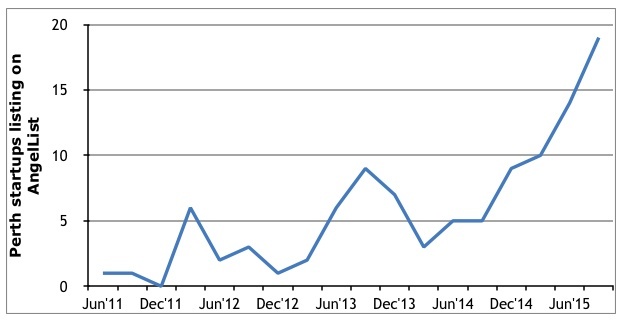
It seems though that local startups are playing catch-up. I pulled some data from AngelList for the quick-and-dirty analysis below, which shows the increasing rate at which Perth startups are engaging with the platform.
A list of lists
As a quick overview, while AngelList had started as an online introduction board for startups seeking funding, it is now a professional social network, similar to LinkedIn. It focuses on startups and investors in startups, though it also facilitates job searches in that space.





Stay updated on the go with our mobile app.
Get latest insights with smoother, more personalized experience through TIA mobile app.









📅 Upcoming Events
22 October 2026
Payoneer x CSPN Summit 2026