- Insights This article was written by a TIA community member. Insights pieces undergo the same rigorous editorial process that newsroom-produced articles have.
 Kun Su · · 4 min read
5 interesting facts about Thailand’s ecommerce industry last year

Photo credit: Prasit Rodphan / 123RF
We at iPrice have recently released our State of Ecommerce in Southeast Asia 2017 report. Our aim is to shed light on some of the most important ecommerce metrics from the perspective of thousands of ecommerce operators. We also highlight the differences and similarities of each market.
The research uses our proprietary data from over 1,000 ecommerce players operating in the six largest Southeast Asian markets (i.e. Indonesia, Malaysia, Singapore, Thailand, Philippines, and Vietnam.)
Here are some interesting findings about the ecommerce space in Thailand.
1. Mobile traffic is the second highest in Southeast Asia
The rise of mobile ecommerce in Southeast Asia seems unstoppable. In the past 12 months, mobile traffic has increased by an average of 19 percent, which now accounts for 72 percent of the overall ecommerce web traffic.
Among Southeast Asian markets, Thailand (79 percent) has the second largest mobile traffic after Indonesia (87 percent).
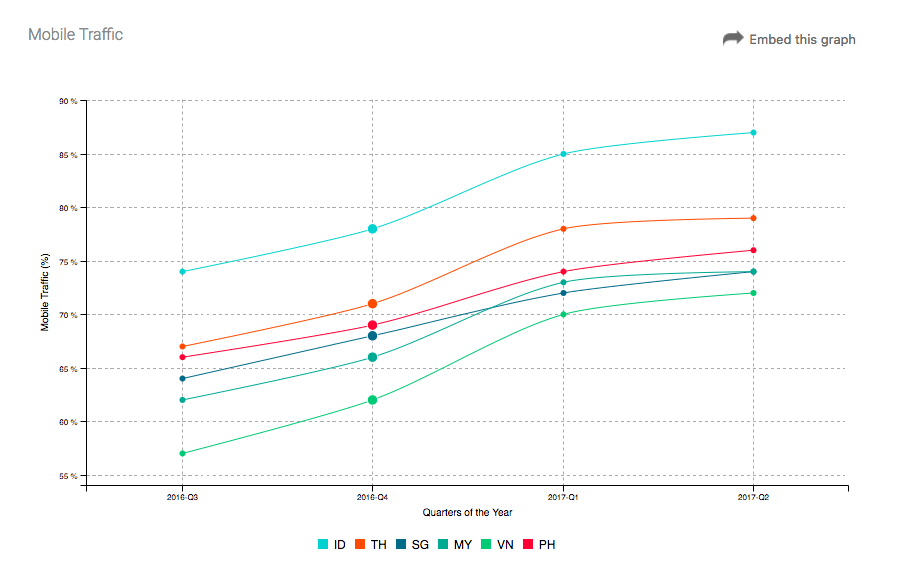 Therefore, mobile ecommerce traffic accounts for more than 70 percent of overall web traffic, while desktop traffic is less than 30 percent. We expect to see an increase in mobile traffic in the following years.
2. Lowest conversion rate in Southeast Asia
Conversion rate is the percentage of website visits that turn into a product purchase.
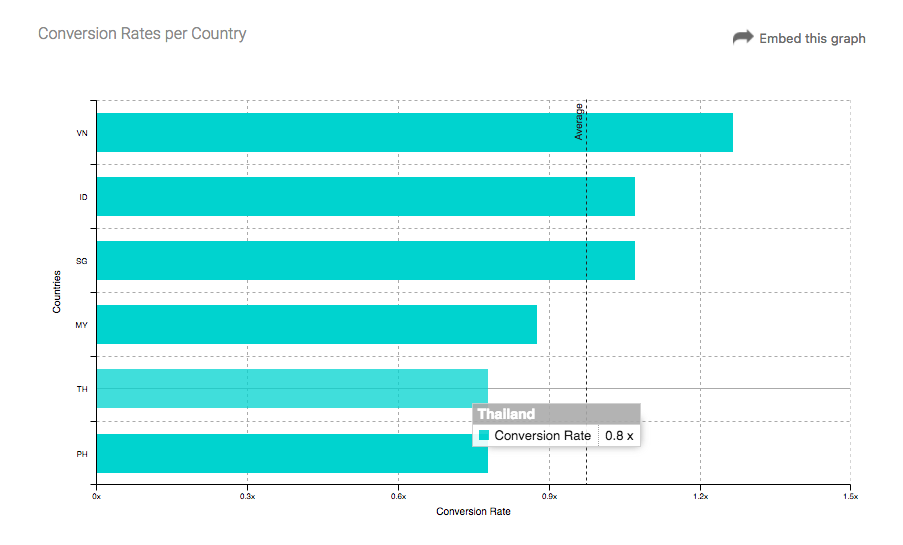
Our research reveals that Vietnam has the highest conversion rate in Southeast Asia—30 percent higher than the average. Meanwhile, Thailand and the Philippines are at the bottom of the list, with conversion rates that are 20 percent lower than the average.
The comparison between mobile and desktop conversion rates shows that the former is 1.7 times higher on average than the latter. For Thailand, however, desktop conversion rate is 1.3 times higher than mobile. That means people are more likely to convert on desktops because their big screens allow them to navigate ecommerce platforms more efficiently. They are also more secure when processing payments.
Although the conversion rate on desktop is higher than mobile, ecommerce companies should not focus entirely on desktops, as the country has an increasing mobile traffic.
3. Thailand’s basket size ranks fourth
4. Wednesdays show an increase in online shopping
5. Bank transfer and offline point of sale are popular payment solutions





Stay updated on the go with our mobile app.
Get latest insights with smoother, more personalized experience through TIA mobile app.