- Premium Content It takes our newsroom weeks - if not months - to investigate and produce stories for our premium content. You can’t find them anywhere else.
 Gabriel Budi Sutrisno · · 7 min read
What it takes for Gojek to go entirely green
As climate change edges ever closer to becoming irreversible, ride-hailing firms like Uber and Lyft are committing to eliminate carbon emissions by 2030. Indonesia’s Gojek has followed suit.
“For zero-emission, we see it as not only a world-saving initiative but also a source of a lot of potential economic value for the next five to 10 years,” Raditya Wibowo, Gojek’s chief transport officer, tells Tech in Asia. “In a way, it checks all the boxes for us.”
It is an ambitious target. Electric vehicles (EV) are a linchpin in the strategy, but the infrastructure is still nascent in Gojek’s biggest market of Indonesia. Switching to EVs wouldn’t be as impactful if much of the country’s electricity is still powered by coal.
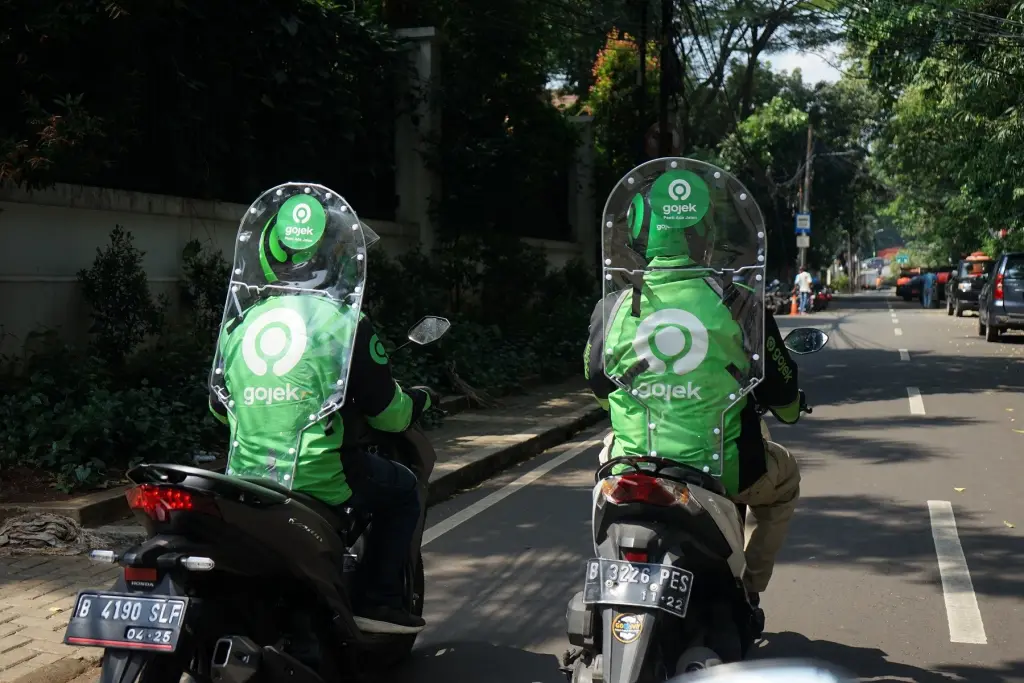
Gojek drivers during the pandemic / Photo courtesy: Gojek
However, a company of Gojek’s stature – with its transport-based businesses as well as millions of users and driver-partners – can make a difference.
“The best time to start was yesterday,” says Tanah Sullivan, Gojek’s group head of sustainability. “If you don’t change the trajectory that we are on, we’re really going toward a scenario that is going to be quite disastrous for many people.”
Why drivers are crucial
Many companies have committed to net-zero carbon emissions, but these ride-hailing companies – including Uber and Lyft – are taking it a step further. Instead of offsetting the number of greenhouse gases they produce, ride-hailers are committing to zero emissions. That means releasing no direct emissions at all.
Meanwhile, Gojek’s close rival Grab is set to launch a carbon offset feature to be integrated within its app, where its customers can choose to purchase carbon offsets at less than US$0.10 per ride.
For ride-hailing companies, carbon emissions are inseparable from their business strategy. For one, climate change would have a direct effect on these companies’ operations in the field (e.g., increased rainfall may lead to reduced demand for motorcycle taxi services). But more importantly, carbon emissions are an obvious byproduct of any transport business.
Almost 95% of Gojek’s carbon footprint comes from its products and services, and it produced a little over 1 million tons of carbon dioxide equivalents (CO2e) in 2020. Indonesia, the firm’s home country, also churned out 625.7 million tons of CO2e in 2019, ranking ninth globally.
The archipelago is “one of the most vulnerable countries to climate change,” Sullivan says.

Since most of the emissions come from the app’s ride-hailing and delivery services, Gojek’s top priority is in EVs – a similar plan to other ride-hailers. However, the company’s success here may come down to the cooperation of its driver-partners.
Should Tokopedia join in?
It’s ultimately a group effort
Stay ahead in Asia’s tech landscape
This is premium content. Subscribe to read the full story.
Gojek’s drive to go green will be challenging. However, inaction is no longer an option.
We know this is not ideal. ⌛ Sign up in 20 seconds. Cancel anytime.
Our subscriber community includes professionals from these companies:





Stay updated on the go with our mobile app.
Get latest insights with smoother, more personalized experience through TIA mobile app.