Mary-Anne Lee · · 5 min read
SteelSeries Siberia Elite review: cool and classy but not worth the money
SteelSeries has long been known for producing sleek yet functional gaming peripherals, as well as a direct competitor to Razer.  The Denmark brand is big in Asia and is a nice alternative to the black and green we’re so used to. But does the pure-white SteelSeries Siberia Elite match up to the rest of its brand?
Appearance
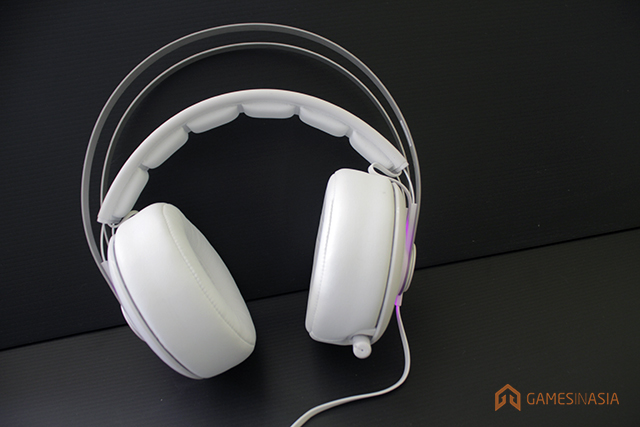
The Siberia Elite is gorgeous. No, really. This first iteration out on the market comes in just one colour: snow white, and puts the Disney princess of the same name to shame. It’s got a metal frame that everything hangs off from, soft, puffy, marshmallowy ear cups, and a sleek and handsome design.
There are no extra bits and bobs with the Siberia Elite. The volume dial is built into the right ear cup, while the mute button is hidden in the left one. These ear cups are adorned with flawlessly impressive yet ultimately useless LED lights. The microphone slides seamlessly in and out of the left side and can be bent to your exact angle. The Siberia Elite’s connecting wire is flat and doesn’t tangle. It’s a gorgeous thing, an item you’d want to cradle to your chest and snuggle up with at bedtime.
But its appearance, however, is where the magic ends.
Usability
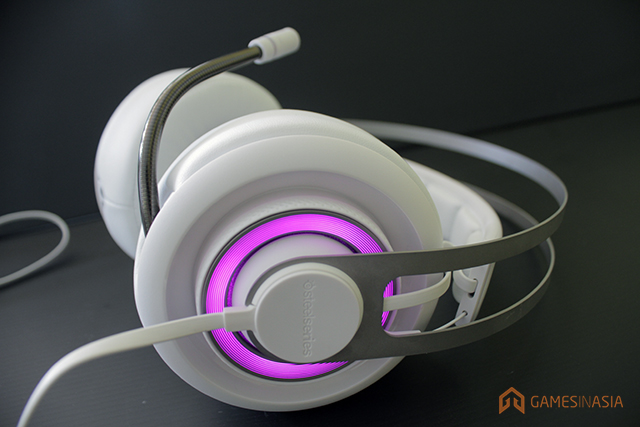
The Siberia Elite is big and heavy. This is a minus point, considering the device is marketed as something for the masses. The Siberia Elite is meant to appeal to non-gamers, and, as we heard at its launch event, also meant to be something you can tote about on a daily basis. Its weight is a huge contradiction to its cause.
This heavy headset is also literally a pain. Its headband stretches to accommodate users, so it can be a one-size-fit-all item, but on my head in particular, wearing the Siberia Elite for what wouldn’t even amount to a moderate time pinched my crown and gave me the worst headaches.
Physical inconvenience aside, the Siberia Elite has one too many inputs. Its standard output is a micro-USB jack, and it comes packaged with a micro-USB input to 3mm sound/voice output, a 3mm audio jack to micro-USB input, an extension micro-USB cable, and a USB-powered hub that allows for both micro-USB and 3mm audio inputs. The lack of a standard audio jack already makes me mentally relegate this headset to the computer.
What’s worse was that my first try with getting it to work via the micro-USB to USB failed; neither the audio nor microphone worked. My second attempt, using the 3mm audio jacks, produced audio, albeit without a working microphone. The headset’s workability is a bit of a hit and miss, and I can’t be sure if it’s the review set’s problem or if it’s my computer.





Stay updated on the go with our mobile app.
Get latest insights with smoother, more personalized experience through TIA mobile app.