 Grace Priscilla Teo · · 6 min read
The strategy that turns operational friction into market moats
This article summarizes an episode of Kleiner Perkins’s video series featuring Aman Narang, CEO of Toast.
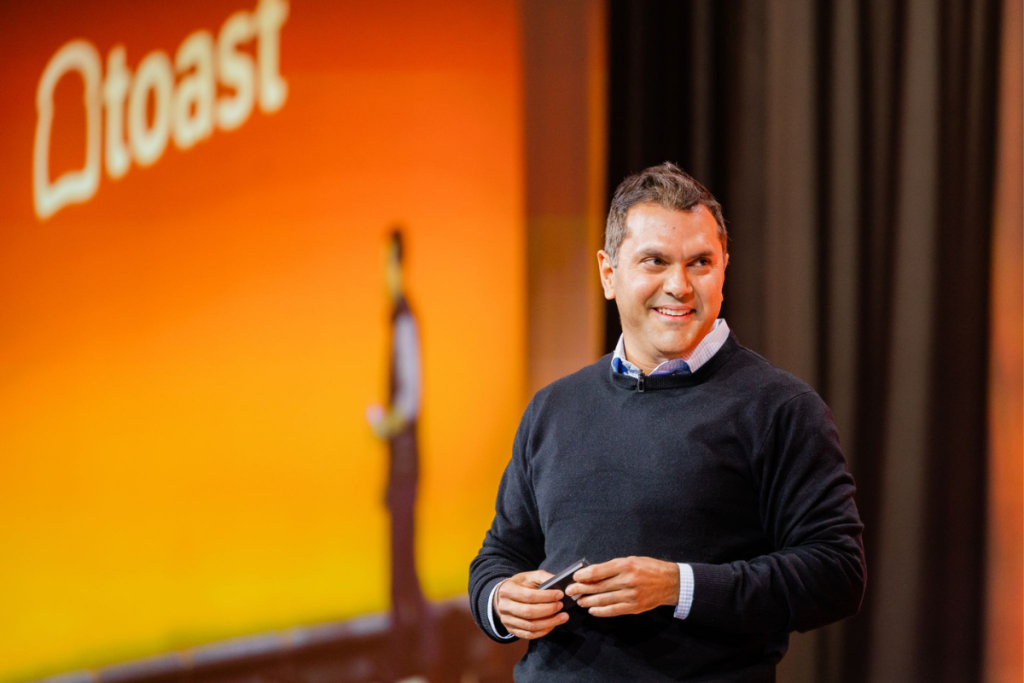
Aman Narang, co-founder and CEO of Toast / Photo credit: Aman Narang
Aman Narang, co-founder and chief executive officer of Toast, believes that avoiding difficult problems is a fast track to failure. Instead, the company built its huge market share by actively embracing operational friction.
Today, the restaurant technology giant provides the foundational software, commercial-grade hardware, and payment processing that powers local commerce for more than 171,000 restaurant operators.
By leaning into the real-world demands of food service, Narang shares that Toast turned operational roadblocks into a competitive edge, a philosophy that continues to dictate how Toast scales, recruits executives, and deploys AI.
The hidden problem with early growth
The lesson emerged early, when Toast’s founders believed a simple software layer could modernize the restaurant experience.
They soon discovered a structural roadblock: restaurant owners simply lacked the foundational technology required to connect to basic mobile applications.
“Most of the industry was using these systems to run their businesses that were built in the ’90s, or they were on-premise systems with physical hardware like a server in your basement,” Narang explains. Because these legacy systems lacked API connectivity, the startup hit an immediate scaling wall.
However, when the founders asked owners about their broader technology needs, a new opportunity emerged. “None of them liked their legacy platforms,” Narang says.
The team also discovered restaurants were using far more technology than anticipated. To adapt, Toast built around the realities of the hospitality industry:
- Track the restaurant owner’s actual day: This meant building a system to monitor everything a restaurant touches, including food orders, kitchen task routing, employee schedules, and cash management.
- Accept the physical mess: The product had to be engineered to run on ruggedized hardware and survive power outages without internet access.
- Make payments part of the core product: Integrating payment processing directly lowered upfront equipment costs for owners while building a durable, recurring revenue stream.
- Treat local service as a primary feature: Because restaurants highly value having operational support nearby, localized service built essential trust in a shifting market.
- Welcome diverse customer profiles to widen the moat: Working with edge cases, like food trucks and nightclubs, ultimately improved the resilience of the core software.
Growing by adapting the product for each user
Supporting such a wide variety of customers was a deliberate, albeit difficult, strategy. While critics advised focusing on a single customer segment, Toast saw enough overlap across restaurant types to justify building a universal platform.
The founders knew their localized sales and service teams would become a lasting competitive advantage.
Finding the limits of early leadership
Despite this universal platform establishing a strong competitive moat, massive market demand meant the company was quickly selling software much faster than it could physically install it.
Evolving leadership skills
Expanding into local retail





Stay updated on the go with our mobile app.
Get latest insights with smoother, more personalized experience through TIA mobile app.









📅 Upcoming Events
22 October 2026
Payoneer x CSPN Summit 2026