- Premium Content It takes our newsroom weeks - if not months - to investigate and produce stories for our premium content. You can’t find them anywhere else.
 Nikita Puri · · 7 min read
Trash, cargo, security: a profitable robot firm’s many interests
In the city of Varanasi in India, the mighty river Ganga stretches as far as the eye can see. Lined up on its shores are boats whose sideboards are brightly painted in yellow, blue, and red. A few weeks ago, another vessel joined their ranks – a relatively sleek one that has no use for primary colors as the bulk of it stays underwater.
Unlike its neighbors, this boat ferries no man or animal. Instead, it is tasked with getting rid of the trash in this patch of India’s holiest river.
Made by a Hong Kong-headquartered firm called Clearbot, this AI-powered electric vehicle (EV) doubles as a surveillance and monitoring system with built-in cameras as well as a goods transport medium. The startup offers these unmanned boats under a robot-as-a-service (RaaS) model.
“Governments spend millions of dollars cleaning trash from rivers and oceans,” says Sidhant Gupta, co-founder and CEO at Clearbot.
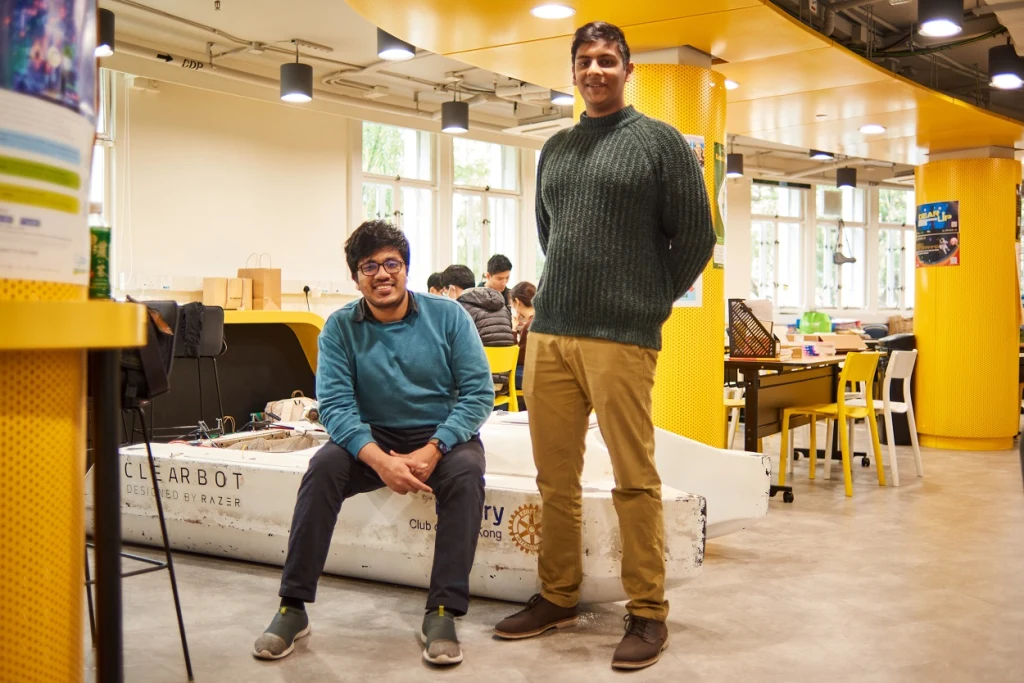
(From left) Clearbot co-founders Utkarsh Goel and Sidhant Gupta / Photo credit: Clearbot
“We saw an opportunity to address this archaic system that creates pollution because it runs on fuel,” he adds, referring to the boats that carry people who will pick up pieces of floating trash.
A Clearbot boat can collect up to 15 liters of floating oil from discharges like spills and 200 kilograms of garbage – or goods – in a day. With zero emissions, this remotely controlled vehicle has smart navigation capabilities and can also be used for cleaning invasive weeds from water bodies.
In December 2022, the startup secured an undisclosed amount of seed money in a round led by Alibaba Hong Kong Entrepreneurs Fund, which is managed by Gobi Partners GBA. Earth Venture Capital, Asia Sustainability Angels, and CarbonX Capital also participated in the fundraise.
There was some skepticism around the business initially, partly due to the relatively young age of its co-founders, who were in their early 20s at the time. They were seen as “a bunch of kids who said they wanted to save the world,” Gupta recalls.
But its numbers and having traditional, recognized investors on board have helped address some concerns.
“We are post-revenue and profitable,” says the CEO, though he didn’t give more details.
However, Clearbot could be profitable because it still operates at a small scale, with only 12 members in the team.
Anchored in robotics
In early 2021, the bootstrapped company transformed its prototype into the first model of Clearbot with the help of Singapore-based gaming firm Razer. The model had its first test in open waters in June of the same year.
“We did sell the first few boats to clients in Hong Kong, but that’s no longer the business model. We quickly realized it didn’t make sense to do that,” says Gupta. The firm found out that scalability could be a problem since different environments and needs would require different kinds of boats.
The nautical chart to a 100 boats
Stay ahead in Asia’s tech landscape
This is premium content. Subscribe to read the full story.
Now backed by an Alibaba fund, Clearbot’s founders weren’t taken seriously when they began using robots to take on marine pollution.
We know this is not ideal. ⌛ Sign up in 20 seconds. Cancel anytime.
Our subscriber community includes professionals from these companies:





Stay updated on the go with our mobile app.
Get latest insights with smoother, more personalized experience through TIA mobile app.










📅 Upcoming Events
22 October 2026
Payoneer x CSPN Summit 2026