I love Metroidvania games and 2D action adventures, so I thought I was going to love Strider. For those of you who are unfamiliar with the term Metroidvania, it’s the name given to games that follow in the style of Castlevania and Metroid.
They feature large, interconnected levels which can be traveled between at will, and they require you to find items in order to unlock doors, blow up walls or whatever allows you to progress. Metroidvania-style games are one of my favourite genres, because exploration pays off with tangible rewards, bigger health bars, more abilities and a generally more awesome character.
I hadn’t played the original Strider (I was two years old when that came out) but I had heard good things, and after the disappointment of Castlevania: Lord of Shadows I thought that slicing my way though a traditional Castlevania-style game as a futuristic ninja would cheer me up!
Unfortunately, Double Helix’s reboot of the 1989 classic left little impression on me. There are some shining moments, but Strider was overall a forgettable and often frustrating experience.
Style without substance
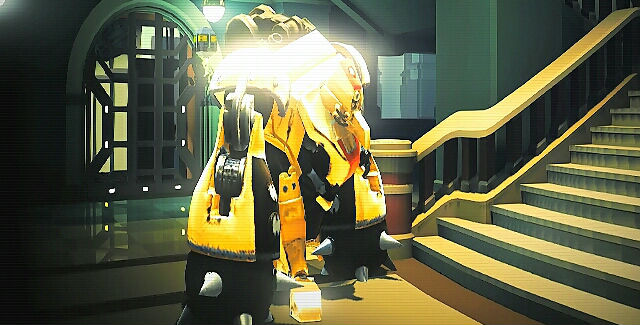
Strider is a good looking game. Strider Hiryu is well modeled, the city looks great, and the enemies are all very nicely polished. The killer robots look fresh from the factory and the infected monsters look straight from the swamp. It’s not original but it does the job.
Kazak City, the fictional metropolis where the game is based in, also lacks originality. It’s the same as every other dystopian city; lots of shiny metal, oppressive propaganda and plenty of anonymous robots/soldiers to cut into pieces. It’s not bad, it’s just not new and after spending some time in Kazak City it would have been nice to know more about it. Unfortunately we don’t, we never do.
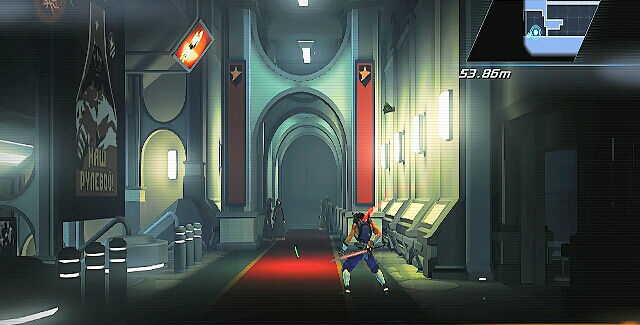
There’s the usual collection of levels; an underground city, sewer systems, guards barracks and power plants, all the essentials for a good old fashion game. Considering Strider is based on a 1980’s coin-op arcade game, you could choose to see this as homage to the original. That being said the levels are great, and the stages are big and bold with lots of hidden passages and concealed chambers to explore. The colors are vibrant and the constant speeches by various future bosses really add texture to the game.
Unfortunately my strongest memories of Kazak City are not going to be its looks, because what stood out the most were the constant copy and pastes. After few hours of play, I noticed that enemies are all re-skinned versions of those you met in the first hour. This is especially obvious for the larger robots. The only difference between models is color! At least the foot soldiers get new hats.
Enemies do get tougher as you progress; they get new guns, get shields, or can only be killed with certain weapons. Most of the time you are moving so fast this doesn’t matter, though, and the main difference is how many slashes they can take. Once you’ve killed the same robot dude several thousand times, you begin to get bored of it. Even if it does have a new hat.





Stay updated on the go with our mobile app.
Get latest insights with smoother, more personalized experience through TIA mobile app.