Michael Tegos · · 5 min read
IDA wants to make Singapore a Smart Nation. Here’s what you need to know

The Infocomm Development Authority (IDA) of Singapore wants to make the country the world’s first true Smart Nation, it revealed today at the Smart Nation Innovations 2015 event. But what does this mean, exactly? For one thing it means trying new ideas, building on them, testing them, and moving forward, according to IDA executive deputy chairman Steve Leonard. “2015 is a year of prototyping,” he said during the event.
Transportation, population density, population aging, healthcare – these are all problems in any developed country. Solutions using smart technologies are what the initiative is all about, according to Leonard, and Singapore has the opportunity to be a world leader in this field.
Those ideas will be taking shape in the months and years to come, as the IDA aims to try and try again to work with technology and business experts and bring about the vision it calls “E3A”: Everyone, Everything, Everywhere, All the time. For this reason, it’s developing the Smart Nation Platform, or SNP, which will involve infrastructure and technology to enable a whole host of new capabilities to citizens, businesses, and the government.
Rolling out end of 2015
The SNP is planned to roll out in two phases; the first, scheduled to be completed by the end of this year, will involve localized trials for wired and wireless connectivity sensors and networks. The second phase is expected to be a large scale deployment of technologies in collaboration with industry partners, with which the IDA will be selecting and consulting.
IDA is partnering with a multitude of tech industry companies to develop ideas for its SNP. Besides the aforementioned Singaporean telcos, the announcement mentions Microsoft, IBM, Hitachi Data Systems, Cloudera, Key Insights, and more. Local tech companies and startups can provide their own resources and ideas to the cause, such as Singapore-based Green Koncepts, developer of Energetix, a cloud-based energy management platform, and Trakomatic, developer of a video analytics and position tracking platform for retailers.
Always online
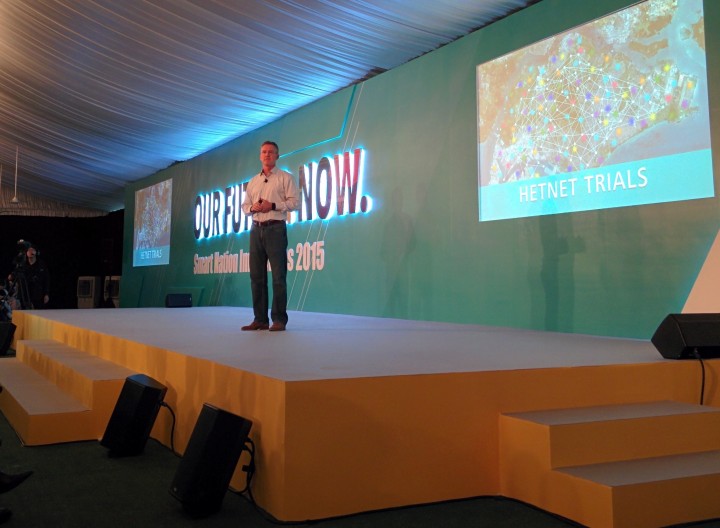
For now, the first phase of the project involves connectivity: a project to keep everyone in the island city state perpetually connected to the internet via their mobile devices. Through an initiative termed HetNet (abbreviated from Heterogeneous Network), IDA aims to enable everyone to remain online from the moment they leave their home until they return.
To achieve this, IDA is working with four Singaporean telcos – Singtel, StarHub, M1, and MyRepublic – who will provide the infrastructure so that the user can seamlessly switch between his/her own personal connection and a public one provided by HetNet as he/she moves about the city. The plan is to begin trials for the initiative in the latter half of 2015 at Singapore’s Jurong Lake district. The trials will focus on locations with heavy human traffic, such as lifts, pedestrian walkways, bus interchanges, and MRT (subway) stations.
This will allow providers to measure how heavy the network usage gets in those areas and work to ensure the experience is uninterrupted even when users watch streaming video on their devices (which people do a lot, as anyone who has used public transportation in Singapore can attest). The trials will also focus on places not traditionally associated with public wi-fi coverage, such as HDB lifts and void decks.
The point, of course, isn’t just to ensure commuters won’t miss a second of their favorite K-drama on the train. The plan is for the technology to eventually allow for connectivity across a wide variety of smart, connected devices with applications such as remote health monitoring, remote learning, even self-driving vehicles.
Setting the standards
Fitness trackers, smartwatches, and other wearables will need to be accommodated by the new infrastructure. Sensors placed across the city will be constantly transmitting all kinds of data, including communication, health, entertainment, traffic. They will all need to talk to each other, and to their own providers, whether to inform your doctor of your heart condition or to alert the authorities of a possible traffic congestion. Interoperability and compatibility will be key factors in all this stream of data reaching its intended destination.





Stay updated on the go with our mobile app.
Get latest insights with smoother, more personalized experience through TIA mobile app.