- Premium Content It takes our newsroom weeks - if not months - to investigate and produce stories for our premium content. You can’t find them anywhere else.
 Jofie Yordan · · 7 min read
Southeast Asia’s ecommerce players go low to get ahead in price war
In mid-2023, a platform called Choice was launched on Lazada in Southeast Asia with little fanfare. No press releases were sent out, but the Alibaba-owned company’s help center says that Choice aims to “bring the best value products of the world to Southeast Asian consumers.”
The Chinese tech titan introduced Choice across its international ecommerce platforms last year, beginning with its global cross-border unit AliExpress in February, Lazada in August, and South Asia-focused Daraz in October.
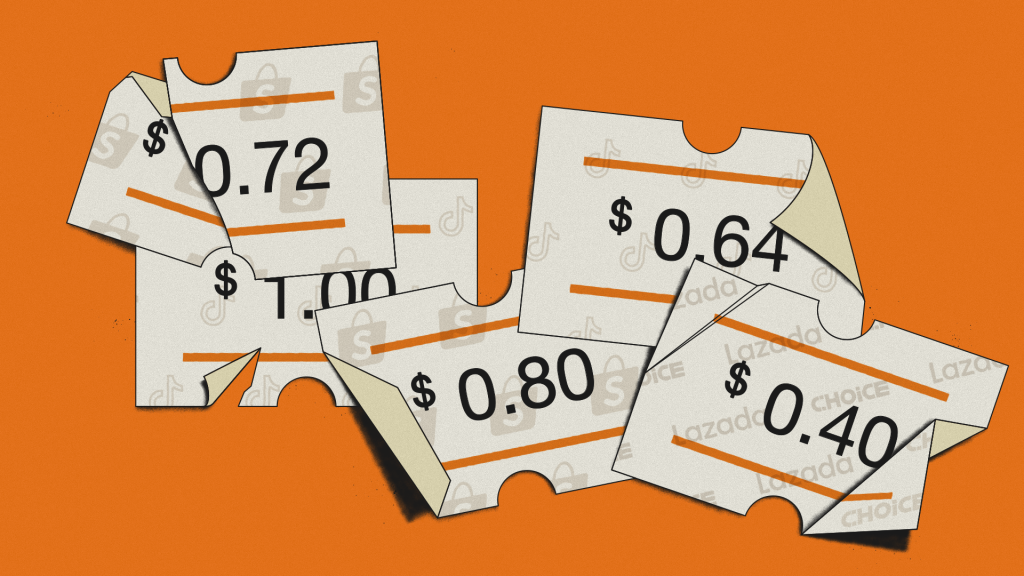
Image credit: Timmy Loen
Choice is Alibaba’s attempt to emulate low-cost platforms Temu and Shein by collaborating directly with manufacturers and subsidizing them to reduce prices. Temu, the Boston-headquartered unit of China’s PDD Holdings, expanded to the Philippines in the same month as Choice’s rollout on Lazada and then entered Malaysia in September.
Qoo10, a relatively lesser-known ecommerce firm based in Singapore, set its sights westward, acquiring US discount retailer Wish for US$173 million in February 2024. Can Qoo10 revive the once-popular Wish and bring it to this part of the world?
For now, these developments signal a brewing price war in Southeast Asia’s ecommerce sector. Could the so-called “dirt cheap” segment become the new battleground for these tech players?
How cheap is cheap?
The Choice page, which can be accessed within the Lazada app, displays products priced as low as 1,000 rupiah (US$0.064) to 30,000 rupiah (US$1.90) in Indonesia. In the Philippines, the prices range from 4.3 pesos (US$0.077) to around 159 pesos (US$2.84). The platform also offers shipping and bundle discounts to customers who buy three products.
In its latest earnings call for the quarter ending December 2023, Alibaba reported that AliExpress had recorded a quarter-on-quarter order growth of over 60%. This surge was primarily driven by AliExpress Choice.
Tech in Asia has contacted Lazada for comment on its Choice platform and reached out to Qoo10 to learn more about its acquisition of Wish, but both companies have not responded.
Joe Zhang, founding partner at Chinese ecommerce consulting firm Sailer Partners, believes that Southeast Asia is already saturated with affordable products. Still, Temu and other players could intensify the price war, potentially pushing prices down by another 10% to 15%.
See also: Why SEA should watch out for Shein’s top rival Temu
To provide ultra-low prices, Temu uses what the industry calls a “fully managed” model. Under this approach, the company takes care of everything from warehousing to customer service, enabling it to dictate pricing on behalf of Chinese manufacturers.
It has also been leveraging the capacity of its sister company, Pinduoduo, which has an extensive network of sellers in China. This facilitates Temu’s ability to get goods from factories and merchants that offer the lowest prices.
Who can compete?
Profitability issues and regulatory hurdles
Stay ahead in Asia’s tech landscape
This is premium content. Subscribe to read the full story.
Choice, Lazada’s latest budget-centric platform, steps into the arena to go head-to-head with Shopee, TikTok Shop, and Temu.
We know this is not ideal. ⌛ Sign up in 20 seconds. Cancel anytime.
Our subscriber community includes professionals from these companies:





Stay updated on the go with our mobile app.
Get latest insights with smoother, more personalized experience through TIA mobile app.











📅 Upcoming Events
22 October 2026
Payoneer x CSPN Summit 2026