- Insights This article was written by a TIA community member. Insights pieces undergo the same rigorous editorial process that newsroom-produced articles have.
 Avinav Trigunait · · 4 min read
The future is inevitably humans plus AI – IDC report
By 2022, over 65 percent of Asia Pacific’s GDP will be digitized, driving US$2.3 trillion in IT-related spending from 2019, according to IDC FutureScape: Worldwide Digital Transformation 2018 Predictions – Asia Pacific (Excluding Japan) Implications, a report we released earlier this year.
Today, we live in a mobile-first world where people use their smartphones as a one-stop device for all their needs. This is especially true for millennials, who will make up most of the workforce in the region by 2020.
In addition, the rise of technologies such as artificial intelligence (AI), cognitive interfaces, augmented reality (AR), virtual reality (VR), and wearables are also further blurring the lines between digital and physical. IDC forecasts that by 2021, 3D technologies (social, mobile, analytics, and cloud) and innovation accelerators (AI, AR, VR, internet of things, 3D printing, robots, and drones) will account for about 89 percent of total IT spending in Asia Pacific.
As such, many organizations are already running or planning to run massive re-skilling initiatives to equip the workforce with the digital skills necessary for the future.
However, organizations and governments need to consider these changes in a holistic manner. Some questions to consider, particularly with the advent of AI, are:
- How will organizations deal with bots?
- Will they use the same set of criteria in evaluating bots’ performance as the one for humans? Will they provide bots with cultural and organizational trainings?
- How will success be measured?
- What is the optimal mix of humans and bots in the society and in companies?
- Will bots be required to pay taxes?
- Who will monitor bots’ actions? Who will be liable for their misconduct?
There’s no one-size-fits-all approach, and each country and sector’s needs and response will be different. But all these factors combined plus the growing number of millennials at work are fundamentally altering the concept of work and how it’s done.
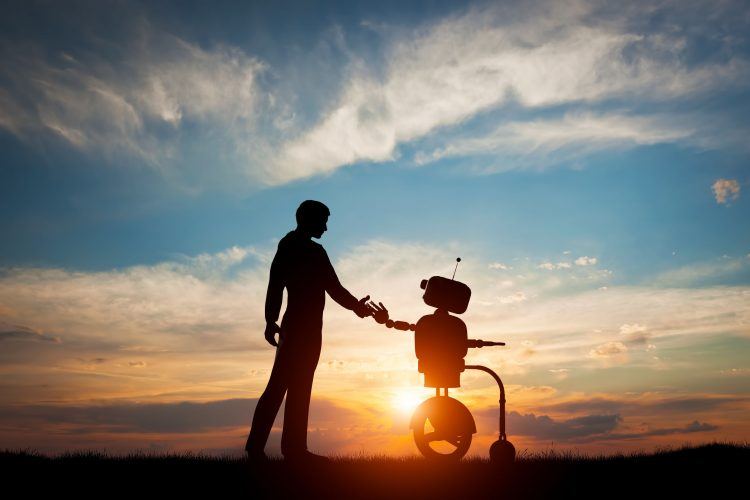
Photo credit: Michal Bednarek
Predictions for the workforce
In our 2018 Future of Work Survey, we interviewed more than 1,400 business and IT decision-makers. We found that over 45 percent of business leaders recognized the need to make changes in the workspace, work culture, and the use of technologies.
The future is inevitably humans plus AI.
In this year’s predictions for 2019 and beyond, we explored the key factors impacting the future workforce. Here are some of the key predictions:
- In 2019, 25 percent of IT development and operation processes will be automated, resulting in a 15 percent gain in IT productivity and redefining of IT skills and managing digital workers.
- By 2022, 35 percent of businesses will have replaced traditional KPIs (key performance indicators) with KBIs (key behavioral indicators) to measure collaboration, communication, problem-solving skills, deliverables, and objectives.
- By 2023, 40 percent of workers will use gig economy platforms and talent marketplaces to offer their services and digital skills, fundamentally changing HR policies, processes, and tools.
- By 2024, 50 percent of structured repeatable tasks will be automated, and 20 percent of workers in knowledge-intensive tasks will have AI-infused software or other digitally connected technology as a “co-worker.”
Today, AI is augmenting human capabilities, helping solve complex problems in medicine, research, climate change, material science, space exploration, etc. However, this also causes fear around job losses and has broad implications for businesses and the society at large.
Think robotic process automation in business process outsourcing companies, robo-advisors in financial services, and robots at factory floors and in the service sector. These are not theoretical concepts. Today, there are more than 100,000 bots on various messaging platforms, and companies are deploying thousands more across various use-cases.
Fresh thinking





Stay updated on the go with our mobile app.
Get latest insights with smoother, more personalized experience through TIA mobile app.