 Terence Lee · · 6 min read
Singapore’s self-driving car makes Google’s version an unnecessary luxury
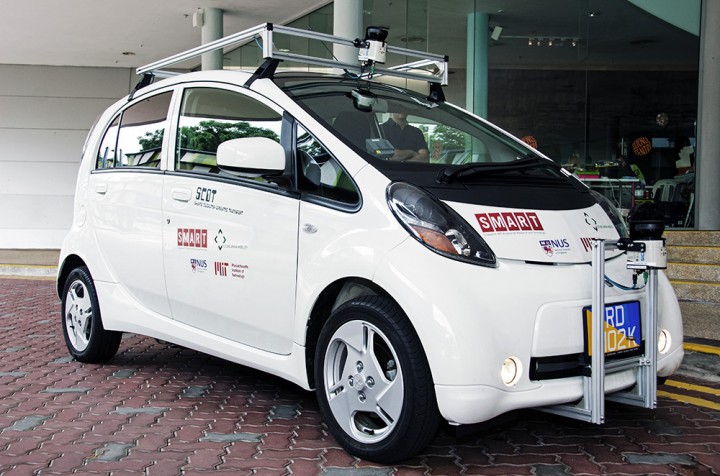
While Google may be hogging internet traffic with news of its self-driving cars, the reality is that they are forbiddingly expensive. The system, which is mounted onto a conventional car and uses cutting-edge 3D laser sensors, costs between $75,000 to $85,000 each – more than the car itself.
Now, a team in Singapore has successfully developed their own self-driving car prototype at under half the cost – just S$30,000 ($23,500) for two off-the-shelf Lidar sensors and an onboard computer which are mounted onto a conventional vehicle. That’s like a Toyota to Google’s Mercedes Benz, figuratively speaking.
The team, comprising of 12 researchers from the National University of Singapore (NUS) and the Singapore-MIT Alliance for Research and Technology (SMART), hopes to bring the cost down to S$10,000 ($7,800) eventually.
“What we’re trying to do is to forget the top-of-the-line sensors, and figure out what is the minimum we can get while still guaranteeing that the car is able to operate safely and reliably,” said Emilio Frazzoli, lead investigator of the future urban mobility group at SMART.
In a situation where all legal obstacles are removed, the team believes it can bring their prototype onto public roads in two years.
This is not the first time NUS and SMART have rolled out an autonomous vehicle. In 2011, they retrofitted a golf cart and tested it on NUS grounds.
According to Frazzoli, students initially reacted with amazement whenever the cart roamed around and emitted annoyed R2D2 sounds when someone blocked its way.
But now the vehicle has become such a common sight that people hardly give it a second glance. It’s a sign that consumers could soon treat driverless cars as an ambient part of their environment.
A potential multi-trillion dollar industry
Autonomous vehicles are being promoted as the next great advancement in automotive technology, with tremendous benefits for consumers. It frees people from the drudgery of driving in heavy traffic, which means more time for work and play.
Artificially intelligent drivers are also safer than human ones, since they won’t fall asleep, aren’t ruled by emotions, and have a wider field of vision.
Car owners could monetize their vehicle when they’re not using it – which is about 90 percent of the time – by offering it up to a car sharing service.
The vehicle, in theory, could drive the owner to work, then proceed to drop her kids at school. As part of a car sharing network, it could then pick up other passengers, even deliver goods on behalf of an e-commerce company, and then circle back to pick up the owner just as she leaves the office for home. The car owner would then be paid a fee for offering up her car, with an insurance policy borne by the car sharing company to protect against damages.
Not yet reality
Making driverless car sharing viable





Stay updated on the go with our mobile app.
Get latest insights with smoother, more personalized experience through TIA mobile app.











📅 Upcoming Events
22 October 2026
Payoneer x CSPN Summit 2026