Stefanie Yeo · · 6 min read
These 3 startups are making waves in the Malaysian fintech space

If you bought food from a hawker in Malaysia 10 years ago, you would have probably had to pay in cash. Now, QR codes and point-of-sale machines for payments abound among the nation’s merchants.
This transformation is just part of the larger fintech wave that’s surging in Malaysia, brought about by a burgeoning banked population, a rising middle class, an openness to new technologies, as well as a growing need for the nation’s small and medium-sized businesses (SMBs) to adopt new digital technologies.

Photo credit: ximagination / 123RF
“Our local fintech landscape has evolved exponentially over the past decade – the digital shift has been further accelerated by the Covid-19 pandemic,” says Amiruddin Abdul Shukor, acting CEO of the Malaysian Global Innovation & Creativity Centre (MaGIC). The government agency aims to support the growth and development of startups in the country.
Fintech plays a prominent role in the lives of Malaysians. Aside from digital payments, citizens also rely on insurtech platforms, remittance services, and electronic “know-your-customer” processes.
The Malaysian government has done much to spur on this growth, rolling out several programs to drive the industry forward. Over the last five years, the country’s central bank has introduced a number of initiatives in this respect – from a regulatory sandbox to digital bank licensing schemes.
As fintech gathers steam in Malaysia, it’s no surprise that the country has produced several notable fintech startups. Here are three that are making waves in the space.
1. Finology: streamlining access to financial services
Jared Lim and his co-founder Robin Ang started financial services firm Finology in 2017 after they noticed a major hurdle in the customer journey when they were running their first business.
“Even though many customers began applying for products online, they cannot complete the journey digitally,” says Lim. “Every application still flows into some manual sales and onboarding process for continuation offline.”

Jared Lim, co-founder of Finology / Photo credit: Finology
The processes involved with loans and insurance, for example, are often opaque and tedious for all parties involved and can take days or even weeks to complete. The duo launched Finology in order to streamline the process, with the goal of making the onboarding and underwriting process for different financial products as seamless as possible.
To do this, the firm offers white-label solutions for businesses covering areas such as instant credit approvals, digital onboarding, and instant insurance ratings and underwriting. It also runs a banking and insurance comparison site and a loan screening and management system in the property sector.
Finology has come a long way since 2017. The firm now has clients from across the globe and recently took home the first prize at the Seedstars World Competition 2020/21.
At the beginning, though, the company had trouble connecting with the relevant government authorities to address certain regulatory requirements, and finding the right talent proved to be difficult as well.
Fortunately, with organizations like MaGIC to turn to, the company has found solid ground.
“MaGIC is our first port of call when we need issues solved with specific government agencies – they would be able to connect us to the relevant persons or act as a go-between,” shares Lim. “They’ve also helped with filling certain vacancies we’ve had. We have recruited engineers coming out of MaGIC-run programs in the past, and [the agency] has really helped plug the local engineering talent gap through their programs.”
2. Soft Space: empowering small merchants with fintech
When Soft Space was founded in 2012, it had one goal: making digital payments accessible to SMBs in Malaysia.
“We started with a vision to create a solution that can empower the underserved merchant segment to accept digital payments at a comparatively low cost,” explains Chris Leong, the company’s chief strategy officer.

Chris Leong, chief strategy officer of Soft Space / Photo credit: Soft Space
Soft Space began by offering mobile point-of-sale solutions to merchants who weren’t able to access such services. Since then, the firm has evolved to providing other payment solutions for SMBs, such as its Tap to Phone solution, which allows businesses to accept contactless payments on an Android device.
It also launched white-label e-wallet services with Visa, enabling businesses to develop their own wallet without needing to invest large amounts of money in the infrastructure required to do so.
The firm has grown significantly since its launch, having struck up partnerships with notable players such as UnionPay International and JCB.
In 2015, Soft Space participated in MaGIC’s e@Stanford program, which lets local Malaysian startups visit Silicon Valley and speak to notable founders and business leaders to learn from their experiences and seek advice on running their startups.
The experience was pivotal in building the confidence of Soft Space’s leadership team and proved that they could make the company a global enterprise. To date, the firm has worked with over 30 financial institutions in 10 countries, and has been recognized by the International Data Corporation as one of the fastest-growing fintech firms in the region.
“The enlightening part about what we learned is that, with the right knowledge, there is nothing fundamentally stopping startups in Southeast Asia from scaling in the same way as the best companies in the world,” Leong says. “That gave us the confidence that we have what it takes to actually compete on the global stage.”
3. Supplycart: tackling the problems of procurement and beyond
Unlike most fintech companies, which start with a clear finance-oriented objective in mind, Supplycart’s origins were a little different.
Launched in 2016, the firm began with the goal of streamlining the way that small and medium-sized businesses manage their office supplies, products, and services.
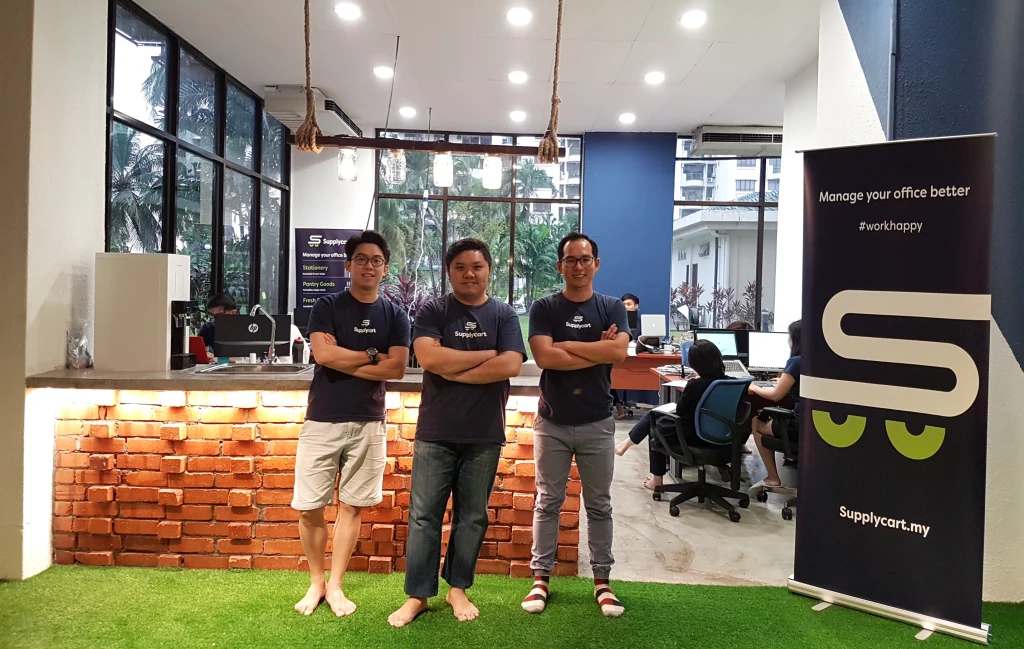
Jonathan Oh, founder and CEO of Supplycart (center), with his leadership team / Photo credit: Supplycart
“We wanted to create simple and affordable digital solutions to cope with the challenges and inefficiencies faced by these businesses,” shares Jonathan Oh, Supplycart’s founder and CEO. “We also wanted to help these businesses receive payments quickly and acquire working capital through reliable, convenient channels.”
Supplycart enables this through its cloud-based platform, which integrates the procurement and vendor management process with payments to streamline the process and make bookkeeping more effective. It also offers embedded finance capabilities, which it developed in partnership with financial institutions, to help businesses receive the capital they need.
According to Oh, Supplycart saw tremendous growth over the last year, as the Covid-19 pandemic forced more companies to digitalize their processes. The firm also established key partnerships with financial institutions and other entities in order to better support its customers in supply chain financing.
For one, Supplycart has benefited from being a part of MaGIC’s ecosystem. The fintech firm participated in the e@Stanford program, where its team was able to meet relevant trade and financial institution partners that could help Supplycart build its platform. Another advantage, for Oh, was on a personal level: He was able to connect with other founders as well as prospective employees.
“MaGIC really helped provide different insights and experiences, [enabling us] to learn from so many different businesses and people, which has been valuable in our journey,” Oh says.
The Malaysian Global Innovation & Creativity Centre (MaGIC) is an agency that discovers and empowers technology startups and social innovators through creativity, innovation, and technology adoption and develops a vibrant and sustainable entrepreneurship ecosystem in Malaysia.
Learn more about MaGIC and how it can help your business over on its website.
This content was produced by Tech in Asia Studios, which connects brands with Asia’s tech community. Learn more about partnering with Tech in Asia Studios.
Stay updated on the go with our mobile app.
Get latest insights with smoother, more personalized experience through TIA mobile app.
Recommended reads
 Bank of Thailand partners with 2C2P, others to launch CBDC trial
 Alibaba Cloud invests $1b to boost global partner network
 Init 6 is making an early bet on this Indonesian coding test firm
 Australia to roll out trial program for CBDC
 These startups are scaling successfully with Huawei’s help
 This Singapore company is turning the tide of plastic pollution at scale
 How fintech firms can develop great products to stay ahead of the curve
 How CFOs can balance their duties in driving startup growth
 SG cross-border payments firm raises $3.3m in seed money
 MAS awards major payment institution license to SG crypto platform





Editing by Nathaniel Fetalvero and Jaclyn Tiu
(And yes, we’re serious about ethics and transparency. More information here.)