C. Custer · · 2 min read
Sh*tstorm incoming: Japanese mobile game blames China for World War II
Well, this is likely to cause a bit of a fuss: the latest mobile iteration of Japanese developer Systemsoft Alpha’s Daisenryaku series will be hitting smartphones this summer, but some of its promotional materials have already hit the web, and Chinese gamers are not amused.
The strategy game allows players to take the reigns in some of the great Asian conflicts of the 20th century, and while gameplay depends on player decisions and is thus pretty ahistorical, the game’s promotional materials do include some historical background, including this sentence about what kicked off Japan’s invasion of China proper in 1937:
In 1937, Japanese troops drilling near the Longwang Temple were shelled by Chinese forces, and Chinese soldiers [stationed there] met [the Japanese army] head on; history calls this the Marco Polo Bridge Incident.
This description, as Chinese gaming sites like Netease have pointed out, implies that Chinese aggression caused the incident and that Chinese forces provoked Japan into invading China proper.
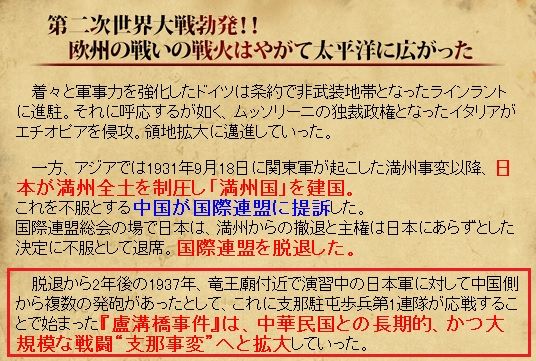
A screenshot of the game’s promotional materials highlighting the offending phrase at the bottom.
That’s not a popular interpretation of events in China, and it’s not really in line with third-party historical accounts either. Firstly, as the Netease article points out, it completely ignores the question of why Japanese troops were in Manchuria in the first place. But moreover, the game’s account of the incident itself is fairly distorted. Chinese forces fired a few ineffective rifle shots, but they did so only because the Japanese troops had begun a nighttime military drill without first informing the local Chinese commanders, despite having previously agreed to give advance notice of all military drills. Moreover, Chinese and Japanese forces didn’t fully come to blows until Japanese machine gunners opened fire on the Chinese side early in the morning, after a dispute over a missing Japanese soldier had raised tensions on both sides.
Historical distortions aside, the news has also raised questions in China about politics and history in video games, and whether China is really doing much better. At present, one of the most popular of the hundreds of comments this article about the game has attracted reads:
In the Japanese game players can choose which army to play as. Does China dare to release a game where players can choose to play as the Japanese army?
The answer is almost certainly no, although the reason for that has as much to do with the vitriol that would be heaped on the developer that designed it as it does to do with the Chinese government’s stance on such a game. Anti-Japan sentiment is pretty commonplace in China, and given that plenty of Chinese people still remember the horrors of the Japanese invasion, any sympathetic portrayal of Japan’s role in that conflict is likely to be met with a flurry of Mandarin curse words.
Related:
Attack the Devils: history, nationalism, and overreaction to China's anti-Japan flash game




Stay updated on the go with our mobile app.
Get latest insights with smoother, more personalized experience through TIA mobile app.