Collin Furtado · · 3 min read
Sequoia Capital India invests in commerce-based AR startup Avataar
Avataar, a 3D and augmented reality (AR) startup, raised US$7 million from Sequoia Capital India in its series A round of funding.
The Bengaluru-based startup, which creates commerce-based AR products, is eyeing to gain a large share of the projected US$27.4 billion global AR revenues by 2023.

(Front row, from left) Avataarme founder and CEO Sravanth Aluru, head of platform design Sneha Smriti, (second row, from left) chief technology officer Sarbartha Sengupta, chief operating officer Gaurav Baid, and chief business officer Mayank Tiwari / Photo credit: Sequoia Capital India
“In 2019, more than 300 million users were actively using AR. Spends on AR tools [intended to create] social engagement for brands, along with ‘try-before-you-buy’ experiences, was $1.5 billion – this is expected to grow 10x by 2023. Undoubtedly, the time for AR and VR is now, with ecommerce being one of the broadest applications,” Sequoia Capital India managing director Shailesh Lakhani said in a company statement.
Before its series A round, Avataar had raised a total of over US$3 million in angel funding in 2016 and 2018.
Launched in 2016, the company has nearly 14 US patents behind its Plug and Play platform, which took over four years to develop. With this platform, Avataar claims it can create AR models using just a single picture of a product.
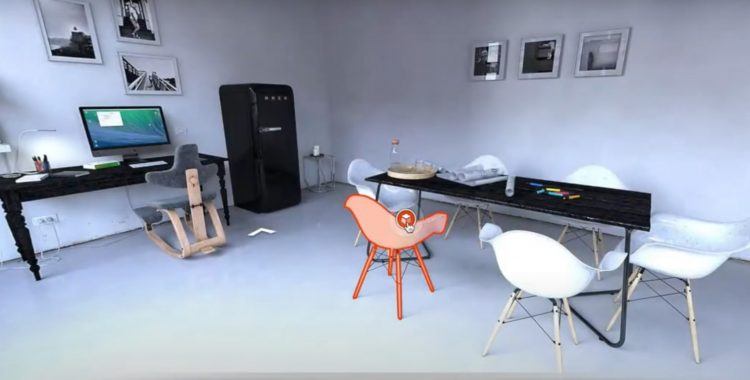
An Avataar AR tool being used to see how a product would look in a room / Photo credit: Avataar
What is the opportunity? “By the end of 2019, there were about 1.65 billion handsets with built-in AR capabilities in consumers’ hands. This is creating an opportunity for AR and VR that didn’t exist 12 to 18 months ago,” Avataar founder and CEO Sravanth Aluru told Tech in Asia.
He added that computing power in mobile CPUs and GPUs now allow for complex deep-learning algorithms to run in real time and deliver computer vision capabilities that were not possible even a year ago.
The company, which began its commercial operations last year, envisions to make online shopping experiences more engaging by replacing current 2D visuals with life-sized and hyper-realistic 3D extended reality (XR) and AR experiences.

An Avataar AR tool being used to see how a product would look in a room / Photo credit: Avataar
What problem it is trying to solve? “The look and feel [of a product] are the top two reasons why people are going offline [to shop],” Sravanth said.





Stay updated on the go with our mobile app.
Get latest insights with smoother, more personalized experience through TIA mobile app.