- Premium Content It takes our newsroom weeks - if not months - to investigate and produce stories for our premium content. You can’t find them anywhere else.
 Gabriel Budi Sutrisno · · 6 min read
Indonesia’s ascent to the top of global Islamic fintech faces obstacles
Indonesia is a leading Islamic fintech hub, but it still lags behind Malaysia and Saudi Arabia, despite the fact that the latter two have smaller Muslim populations.
Malaysia and Saudi Arabia remained the first and second Shariah fintech markets in 2022, according to the Global Islamic Fintech Report by research and advisory firm DinarStandard. The study considered factors such as talent, regulation, infrastructure, capital, as well as market and ecosystem.
Indonesia improved one rank to third place with an overall score of 64.7%, surpassing the United Arab Emirates.
Ironically, despite having the biggest Muslim population globally, Indonesia trails behind in market size, reaching only US$4.2 billion in 2021. Malaysia had US$4.8 billion, while Saudi Arabia saw a whopping US$26 billion.
Market size is calculated based on actual transaction volume, and what might have contributed to Indonesia’s modest figure is the 5% Shariah fintech penetration rate. Nevertheless, low penetration rates are a common trend in many Muslim-majority countries, according to local player Hijra Group (previously Alami).
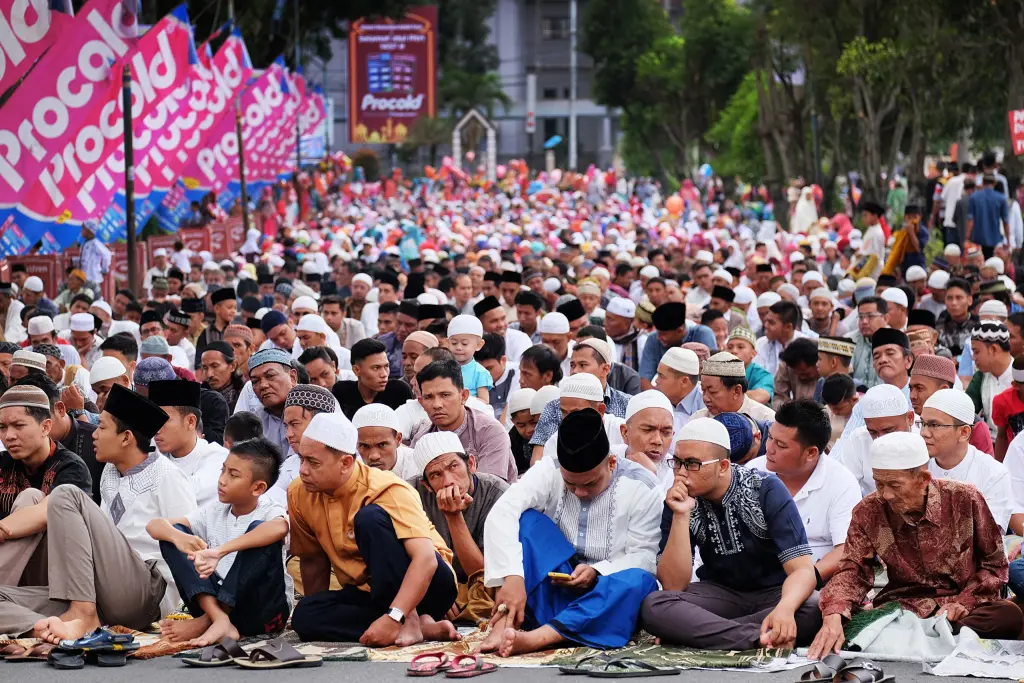
The Muslim community celebrates Idul Fitri at a public park in the city of Pematang Siantar, Indonesia. / Photo credit: Shutterstock
That said, the archipelago is home to 61 Islamic fintech players, but the number is only a fraction of the 300 fully licensed fintech firms. Still, 61 is the world’s highest compared to Saudi Arabia’s 38 and Malaysia’s 37 companies.
Although Shariah fintech is growing rapidly, it has a meager market share compared to the Islamic financial industry at large, says Yusuf Wibisono, director of think tank Indonesia Development and Islamic Studies.
He adds that as of January, Islamic fintech assets in Indonesia stood at 136 billion rupiah (US$9.2 million), less than 0.1% of Shariah non-bank financial industry’s total assets, which reached 148 trillion rupiah (US$9.9 billion).
But there’s significant room for growth. The DinarStandard study predicted that by 2026, the country’s Islamic fintech market will hit US$11.3 billion, while Malaysia will have US$12.1 billion and Saudi Arabia US$52.3 billion.
Limited budget, low inclusion
The Indonesian government’s push for Islamic economic development has been far greater than in the previous two decades, says Wahyu Jatmiko, a finance lecturer at the University of Indonesia.
Supportive regulations have been put in place, including specific laws on Islamic banking and zakat, as well as general regulations related to Shariah economics.
Furthermore, the country has formed national committees and bodies to accelerate the Shariah finance industry growth.
Three large state-owned banks – Mandiri, BNI, and BRI – have also merged their Shariah units into one entity called Bank Syariah Indonesia.
Late to the game
Younger Muslims critical to prospects
Stay ahead in Asia’s tech landscape
This is premium content. Subscribe to read the full story.
The archipelago has more Shariah fintech players yet a smaller market size than Malaysia and Saudi Arabia.
We know this is not ideal. ⌛ Sign up in 20 seconds. Cancel anytime.
Our subscriber community includes professionals from these companies:





Stay updated on the go with our mobile app.
Get latest insights with smoother, more personalized experience through TIA mobile app.










📅 Upcoming Events
22 October 2026
Payoneer x CSPN Summit 2026