 C. Custer · · 4 min read
Why a seasoned China investor is launching a new China-focused media startup
First: the warm, bouncing strums of an acoustic guitar, fast and bright. Then, as the pattern repeats: the first tentative taps of the hi-hat before the growing whine of feedback explodes into pounding drums and racing electric guitars. “Welcome to the Sinica podcast…” a warm baritone voice starts.
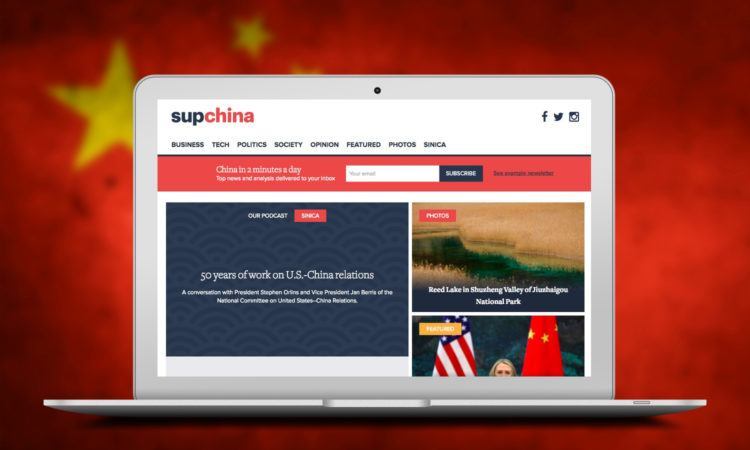
If you’re somebody with an interest in China, that’s an opening that you’ve probably heard dozens of times over the past few years. Hosted by Kaiser Kuo and Jeremy Goldkorn, two of the most well-known China hands in the biz, the podcast has long been the place where serious China watchers go for in-depth discussions with experts on everything from China’s politics to Chinese technology to Chinese history. But as of today, that podcast officially has a new home, because it has been acquired by a new China-focused media startup called SupChina.
SupChina has been soft-launched for a little while, but today is the day it gets serious. Sporting a newsletter, a website and a mobile app, SupChina has functioned mostly as a China-related content aggregator. But now it’s getting serious about original content, having acquired the Sinica podcast and retained the services of both Michael Yamashita (an award-winning photojournalist) and Amedeo Tumolillo (who joins SupChina from The New York Times).
Whence SupChina?
Even with its star-studded media roster, there’s no doubt that the most important person at SupChina is its founder and CEO Anla Cheng. Cheng, who is also a senior partner of Sino-Century China Private Equity Partners, told Tech in Asia that like every good startup, SupChina began with a problem that needed solving.
China and the US are intertwined, whether you like it or not.
“Everything that I do revolves around China,” Cheng said. “My charities, my work, my business. So I would get up very early in the morning […] and take 30 minutes to an hour to go through all the newspapers and [scan all the China-related stories] before I leave for work. I’ve always thought, ‘Wouldn’t it be great if there were one source that would just collectively put all these stories together in one newsletter?'” It was taking her too much time to track down China-related stories across a half-dozen different newspapers, and she wanted a more efficient way to find the news she, as a China-focused investor, was looking for.
At the same time, Cheng says, building understanding of China in the West has been a personal passion for quite some time. “China and the US are intertwined,” she said, “whether you like it or not,” so it’s important that we try to understand each other. “For me, [that’s] very important,” Cheng said. “It resonates with me.” SupChina came to her as a way of killing two birds with one stone – she could collect the best news articles about China in one place and use that as the basis of a platform for spreading understanding of China through a variety of channels (including original content like the Sinica podcast).

One of the Michael Yamashita photos featured on SupChina. Cheng hopes his photography will help SupChina build a solid Instagram following.
Explaining China
Cheng has participated in a number of charitable projects aimed at building understanding of China, but SupChina is not a charity project. “I’m a businessperson, so I really want revenues as quickly as possible,” she said. SupChina is currently funded by friends and family, but in the long run Cheng wants SupChina to be profitable. The next step is to attract VC funding, and then build a large enough audience that it can be monetized through things like advertising, subscriptions, and events.
Our team is very forward-thinking, and they’re thinking beyond what we have now.
Is there a large enough audience for what might seem like such a niche-interest site? Cheng thinks so. In addition to the obvious audience of foreign Sinophiles and China-watchers, Cheng says SupChina will be able to draw readers the 50 million mostly-English-speaking members of the global Chinese diaspora, the 350 million English-speakers in China, the Fortune 500 businesses that work in China, and other curious people. “I think we’ve got a huge audience,” she said.
Plus, Cheng said, media is changing. “Media companies that used to serve niche markets, we believe, in the long term will generate much better value and much more value than the larger companies which are fragmenting themselves in mass markets.”
Looking forward





Stay updated on the go with our mobile app.
Get latest insights with smoother, more personalized experience through TIA mobile app.










📅 Upcoming Events
22 October 2026
Payoneer x CSPN Summit 2026