 Renhao Wong · · 6 min read
Behind Grab’s push for efficiency and how it benefits partners and consumers

The green-clad delivery rider steps into the restaurant and heads over to the counter, easily identifying and picking up the two orders assigned to her. Setting off for her destination, the app helps her avoid an impending traffic jam by suggesting an alternative route. As she hands off the second order 10 minutes later, her smartphone buzzes again. Several floors above, a parcel needs picking up. She’s not familiar with the address it needs to be delivered to, but she knows there’ll be turn-by-turn directions to guide her there.
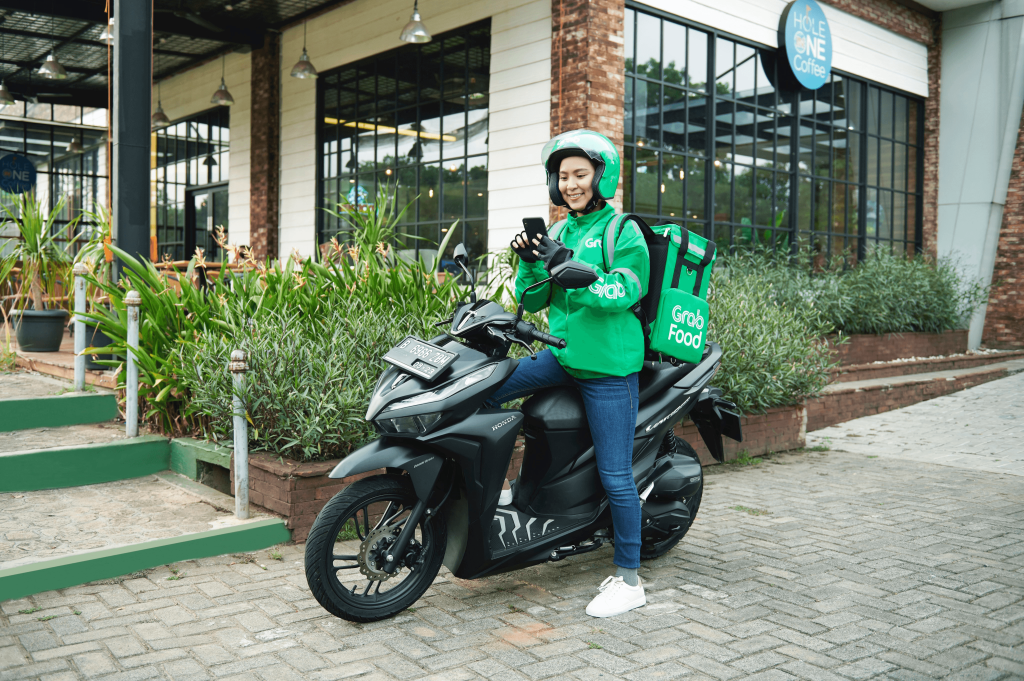
Photo credit: Grab
While consumers expect their food to reach them fresh and hot, delivery partners also want their time on the job to be as productive as possible to maximize their day’s earnings. In addition, merchants hope for prepped orders to be picked up swiftly, especially during peak hours.
It is between the lines of these numerous expectations that Grab’s fulfillment tech stack works its magic.
“[This stack] is how we ensure all bookings and orders that we receive across our super app can be fulfilled using the ecosystem of our driver fleets and marketplace capabilities,” explains Prashant Kumar, head of product for fulfillment at Grab.

Prashant Kumar, head of product for fulfillment at Grab / Photo credit: Grab
The Singapore-based super app, which listed on Nasdaq in December 2021, has some 5 million registered drivers and delivery partners across its transport, food delivery, grocery shopping, and parcel delivery services. To that end, it has become crucial for Grab to examine how it can optimize these rides and journeys for its drivers and delivery partners, enabling them to earn more from the platform while providing consumers with a reliable experience.
Shaving seconds
While the fulfillment tech stack is integrated in all of Grab’s services, one of its biggest beneficiaries has been food delivery, a vertical that Kumar’s team has been actively working on.
For example, a common grievance often faced by both food delivery riders and merchants was how orders would not be ready for pickup when the driver arrived at the restaurant or store. This time spent waiting could have been used by the driver to accomplish more jobs, while for merchants, it was neither pleasant nor productive for riders to crowd around, especially when there’s a rush of customers to serve on-site.
To solve this, Grab is building a deeper understanding of order attributes, such as how long food prep takes at each restaurant. Following that, the platform is able to better predict what time a driver needs to reach a merchant for pickup and identify the most suitable rider for the job.
In both cases, real-time data and insights from each order are channeled back into the company’s AI models, allowing it to constantly improve in accuracy.
These “supply chain optimizations,” Kumar says, come together to create a more efficient system, which lets partners earn more. He shares that in July 2022, Grab eliminated approximately 12 million minutes of driver-partner wait time from their network compared to February 2022.
“Ultimately, this gives partners greater confidence in working with Grab’s system,” he adds. “Consumers also enjoy more consistent and reliable experiences, encouraging better economies of scale with robust supply and demand.”
Multiplying time
Alongside these mechanisms to optimize an order’s journey, Grab also implements batched orders. While it may seem simple in theory to assign various orders being delivered to the same area within the same time frame to a single driver, Kumar explains that technologically, it is a complex problem with multiple parts to solve.
“If we do our job right, the driver only has to park once in a mall, go to the merchants where orders are ready for pickup, and move on to multiple deliveries within a single office building or apartment block,” Kumar elaborates. “We want them to be able to ‘multiply time.’”
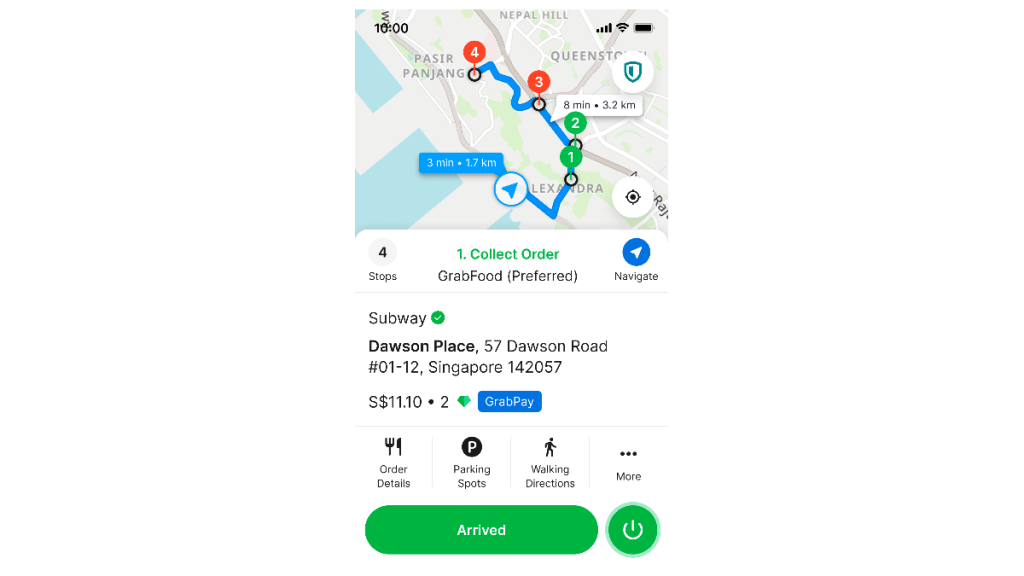
Photo credit: Grab
To achieve this, Grab seeks out the answers to granular questions – such as what items are being carried, how much they weigh, and how long they may take to prepare – by analyzing data collected with the help of merchants, drivers, and its own geo operations team. With this information, the company’s data science models can work out the best route to guide a rider through a batch pickup and drop-off.
Closely tied to order batching is a deep understanding of road networks, parking, and navigation. Utilizing the experiences and insights of its multinational fleet, Grab collects information about the physical world to improve its in-house mapping technology.
All these efforts behind the scenes contribute toward Grab’s objective: letting its riders come online and focus on driving and delivering without having to worry about the details.
Going local
While Grab works to create more efficient and productive journeys for its driver-partners, it also keeps in mind the differences between the eight markets it serves in Southeast Asia.
“Southeast Asia is a very competitive market with lots of nuances,” Kumar emphasizes. “If we are serious about our ambition to solve customer and driver needs, a one-size-fits-all approach will not work.”
For a start, each locale’s fleet mix can differ greatly. Singapore has a sizable number of cyclists while Vietnam’s cities are dominated by motorcyclists. This presents differing opportunities in how each fleet can be deployed and optimized.

Photo credit: Grab
To juggle and address the different variables in each market, Kumar stresses that Grab leans heavily on the feedback it receives, whether from its own data or from its consumers, drivers, and merchants on the ground. By making sense of this data, the team is able to customize the platform’s core technology stack to each market’s specific needs and wants.
Grab’s data science models are scalable and built with regional complexities in mind, and much of the data that it uses – such as local traffic conditions or fleet mix – come from the firm’s own collected information. However, Kumar shares that there are also local nuances such as regulatory requirements that have to be manually specified by the team.
The impact of all these constant optimizations trace back to the core of what Grab aims to provide as a platform: reliable and affordable access to essential daily services for consumers, viable income opportunities for drivers and delivery partners, and an expanded customer reach for merchants.
In the meantime, Kumar and his team continue to work on several improvements and optimizations for the platform to benefit Grab’s super-app ecosystem.
“Every time we get this right, we go a step further in realizing our mission to support everyday entrepreneurs across Southeast Asia,” he says.
Grab is Southeast Asia’s leading super app, offering a suite of services consisting of deliveries, mobility, financial services, enterprise and others
Find out more about Grab today.
This content was produced by Tech in Asia Studios, which connects brands with Asia’s tech community. Learn more about partnering with Tech in Asia Studios.
Stay updated on the go with our mobile app.
Get latest insights with smoother, more personalized experience through TIA mobile app.
Recommended reads
 Gojek, ComfortDelGro Taxi to swap unclaimed rides with partnership launch
 China’s Nio expects to sell less EVs amid Covid-19 crisis
 Is Grab’s ride-hailing business future-proof?
 Tesla faces $2.2m fine in South Korea for overstating driving range
 Grab partners with ID conglomerate to digitalize more warungs
 Gojek to up service fee in Singapore starting February
 Baidu expands driverless robotaxi service in Wuhan
 ‘India’s Elon Musk’ is on a warpath
 Grab, OpenAI partner up to build AI tools for super app’s users, employees
 Tesla to build China data center to power global autonomous driving





Editing by Stefanie Yeo, Winston Zhang, and Lorenzo Kyle Subido
(And yes, we’re serious about ethics and transparency. More information here.)







📅 Upcoming Events
22 October 2026
Payoneer x CSPN Summit 2026