- Premium Content It takes our newsroom weeks - if not months - to investigate and produce stories for our premium content. You can’t find them anywhere else.
 Simon Huang · · 5 min read
How GrabMaps plans to beat Google Maps in $1b sweepstake for SEA dominance
The launch of a new B2B service called GrabMaps will enable customers to take advantage of the super app’s self-developed location-based intelligence and tech.
Grab says this is a US$1 billion market opportunity in Southeast Asia, and it has raised the prospect of offering it to users outside the region as well.
While GrabMaps isn’t a consumer play, the super app does appear to have a unique edge over existing players in chasing enterprise map users. But don’t expect any revenue contributions to move the needle in the near term.
Leveraging local knowledge to win
The project got off the ground to address the deficiencies of existing map tech, which came to light when Grab was building out its ride-hailing and deliveries businesses.
Many cities in Southeast Asia have back alleys and narrow side streets that drivers and riders often rely on to cut travel times and avoid traffic jams. This is especially true for two-wheel and three-wheel drivers – i.e., those who do not drive cars.
However, these passageways don’t show up on conventional maps, as existing providers tend to focus on car drivers.
Global providers also don’t have the same level of understanding of the region, so many Tier 2 and 3 cities are insufficiently mapped. Grab cited how many of these maps are made by foreigners who fly in for a few days every year to shoot the cityscape.
In contrast, Grab’s drivers and delivery partners navigate these routes daily. This is certainly an advantage, as the super app can update its maps with fresh data and real-time feedback.
How does the process work? Participating drivers and delivery partners are equipped with Grab’s self-developed KartaCam, designed specifically for map-making. This opens a new source of income for these partners.
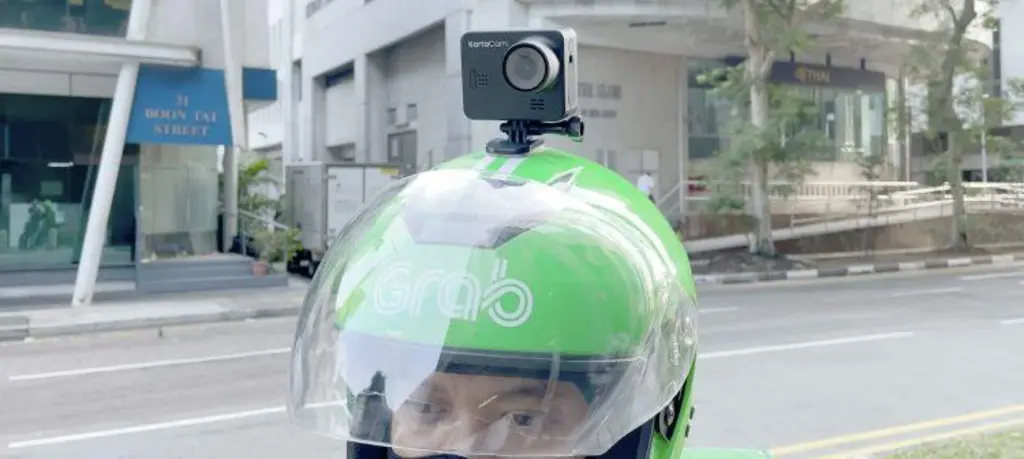
Photo credit: Grab
Deploying these partners enables Grab to collect data that other players would find harder to capture, such as the interiors of huge malls across Southeast Asia that can resemble small cities.
Slash driving costs, boost partner efficiency
Up till now, the biggest benefits of GrabMaps have been internal. The company expects to be “fully self-sufficient” via the service by the third quarter of this year.
This means that Grab will no longer have to pay third-party providers such as Google for their maps and location-based services. Grab did not specify how much it will save, although based on remarks by co-founder Tan Hooi Ling, this amount is “more than” the US$58 million that Uber paid Google between January 2016 and December 2018.
This could yield yearly savings of over US$20 million a year. That figure is not to be sniffed at, but it’s only a fraction of the US$462 million in operation costs that Grab incurred in 2021.
A new source of revenue
Possible pitfalls
Stay ahead in Asia’s tech landscape
This is premium content. Subscribe to read the full story.
Grab’s new B2B mapping service is well-placed to win market share, but don’t expect the numbers to move the needle.
We know this is not ideal. ⌛ Sign up in 20 seconds. Cancel anytime.
Our subscriber community includes professionals from these companies:





Stay updated on the go with our mobile app.
Get latest insights with smoother, more personalized experience through TIA mobile app.