A team of scientists from Nanyang Technological University (NTU) in Singapore has discovered a method to boost energy generation from microalgae, eliminating reliance on non-renewable sources such as fossil fuels and natural gas.
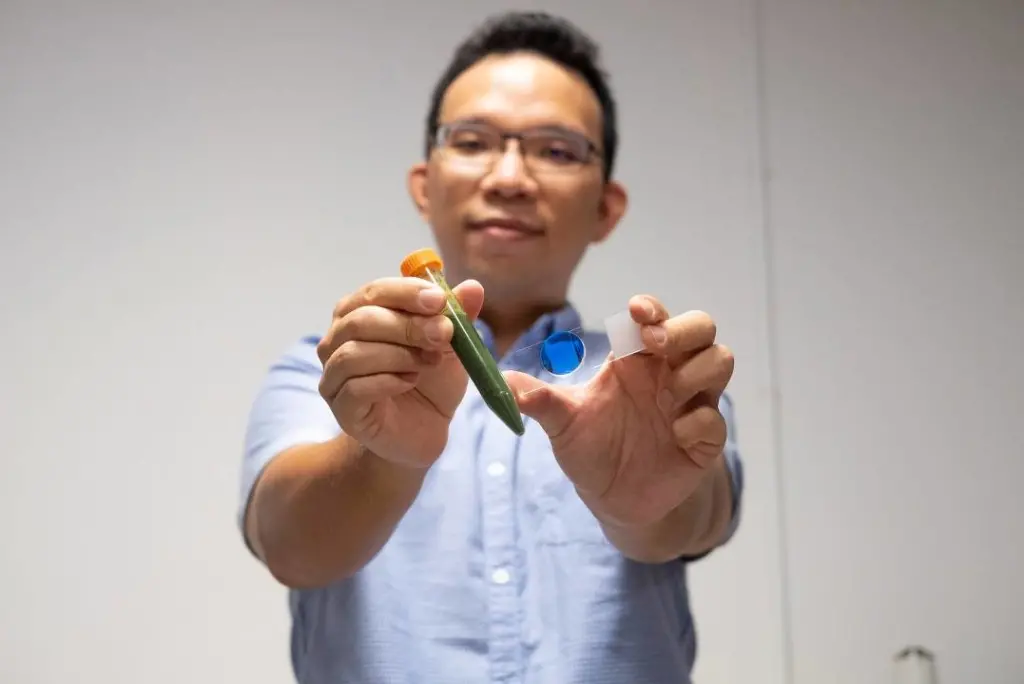
NTU assistant professor Chen Yu-Cheng holds a dropper full of algae and a chip with a microdroplet array. / Photo credit: NTU
The study showed how the binding of algae protein in liquid droplets can “dramatically” enhance the algae’s light harvesting and energy conversion properties by up to three times.
The study, led by assistant professor Chen Yu-Cheng, looked at a particular type of protein found in red algae. Called phycobiliproteins, these are responsible for absorbing light within algae cells to kick-start photosynthesis.
“Due to their unique light-emitting and photosynthetic properties, phycobiliproteins have promising potential applications in biotechnology and solid-state devices,” said Cheng. “Boosting the energy from the light-harvesting apparatus has been at the center of development efforts for organic devices that use light as a power source.”
See also: How Singapore can be 100% powered by geothermal energy
When light hits the droplet, light waves travel around its curved edges. This traps light within the droplet for a longer period of time, giving more opportunity for photosynthesis to take place. Hence, an increased amount of energy is generated.
As the natural energy conversion rate from sunlight to electricity is low, boosting the overall electricity produced could make artificial photosynthesis commercially viable, the research noted.
The study also said that new bio-inspired technology based on phycobiliproteins can be used to make more efficient solar cells, paving the way for greater efficiency within artificial photosynthesis.
Editing by Collin Furtado and Lorenzo Kyle Subido
(And yes, we’re serious about ethics and transparency. More information here.)





Stay updated on the go with our mobile app.
Get latest insights with smoother, more personalized experience through TIA mobile app.