 Ezra Ferraz · · 10 min read
Making Satoshi proud: This Bitcoin umbrella firm has released six companies in three months
In the tiny Makati City office that Bitcoin universal company Satoshi Citadel Industries (SCI) calls its headquarters, there is a sign on the wall that reads: “Ready, fire, aim.” The deliberate botching of a battle cry is meant to convey SCI’s ethos of releasing products first, and refining them later on.
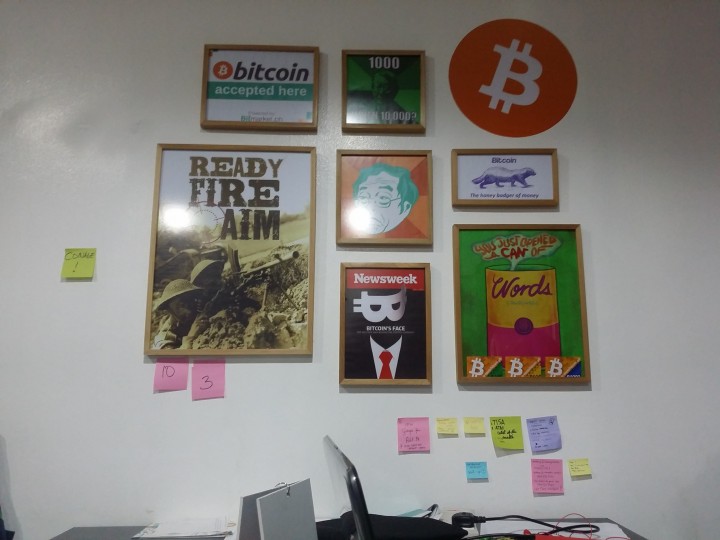
The violent imagery is appropriate too, because SCI is fighting a war: The firm wants to bring Bitcoin to emerging markets, beginning with the Philippines, and they won’t let anything get in their way. Not competitors like Coins.ph or BuyBitcoin.ph, nor government regulations, not the sub-standard infrastructure of the country, nor cultural attitudes toward Bitcoin. It’s an uphill battle indeed.

SCI co-founders (L-R): John Bailon, Nick Galan, Jardine Gerodias, Miguel Cuneta
SCI has only been active since May of this year, but it’s already established a handful of companies. These include Bitcoin payment provider Bitmarket.ph (May 6), selfie-posting site Bitstars (June 8), remittances service provider Rebit (June 27), Bitcoin card provider Prepaid Bitcoin (July 29), bills payment platform Bills Ninja (August 8), and Bitcoin exchange Coinage (August 15). In between all that, they also somehow found time to make a microsite (July 16) to collect donations for the post-Typhoon Rammasun relief operations. For those keeping count, that’s six independent Bitcoin ventures.
See: The state of Bitcoin in Southeast Asia
The umbrella advantage
Though these ventures each have their own models, they are all united by a broader goal. Camill Vazquez, who does business development for SCI, explains that their mission accounts for why they have so many verticals.
“We’re constantly asking ourselves the questions, ‘How can we provide value for people in the Bitcoin space? How can we increase Bitcoin adoption?’” she says. “Whether or not we’re doing a good job at answering those questions is the metric by which we define our progress, not how we stack up against our competitors. At the end of the day, it all comes down to that – value.”
Their mission is not completely altruistic, of course. SCI also wants to provide value to itself. Each additional company that the firm creates makes it easier for it to become the dominant Bitcoin player in the Philippines. After all, why go to Bitcoin payment provider X or Bitcoin card provider Y when SCI already offers Bitmarket and Prepaid Bitcoin under the same roof? If you’re a merchant, you’ll sit through fewer lunch meetings and drawn-out negotiations, and if you’re a consumer, you’ll only have to test your trust in a single company.
“Having multiple companies under a single umbrella allows us to leverage each vertical’s strength in building a complete ecosystem, which ultimately enables SCI to bring better value to our end-users,” chief systems architect Anthony Chua elaborates.
SCI’s bid to become a Bitcoin ecosystem unto itself might put off some Filipino Bitcoin enthusiasts, who may want no such thing, especially given the immaturity of the Bitcoin industry in the country. Such skeptics would point to the implosion of Mt. Gox – the fall of any big company can send shockwaves across a small community.
But their criticism is something that the team may simply have to get used to. Monopoly chatter always comes when a company gets too big in any market, especially when the fish is getting bigger but the pond remains the same size.
SCI argues that its approach is a good thing for the Philippine Bitcoin community. “By delivering our verticals the way we do, we encourage others to bring more, if not the same, passion and vigor to the table,” says director of marketing and PR Sabina Vergara-Lopez. “The competition will collectively spur innovation.”
Piledriving adoption
Product launches and Russian winters
Building a team in the aftermath of Gox





Stay updated on the go with our mobile app.
Get latest insights with smoother, more personalized experience through TIA mobile app.









📅 Upcoming Events
22 October 2026
Payoneer x CSPN Summit 2026