
From ChatGPT to Dall-E, generative AI is taking the world by storm.
It’s no surprise then that businesses want to get in on the action. But for all the hype around genAI, many companies have yet to effectively tap into the technology’s potential.
“With genAI, the immediate thing you see are the creative aspects like generating content or an image. But that’s just scratching the surface of its abilities,” says Donald MacDonald, who heads the group data office at OCBC. In short, companies need to think deeper about how they can leverage genAI’s true capabilities to make an impact on their operations.

Donald MacDonald, head of OCBC’s group data office / Photo credit: OCBC
“From a technology perspective, there is something quite transformative about genAI,” MacDonald adds. “In the past, you had to train lots of models to do very narrow tasks. With genAI, even though a model may not be trained for a task, it can learn and still be able to execute that task, which opens up new opportunities.”
OCBC has long been big on AI, using it for customer recommendations and anti-money laundering alerts, among other functions. Adopting genAI is the natural next step for the Singapore-headquartered bank.
As such, OCBC has been exploring how genAI can help employees be more productive. This led to the development of an in-house coding assistant called Wingman.
Let’s fly
Wingman was developed in May 2023, sparked by conversations in OCBC’s data science team. The program helps OCBC’s developers work faster and more efficiently in various ways.
One of its most notable functions is code completion. After a developer writes several lines of code, Wingman can analyze them and suggest the next few lines that need to be written.
“If it looks good and makes sense, you can just accept the suggestion,” shares Andrea Pisoni, head of data at OCBC. “You become Wingman’s supervisor.”

Andrea Pisoni, head of data at OCBC / Photo credit: OCBC
The application also assists developers with rote tasks such as writing documentation and tests as well as refactoring and optimizing code. It has been embedded into OCBC’s systems and is accessible across the different code platforms used at the bank.
“Wingman leaves the developer more time to be more creative and focus on the high-value tasks instead of writing the actual code,” Pisoni adds. “Architecture, system design, and really understanding the big picture – human creativity is better applied to these tasks.”

The data team working on Wingman / Photo credit: OCBC
Because it was built from an open-source model, Wingman took less than two weeks to develop. In the process, Pisoni and his team had to teach the model OCBC’s context and carry out training and prompt engineering so it can provide accurate and relevant guidance.
The developers also had to manage other factors, such as security and latency.
“In terms of security, Wingman is completely deployed on OCBC data center premises. Nothing ever goes on the cloud or leaves the OCBC environment,” he explains. “OCBC has also built a solid tech stack over the last few years. This has enabled us to deploy machine learning models in a distributed format, allowing Wingman to respond to queries almost immediately.”
Friend, not foe
While Wingman’s actual development was relatively smooth, getting employees on board with it took some time.
“When we first announced Wingman, reactions were pretty mixed,” he says. “As with every emerging technology, the potential impact of AI on the developers’ jobs was somewhat of a concern.”
To tackle this, the data science team focused on education initiatives to showcase Wingman and its value.
One of its most successful initiatives was a hackathon. Developers were split into two teams and tasked with completing coding challenges within a certain amount of time under the same parameters. The twist: One team would do it the traditional way while the other would get help from Wingman.
“The idea was two-fold,” Pisoni says. “It was an opportunity to teach people how to use Wingman – what it can and cannot do – and to get a quantitative measure of how much value it could bring.”
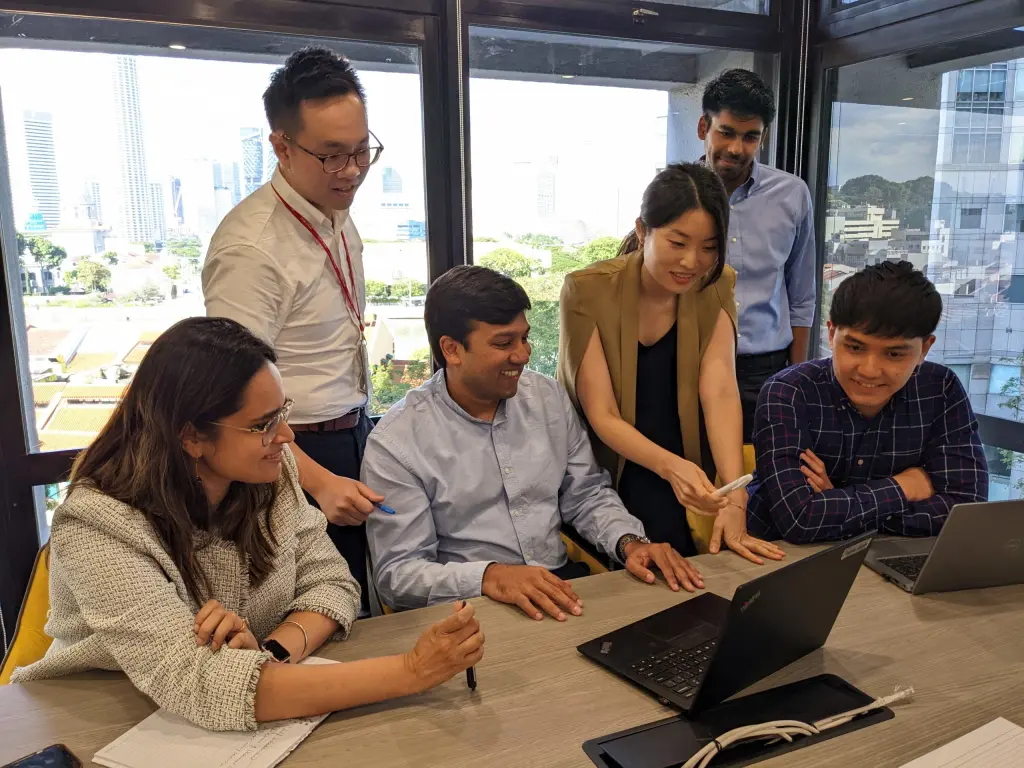
Photo credit: OCBC
Ultimately, the team that used Wingman were able to finish the challenge between 15% to 20% faster than the other team, even though they had never used the tool before. They also had fewer issues in their code.
Another key element to changing people’s mindsets was giving them a stake in the development of the product.
“Often, people don’t have a voice in what these genAI products can do for you – they just take whatever is given to them,” says Pisoni. “But Wingman was built in-house, and [the developers] had a say in it. They could collaborate and give suggestions on what they’d like it to do, instead of just passively using the product.”
He adds, “By giving employees this kind of stake, it makes it a lot easier for AI to propagate faster in the organization.”
To that end, Wingman has undergone several iterations since it was launched and its capabilities have been enhanced at each stage. For example, based on feedback from OCBC’s developers, there are now options to trigger common tasks like writing tests so that users don’t have to manually type out these requests.
Wingman is currently deployed among 1,000 developers in OCBC The bank is progressively rolling it out to all 2,000 of its developers by the end of this year.
According to Pisoni, Wingman provides the equivalent output of 150 to 200 developers as it receives about 30,000 requests per day.
“This has caused a significant shift in the way we do software development,” he says. “Humans have more time to think, program, and design.”
Making better decisions
Wingman is just one of OCBC’s genAI initiatives. The bank continues to experiment with existing tools on the market and with developing its own solutions. For instance, it recently launched OCBC GPT, a variant of ChatGPT for internal use such as drafting replies to customers.

OCBC GPT in action / Photo credit: OCBC
The bank also has Buddy, an in-house AI-powered chatbot that addresses company-related concerns such as questions about HR policies.
Ultimately, OCBC hopes to apply these genAI solutions to streamline how it works and to delegate some of its decision-making tasks to technology.
According to MacDonald, millions of decisions are made at the bank each day, from what code to use to whether a particular money laundering alert is worth investigating. AI could sift through the noise, reducing brain fatigue among humans and giving them the capacity to focus on tasks that really matter.
“Everything that we do is to augment humans, not displace them,” he concludes. “Fundamentally, it’s about using our human resources to do what is actually most important.”
OCBC is the longest-running bank in Singapore. It was formed in 1932 from the merger of three local banks, the oldest of which was founded in 1912. OCBC offers a broad array of commercial banking, wealth management, and specialist financial services, ranging from consumer, corporate, investment, private and transaction banking to treasury, insurance, asset management and stockbroking services.
Its key markets are Singapore, Malaysia, Indonesia, and Greater China. OCBC has more than 410 branches and representative offices in 19 countries and regions.
Learn more about OCBC on its website.
This content was produced by Tech in Asia Studios, which connects brands with Asia’s tech community. Learn more about partnering with Tech in Asia Studios.
Stay updated on the go with our mobile app.
Get latest insights with smoother, more personalized experience through TIA mobile app.
Recommended reads
 Life’s a game, and AI agents are Animoca’s new play
 Indonesian AI startup goes global
 Forrest Li on scaling Sea, building smarter bots, and founder grit
 An AI assistant that joins sales calls and scores team skills
 Beyond the check: Why VCs need more than capital
 SGX’s CEO says it doesn’t need a unicorn to win
 SMEs want AI too, but not the kind Big Tech is selling
 Oatside’s alt-milk rise hits a profitable gear
 Alibaba’s financial health in 12 charts
 Asia’s telcos bundle AI into mobile plans. Will it pay off?





Editing by Winston Zhang and Eileen C. Ang
(And yes, we’re serious about ethics and transparency. More information here.)