
When Donald MacDonald first joined the Oversea-Chinese Banking Corporation (OCBC) Bank in 2004, the use of analytics in the banking sector was limited.
“Back then, analytics [at OCBC] was driven out of the consumer banking side of the business,” says MacDonald, who heads OCBC’s group data office. “It was very focused on marketing and cross-selling – how can we use data to sell more products to our customers? The data landscape was still developing.”

Donald MacDonald, head of OCBC’s group data office / Photo credit: OCBC
Now, nearly 20 years on, things have changed tremendously. Expectations – from customers, shareholders, and regulators – have evolved significantly, and banks are tapping into data and analytics, as well as related technologies such as AI, to improve their processes and keep up with these demands.
“When it comes to customer expectations, you’re not comparing your bank to another bank,” says MacDonald. “You’re comparing your bank to your experience on Amazon, on Netflix, on Grab – the bar for the banking experience is so much higher.”
Working smarter
While the consumer banking and cross-selling aspect of OCBC’s analytics efforts has remained – and evolved to include AI-powered personalized insights and recommendations – the bank now also employs AI and analytics across many other parts of its operations. These include credit scoring, financial crime, fraud detection, and data center optimization, as well as in helping customers make better investment decisions.
One example of this in action is how the bank manages its anti-money laundering (AML) efforts, which was previously a very manual effort.
Every month, a rules-based system would typically generate over 10,000 alerts, with investigators having to review every single one. Each alert could take about 45 minutes to investigate, and a vast majority of the alerts would turn out to be false positives.
While the bank had worked with third-party AML fintech solution providers to address these issues, it wasn’t getting the results it wanted. That’s when MacDonald and his team came into the picture.
“It was an end-to-end transformation process,” shares MacDonald. “In partnership with the financial crime team, we looked at all the major processes and pipelines and said, ‘How could we use AI to make compliance better? Where can it make a difference?’”
The team eventually developed an AI model that applied roughly 500 different features to further sort and prioritize these alerts based on how likely they were to be actual cases of money laundering. Only the top 30% of alerts are actively investigated, with the remaining 70% being either automatically closed or hibernated for further monitoring.
This reduced the investigation team’s workload significantly and allowed staff members to be redeployed to support more meaningful tasks.
Fulfilling customer needs
When the Covid-19 pandemic hit Singapore in 2020, visits to bank branches fell in the face of movement restrictions and fears of infection. Phone calls and emails to OCBC’s contact center increased as a result, overwhelming staff who were attending to customers.
“Working with the contact center team, we thought to ourselves, ‘Can we come up with an AI solution to address our customers’ inquiries and also allow them to actually perform their banking needs through a self-service channel?’” shares Goh Jie Da, a data scientist manager at OCBC’s AI Lab.

Goh Jie Da, data scientist manager at OCBC / Photo credit: OCBC
Goh and his colleagues sat down to develop an internal solution, collaborating with customer experience and customer service teams and tapping into conversational AI and natural language processing technologies. The result: a chatbot that could help customers carry out their banking needs.
For example, if a user wants to update their contact information, the chatbot can walk them through the process and direct them to the right page on the bank’s digital banking service to complete the task.
The service, which was first deployed on OCBC’s consumer banking business, received over 5,000 inquiries in the first month of its launch and led to a notable decrease in calls and emails to the bank’s contact center. It was subsequently rolled out to support OCBC’s corporate banking customers, and today, around 10% of customer service interactions are handled by the chatbot.
The technology behind the chatbot has also been used to power “Buddy,” OCBC’s internal chatbot for employees that answers over 15,000 staff queries per month. Using Buddy, which is available on the bank’s employee mobile app, staff can receive answers to queries about matters such as leave policies and internal acronyms, as well as perform tasks such as unlocking system IDs and accessing the bank’s virtual private network.
Building a data-driven organization
OCBC aims to continue to use AI and analytics to fuel its growth, improve processes, and create new products and services to address customer needs.
According to MacDonald, the bank is transforming to become a truly data-driven organization, where data underpins the decision-making processes at every layer of the business.
For it to achieve this, it needs one crucial element: its people. As OCBC works toward its goals, it has rolled out various initiatives to develop the digital capabilities of its workforce.
The Future Smart Programme, which was launched in 2018, offers OCBC’s employees the opportunity to develop digital skills across pillars such as data literacy and design. The bank also offers programs such as the Data Certification Pathway and the Cyber Certification Pathway, which are 18-month courses that provide participants with in-depth training in data analytics and cybersecurity.
These courses are available online or in person at the OCBC Campus, a dedicated facility for employees’ learning and development needs.
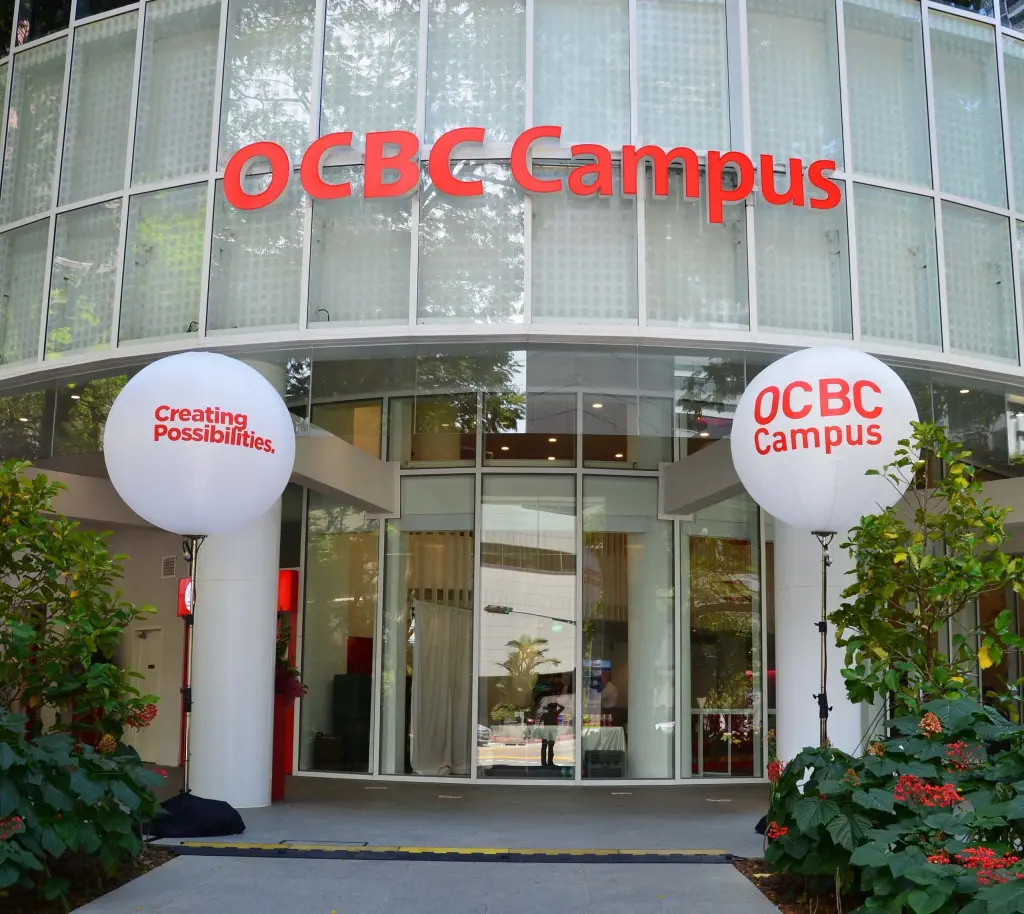
OCBC Campus / Photo credit: OCBC
Through these programs, staff outside of the bank’s data and analytics teams have gained a deeper understanding of the value of data in their work, and these have enabled OCBC to continue to innovate.
“We have a colleague from the treasury side of the business who was previously a trader,” shares MacDonald. “After participating in the Data Certification Pathway, he now leads the innovation team in his department, looking at utilizing data to improve their operations.”
Aside from upskilling its existing staff, OCBC is also seeking to develop young talent. The bank is offering postgraduate AI scholarships and internships in related fields, alongside its Graduate Talent Programme (GTP).
Young graduates joining the bank through GTP are rotated through different departments, exposing them to the various aspects of its operations while being mentored by a senior leader at OCBC. Participants in the program do not need to have any experience or qualifications in the banking or finance sector.
Goh joined OCBC through GTP in 2019 after graduating with a degree in business analytics with very little idea of what the banking world entailed. As part of the program, he spent time at an OCBC bank branch, as well as in departments such as digital business and risk management.
In his view, the program helped strengthen his foundations at the bank, widened his perspectives, and gave him a holistic understanding of the firm’s operations. These have enabled him to better understand the value of data and analytics within the larger organization and enhanced his ability to resolve problems as a data scientist.
“As a service ambassador at the bank branches, you learn that the customer is really at the heart of all that we do, and working with product and software teams, I came to understand the best practices to bridge the gaps between the code and the final product,” he says. “It really helped me gain exposure to different parts of the business and to connect the dots in my own projects.”
Toward a future powered by AI and analytics
Looking ahead, OCBC will continue to build its AI and analytics capabilities. The bank has spent considerable effort modernizing its data platforms, DevOps, and infrastructure. All of these run on a containerized private cloud, enabling OCBC to deploy new applications effectively. It has also continued to create a culture of learning around data literacy and analytics at all levels of the organization.
OCBC is looking to hire over 1,500 tech professionals over the next three years. It’s also bringing the resources it has for training and development in Singapore to its offices across the region, creating a workforce that can actively leverage data for success.
“We want to be the most data-driven financial services organization in Asia,” says MacDonald. “And that’s achievable, having the right people, processes, and platforms in place.”
The Oversea-Chinese Banking Corporation (OCBC) is the longest established Singapore bank. The bank and its subsidiaries offer a broad array of commercial banking and specialist financial and wealth management services.
Learn more about career opportunities with OCBC here.
This content was produced by Tech in Asia Studios, which connects brands with Asia’s tech community. Learn more about partnering with Tech in Asia Studios.
Stay updated on the go with our mobile app.
Get latest insights with smoother, more personalized experience through TIA mobile app.
Recommended reads
 Why Anthropic rewrote the rules to build an AI-native sales org
 Zhipu AI’s formula for surviving China’s tech market
 AppLovin CPO on how renting AI can be a waiting game
 Why AI is hiring problem, not just a technology one
 Nvidia CEO urges rethink of corporate structure
 How Europe wins the AI race in SAP CEO’s view
 Singapore wants to be an AI superpower. Will it work?
 How AI is breaking SaaS where trust matters most
 From data to durians: H2O.ai’s journey to AI-led accessibility
 A new platform digitizes Cambodia’s local pharmacies





Editing by Nathaniel Fetalvero and Jaclyn Tiu
(And yes, we’re serious about ethics and transparency. More information here.)




📅 Upcoming Events
22 October 2026
Payoneer x CSPN Summit 2026