C. Custer · · 3 min read
Guangzhou sting on private car driver leads to protest, raises questions about Didi and Uber’s future
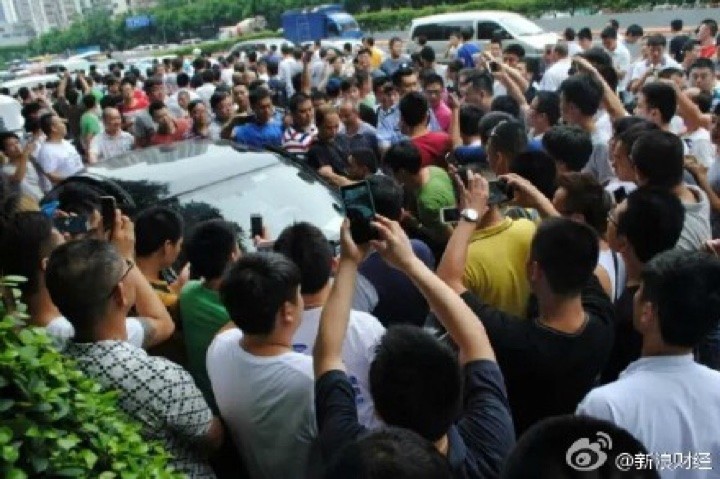
A law enforcement sting operation on private car drivers in the city of Guangzhou led to a large-scale protest and traffic jam on Tuesday, according to reports in the Chinese media. The incident raises a number of questions about the cloudy future of private-car and ridesharing apps in China.
The incident begin when Guangzhou traffic authorities, working in plainclothes, summoned a private car via the app Didi Dache on Tuesday. When the driver of a black Nissan showed up to give them a ride, he was asked to exit the car and told that he was suspected of operating an illegal taxi. Word of the incident spread quickly among other Didi drivers, and many of them sped to the scene to offer their support. Between these other drivers and passers-by who stopped to see what the fuss was about, the road was soon crowded with supporters of the arrested driver, blocking traffic and shouting at the officials to let the car and driver go.
Ultimately other police were called. The crowd dispersed only after police broke out their megaphones and announced that anyone who didn’t leave immediately would be “disturbing the public order” – a serious charge in China that can include jail time. Perhaps thanks to the pressure that had been exerted, traffic authorities let the private car driver they had stopped go.
A dangerous precedent
The incident highlights another side of the continuing battle between Chinese transit authorities and the country’s car apps. China may be ultimately undecided on how it views private-car apps – the lack of a total shutdown of these services is evidence enough of this – but it is definitely not on the fence when it comes to large-scale public protests. Didi drivers participated in a similarly-spontaneous protest in Luoyang last month. If the tension between transit authorities and ridesharing apps continues to lead to “mass incidents” like these, the question of whether to legalize them will become much simpler for Chinese authorities. To put it bluntly: large-scale gatherings and protests make China’s government very nervous, and if private-car apps become a frequent cause of them, then private-car apps are probably doomed.
 China’s car app companies almost certainly recognize this risk. In fact, just hours after the Guangzhou incident, the city’s Uber drivers all received a message from the company: “Today, another platform’s vehicle being inspected led to a large-scale assembly. We wish to emphasize that Uber strongly opposes all forms of illegal assembly, petitioning, and demonstration.”
An Uber driver told Caijing that drivers were also told to comply with authorities if stopped, and refrain from taking “extreme measures.”
If China’s taxi apps hope to see the private-car revolution really take off in the Middle Kingdom, they need to be very careful that it remains a commercial issue and not a political issue or a security issue. Large-scale protests in favor of the apps will send the message that the public supports private-car app legalization, true, but it may also convince authorities that the tension caused by the apps could pose a risk to national security.





Stay updated on the go with our mobile app.
Get latest insights with smoother, more personalized experience through TIA mobile app.