Winston Zhang · · 5 min read
Why online retailers need full-stack observability to scale the customer experience

As the clock strikes midnight, fingers have to move fast and add shortlisted items to the shopping cart, applying every possible discount and cashback voucher available to get the best final price. But, uh oh, the app lags – the flash sale is over and the credit card discount has been fully redeemed, but there was no purchase.
Disappointment and despair? Not at all, just switch to another ecommerce app and perform the same dance – it takes almost no time to do so.
“With so many options available in the market, there is little need for people to wait for brands to fix the issue or to try again later,” says Gregg Ostrowski, executive CTO at Cisco AppDynamics, a leading provider of observability and application performance monitoring technology. He also points out that “57% of people give brands only one shot to impress, and if the digital service does not perform, they will not look back.”
Life for online retailers is more difficult than ever. Customer expectations have skyrocketed, and when they encounter problems on a platform, no matter how small, they don’t wait for it to be resolved. Instead, they’ll switch to an alternative, complain to friends, or even permanently delete the underperforming app.
Retailers need to be able to keep up with these rising expectations or risk being left behind.
Shouldering heavier responsibilities
The exponential growth of ecommerce is contributing to the increased workload of retailers. What used to be a year-end extravaganza with Singles’ Day, Black Friday, and Cyber Monday, has now transformed into an year-round affair. For example, Shopee has had campaigns for most months this year. The need for constant online shopping has created an incredible amount of data for retailers to handle and many more potential points of failure as IT systems are stretched in every direction to keep up with new offers and discount mechanisms.
Consumers also tend to hold retailers accountable for every part of their shopping experience, even if the issues originate from elsewhere. Fair or not, customers blame bad internet connectivity, mobile network interruptions, and technical problems arising from a third-party plug-in on the retailer, Ostrowski says.

Gregg Ostrowski, executive CTO of Cisco AppDynamics / Photo credit: Cisco AppDynamics
He notes that 72% of respondents in the company’s App Attention Index 2021 believe that “it’s the brand’s responsibility to ensure that the digital service or application always works perfectly.” Customers don’t care who’s in charge – they only want issues to be resolved or to encounter “no problems at all.”
Given that expectation, “the new goal for brands is to provide the total application experience – a high-performing, reliable, digital service which is simple, secure, helpful, and fun to use,” he adds.
Solving the most important problems
In order to keep up with these demands, retailers have stepped up their digital initiatives. They have implemented transformation projects three times faster than before and significantly fast-tracked their move to the cloud. However, an unintended consequence of this accelerated digital journey has been the creation of sprawling IT estates that are too complex for the retailers to properly monitor and manage. With the expanded volume of traffic and data generated, it’s exceedingly difficult for retailers and technologists to track each element while also trying to act on valuable insights that can drive the business forward.
According to Ostrowski, technologists are overwhelmed by the data noise and are struggling to navigate their way through it. “This is hindering them from promptly identifying the root causes of performance issues,” he says.
To this end, full-stack observability is presenting itself as a solution, empowering technologists to monitor performance throughout the IT stack – from customer-facing platforms to backend networks. Through its platform, AppDynamics also gives technologists the ability to connect technology performance with real-time business data. This, in turn, allows tech teams to quickly pinpoint problem areas that can significantly affect the business and prioritize efforts to solve them.
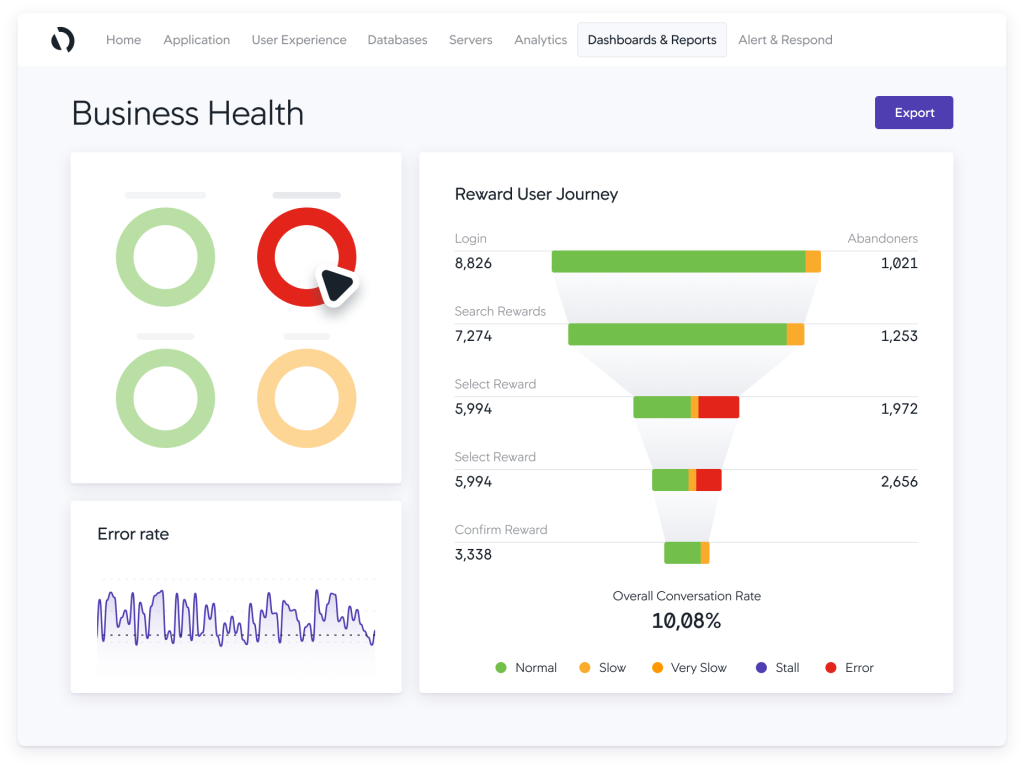
Photo credit: Cisco AppDynamics
Ostrowski explained that “By understanding the potential loss in revenue that may result from slow application response time, retailers can get a clearer view on how to direct and allocate their resources accordingly.” Ostrowski explains. “This optimizes application performance at all times to meet customer expectations, and also makes efficient use of limited time and resources.”
The CTO cites the example of HKTVMall, which was facing severe performance issues due to a surge in customers during Lunar New Year 2021. Unable to diagnose or resolve the problem, Hong Kong’s largest 24-hour online shopping mall resorted to constant server reboots, leading to extended periods of downtime and a heavily-disrupted customer experience.
With the adoption of AppDynamics’ application monitoring solution, HKTVMall was finally able to identify the root cause of the problem: an application memory issue. “Combined with 24/7 monitoring and detailed alerts, the HKTVMall IT team can now stay ahead of potential performance issues,” Ostrowski says. With the help of the platform, the IT team can “make immediate decisions to prevent problems with customers’ shopping and search activities.”
Consistent effort beyond Covid-19
The changes that the pandemic wrought are here to stay – 73% of respondents in AppDynamics’ App Attention Index 2021 indicated that they intend to continue relying on digital services even as life progressively returns to “normal.”
As such, it’s even more critical that online retailers can scale their ability to meet customer expectations.
“As purchase decisions are increasingly influenced by the quality and personalization of digital services, retailers must ensure they have the right infrastructure and tools in place to meet customer expectations,” Ostrowski affirms. “With consumers claiming to be more loyal to an app rather than a brand, providing seamless and innovative digital experiences appears to be the only way forward to secure future success and drive revenue.”
Cisco AppDynamics is a leading provider of observability and application performance monitoring technology. It helps customers observe what matters inside and beyond their IT environments. Combined with the power of Cisco, AppDynamics enables organizations to deliver exceptional user experiences by centralizing and correlating data into contextualized insights of critical business metrics, giving them the power to prioritize actions based on business needs.
Get up to date with how consumers’ digital habits and expectations of digital experiences have changed by downloading and reading the firm’s App Attention Index Report 2021: Who takes the rap for the app?
This content was produced by Tech in Asia Studios, which connects brands with Asia’s tech community. Learn more about partnering with Tech in Asia Studios.
Stay updated on the go with our mobile app.
Get latest insights with smoother, more personalized experience through TIA mobile app.
Recommended reads
 How financial infrastructure powers global startups
 The race to win the AI shopping shelf
 Making mandatory e-invoicing simple for Vietnam’s SMEs
 Building an AI copilot for robotics engineers
 Making AI work in the real world, not just on paper
 Why Anthropic rewrote the rules to build an AI-native sales org
 Startup takes on Sri Lanka’s out-of-pocket healthcare problem
 This startup is unlocking contactless payments for SMEs in SEA
 A solo founder’s fix for unreliable generative AI models
 AI scribe startups’ tricky path in SEA





Editing by Stefanie Yeo and Joy Tirkey
(And yes, we’re serious about ethics and transparency. More information here.)