Nadine Freischlad · · 7 min read
Two brothers are paving the way for Cambodia’s 3D printing revolution
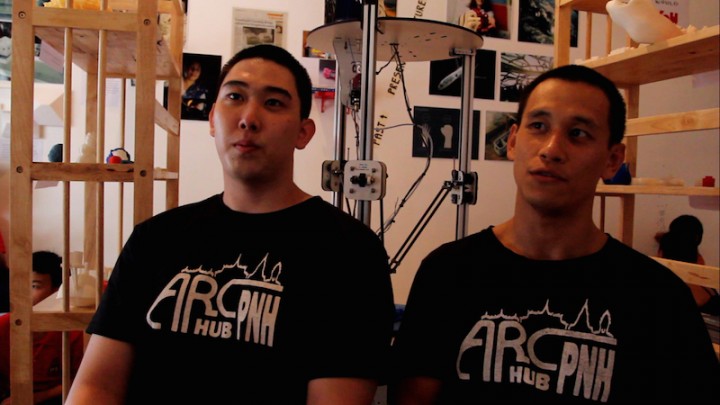
The Tran brothers: Ki How (left) and Ki Chong
“Our vision is based on two big predictions of the future,” says Ki Chong Tran. “Prediction number one: 3D printing will change the way we make almost everything. Number two: the developing world is where most economic and population growth will come from.”
In 2013, Ki Chong and his brother Ki How started up Cambodia’s first 3D printing service – ARC Hub. They produce ready-to-use objects in their Phnom Penh workshop, and they teach others how to use 3D printing technology. Occasionally they bring in experts from outside of Cambodia. Their goal is to make Cambodia “a leader in 3D printing.”
For a country which lags behind others in the region in important measures such as infrastructure development, GDP, and manufacturing, this sounds far-fetched. But in a sense, Cambodia’s lack of existing industry could make it easier for new forms of production to take hold quickly. “We have seen this before with mobile phones,” Ki Chong says. “Developing nations leapfrogged over landline phones and went straight to mobile.”
See: 3D printing is becoming popular in Pakistan, and this founder is leading the way
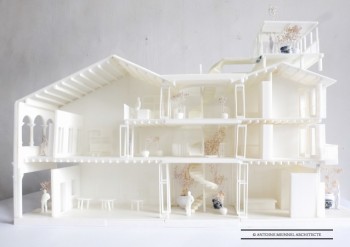
A particularly intricate model of a villa that will be built in Kampot, Cambodia, 3D-printed by ARC Hub
Ki Chong and Ki How hope for a similar leap into the cleaner, faster 21st century prototyping and modelling methods. 3D printing could spur Cambodia’s industrial development as a whole. Adopting this powerful new technology now is a critical opportunity for Cambodia and other developing nations, the brothers believe – if they embrace 3D printing while the technology is still new and evolving, developing countries can participate in innovation and even lead the way, instead of playing catch up.
Origins
Ki Chong and Ki How Tran were born in the US to Cambodian parents, who had somehow managed to flee from the terror of Cambodia in the ‘70s. The family had settled in Los Angeles, but had kept ties with Cambodia. They even tried to live there again in the ‘90s, but then went back to the US because they found the education the kids were getting there simply wasn’t good enough. But one by one, all family members were eventually drawn back to their origins. Their father returned to Cambodia first, in 2010, followed by their mother, then Ki How, in 2012.
“Living in LA I felt like I was always in such a hurry to get from one place to another, only to arrive and do the same things I did every other day. Life overall felt repetitive and at one point I decided that I needed to take a break. Both my parents had already been living in Cambodia for about two years. I decided that I would visit them and do volunteer work around Cambodia,” Ki How recalls. He’s been there ever since.
Ki Chong was the last to remain in LA, where he had work at an aerospace company. His job was to buy and sell airplane parts and here he learned about 3D printing and its potential.
“The concept of 3D printing fascinated me,” Ki Chong says. “I realized that my current job, my current company’s business model, and many other businesses would be completely eliminated if 3D printing were to reach the potential that many people believed it could reach.”
From then on, Ki Chong soaked up everything he could find about 3D printing and tried to visit different makerspaces, meetups and events all over the US to learn as much as possible about the technology. But then he followed the urge to join his family in Cambodia.
“I decided to come back to Cambodia because I saw a huge opportunity for 3D printing here and in the developing world in general. I was also not very happy or fulfilled with what I was doing in the US and had always wanted to start my own business,” says Ki Chong.
Following the gut
Prosthetics
“Not everything can be scaled.”





Stay updated on the go with our mobile app.
Get latest insights with smoother, more personalized experience through TIA mobile app.