David Corbin · · 4 min read
3 pieces of advice Peter Thiel gave Japanese students today
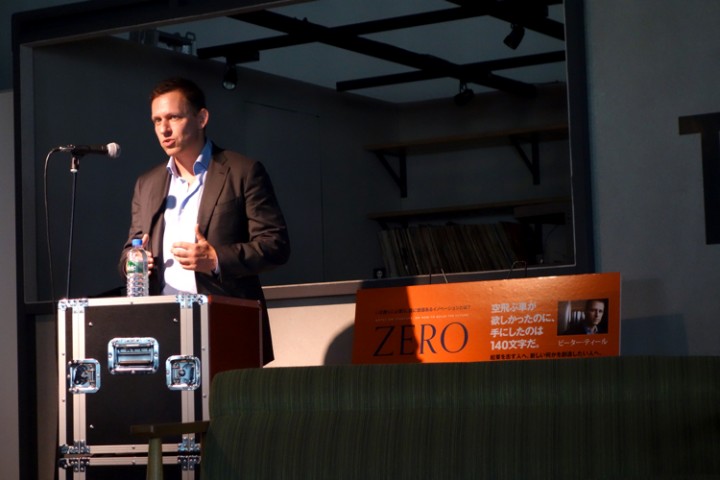
Peter Thiel addresses the crowd in Tokyo.
Peter Thiel, in the midst of his book tour’s Asia leg, is in Japan for the first time in 15 years. Today he stopped by the office of FreakOut, the demand side startup for real time bidding on digital advertising that just IPO’d last year, to address 300 Japanese students – many hopeful entrepreneurs – about his thoughts on starting up.
The content of his opening remarks will be highly familiar to anyone who has read Zero to One. Find a contrarian, yet sensible, business model, capture a small market, quickly expand outwards, and stay focused on getting a monopolistic control over your sector. Stepping into newer territory was his question-and-answer session.
Whether you’re a die-hard Thielot or decidedly skeptical about his business philosophies, it is hard to argue that the man knows how to turn a phrase and keep an audience captivated. Take a look below at some of the highlights.
1. What is necessary for an artificial intelligence (AI) company to be a big success and not just another startup that is more buzzword than substance?
This question was a callback to an earlier statement that Thiel made about the dangers of a company being over-reliant on buzzwords to achieve recognition. In his estimation, “clean energy” became a buzzword and created a bubble in that industry from 2005-2008.
For AI, he agreed that the phrase had become a buzzword, and that it has a key similarity with clean energy. “People are very focused on particular technologies [i.e. deep learning] but not on the business plan. How do these things monetize?” he asked.
He also noted that AI can be challenged by other computer technologies which are more narrowly defined. Good AI ostensibly has a much wider focus and touts its versatility, whereas most software technologies are focused on solving one particular problem well.
Thiel thinks people are approaching the issue with the wrong goal. “We should think of intelligence augmentation – IA. Use computers to get stronger,” he said. Instead assuming it is an advancement if computers can substitute people, companies should work towards building tools that find a way for the two to work together.
As an example he cited LinkedIn, one of the many wildly successful companies founded by the so-called PayPal mafia. According to Thiel, as a business, LinkedIn is not replacing humans. Rather, it is changing the way human recruiters do their job.
2. How can young entrepreneurs fight against legacy players and regulators with a vested interest that can inhibit their new company’s growth?
Thiel acknowledged that starting a company in a heavily regulated industry is risky and he can be reluctant to invest in such firms. If, however, there is a gray zone, and it is not clear if the regulations apply to your company or not that can be beneficial.
He offered a way of analyzing how vested interests might react to a bold newcomer by citing both AirBnb and Uber. Thiel noted that he has invested in the former, but not the latter.
In short, does your entrance into the market threaten the legacy player’s entire existence? By his estimation, hotel owners are not faced with a crisis of life or death because AirBnb starts operating in their city. Taxi owners do face that danger from Uber, and that context informs the regulatory blowback Uber faces.





Stay updated on the go with our mobile app.
Get latest insights with smoother, more personalized experience through TIA mobile app.