Stefanie Yeo · · 5 min read
Meet the startup that’s making the metaverse a reality for enterprises

Imagine being able to see the future and understand how an upcoming typhoon could affect buildings and transport networks in a city or having the ability to go back in time to identify the cause of an explosion at a manufacturing plant.
These may sound like the stuff of a superhero movie, but they’re all things that Singapore-based spatial computing startup Virspatial have made possible thanks to the use of digital twin technologies.
“With digital twins, we’re combining AI, robotics, 5G, the internet of things – all of these technologies – alongside video game technology to create representations of real-world objects and systems,” explains Eric Liu, Virspatial’s founder and CTO.
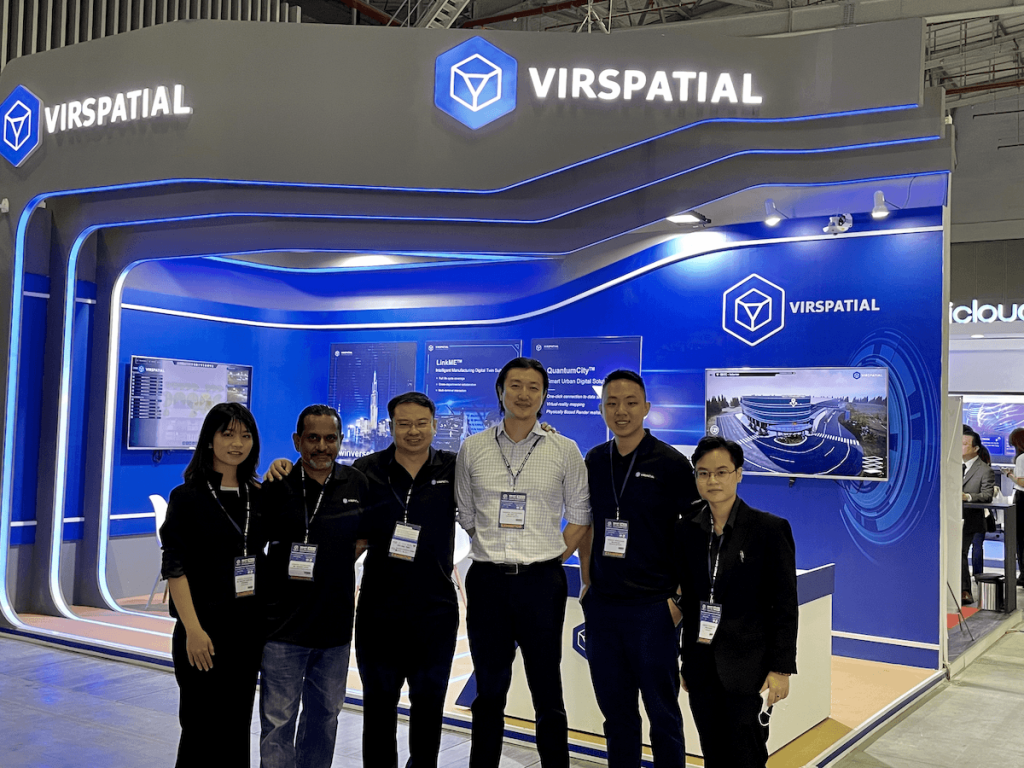
Eric Liu (in white), founder of Virspatial / Photo credit: Virspatial
Through this, Virspatial aims to bridge the gap between digital and virtual spaces, create ways for enterprises to tap into the metaverse, and leverage this new world to drive developments and improvements in their processes.
From flight simulators to virtual cities
Liu’s first introduction to virtual worlds was through simulation technology. His previous startup, Unisol, focused on developing flight simulators for pilot training in China.
“We were basically taking video game technologies, like 3D graphics and rendering, and connecting with physical simulators to help pilots train before they actually got on the real plane,” he explains.
However, he soon came to realize that there were bigger opportunities at play.
Instead of using the technology to power simulators, “I thought, ‘What if we could simulate an entire city?’” says Liu. “What if there’s a natural disaster like flooding or an earthquake? We could simulate that to prepare for potential natural disasters and know how to deal with it.”
Driven by this potential, Liu launched Virspatial in 2019 – first in China, where it’s known as Digitwin Technologies, before moving into Singapore in 2020. The firm then created Twinverse, which helps organizations create digital twins of their factories, buildings, and even cities and lets them control or manipulate these models.
Using sensors and IoT devices, Virspatial can create real-time, one-to-one digital representations of what goes on in a physical space. And this data can be accessed from anywhere in the world.
The company has already worked with the National University of Singapore (NUS) to launch the NUS School of Design and Environment 4 (SDE4) building.
SDE4 has a digital twin in Virspatial’s Twinverse. This allows facility managers to find out things like electricity consumption through IoT sensors connected to the digital twin instead of having to physically check the building’s meter.
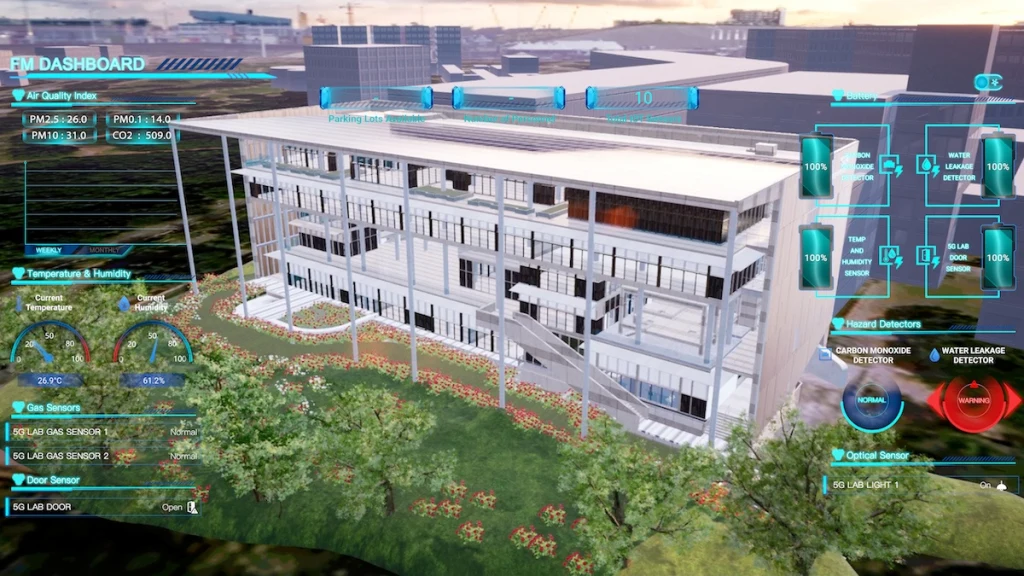
Photo credit: Virspatial
They can also access CCTVs and use AI to recognize license plates and faces, letting them recognize authorized guests and guide them to where they need to go – completely remotely. With robots on the ground in SDE4, staff can also easily deploy cleaning robots where they’re needed without having to be physically present.
What’s more, any future renovation plans can first be made to the digital twin, so building managers can envision how the changes would look and how they could affect other parts of the building.
This feature can also work in reverse. In the event of a lab accident, for instance, the digital twin can be “rewound” back in time to look at what was going on in the facility at that moment.
For Liu, the key selling point of digital twin solutions is the ability for users to be immersed in the digital environment. With the use of VR and AR technology, staff can “walk” through the building as if they were there in real life. What this does is turn abstract data from spreadsheets and databases into interactive, actionable forms.
“Imagine if there’s a power failure in a building,” explains Liu. “The digital twin can tell you exactly where it occurred, walk you to where you need to go, and then provide step-by-step instructions on how to reset the breaker. You don’t have to fumble with building plans or check every power cabinet to find the one that’s causing the issue.”
A bumpy start
Virspatial counts firms like Nokia and Microsoft among its customers and has earned several accolades, such as being selected by the World Economic Forum as one of its technological pioneers of 2022 for its work on digital twin solutions.
However, in its early days, it was difficult to get people to understand exactly what Virspatial was trying to do.
“What is a digital twin? What is the metaverse? What is spatial computing? That’s very technical, and it was hard to also communicate and show people what is possible,” shares Liu. “It spans across many different industries, but people couldn’t connect what I was doing with the flight simulator to other applications of it – they couldn’t understand it.”
It took many demos and proof-of-concepts for Liu and his team to secure the firm’s first major client, a smart industrial park project in China.
“In China, there’s so much new development, but it’s really hard for these construction companies and planning companies to convince investors to back them, or banks to give them a loan,” explains Liu. “But we were able to take their data, their concept of their future smart park, and help visualize this in a tangible way, so that they could tell people, ‘This is what it would be like, this is where people would live and work’ – having that is so striking and more convincing than a PowerPoint presentation.”
That first project got the ball rolling, opening Virspatial up to new projects with organizations both in China and beyond, creating more opportunities for the startup.
Into the metaverse
As metaverse projects become more popular, Liu envisions that enterprises will become increasingly interested in what this new world has to offer. Spatial computing, which allows people to interact with the digital realm, will be a significant area of interest.
“It’s about being able to have these digital user interfaces and models on top of your physical world,” explains Liu.
In his ideal vision of the future, consumers won’t be reaching for their phones when they wake up. Instead, they’ll put on AR glasses and have their latest messages and updates projected onto their bedroom walls. They can also configure their homes so that the weather forecast comes up next to the coffee machine.
Liu hopes that Virspatial will be able to work with more organizations, from governments to retail businesses, in order to bring the real world into the virtual one, creating a whole ecosystem that unites physical and virtual spaces.
“How do we actually bridge the physical world with our digital data and bring these virtual worlds into the real world? That’s what we want to do,” he says.
Accreditation@SG Digital was launched in July 2014 to accelerate the growth of promising Singapore-based enterprise tech-product companies. It helps these firms establish credentials, build business traction, grow, and compete in the global market, opening up more opportunities for their solutions to be showcased and adopted.
Virspatial Technologies is a technology company dedicated to providing spatial digital twin creation and interactive technologies for enterprise meta-universes, empowering enterprise meta-universe applications, and providing excellent spatial digital experience.
Learn more about Virspatial Technologies on its website here.
This content was produced by Tech in Asia Studios, which connects brands with Asia’s tech community. Learn more about partnering with Tech in Asia Studios.
Stay updated on the go with our mobile app.
Get latest insights with smoother, more personalized experience through TIA mobile app.
Recommended reads
 Can remotely operated excavators fix construction’s labor gap?
 2 AI giants, 1 honesty problem
 Fixing doctor burnout with AI is harder than it looks in SEA
 Inside OpenAI’s public-first bet on medical AI
 From data to durians: H2O.ai’s journey to AI-led accessibility
 This startup helps chipmakers stop repeating the same mistakes
 AI uses pilot-style checklists to help doctors decide safely
 Why construction giants are using this WhatsApp AI tool
 Southeast Asia pulls ahead of global average on AI adoption
 Robots still struggle with touch. Sharpa wants to fix that





Editing by Nathaniel Fetalvero and Jaclyn Tiu
(And yes, we’re serious about ethics and transparency. More information here.)