Terence Lee · · 3 min read
Tech in Asia’s intern isn’t a real person
Last week, a photo labeled as me appeared on Tech in Asia’s Instagram account.
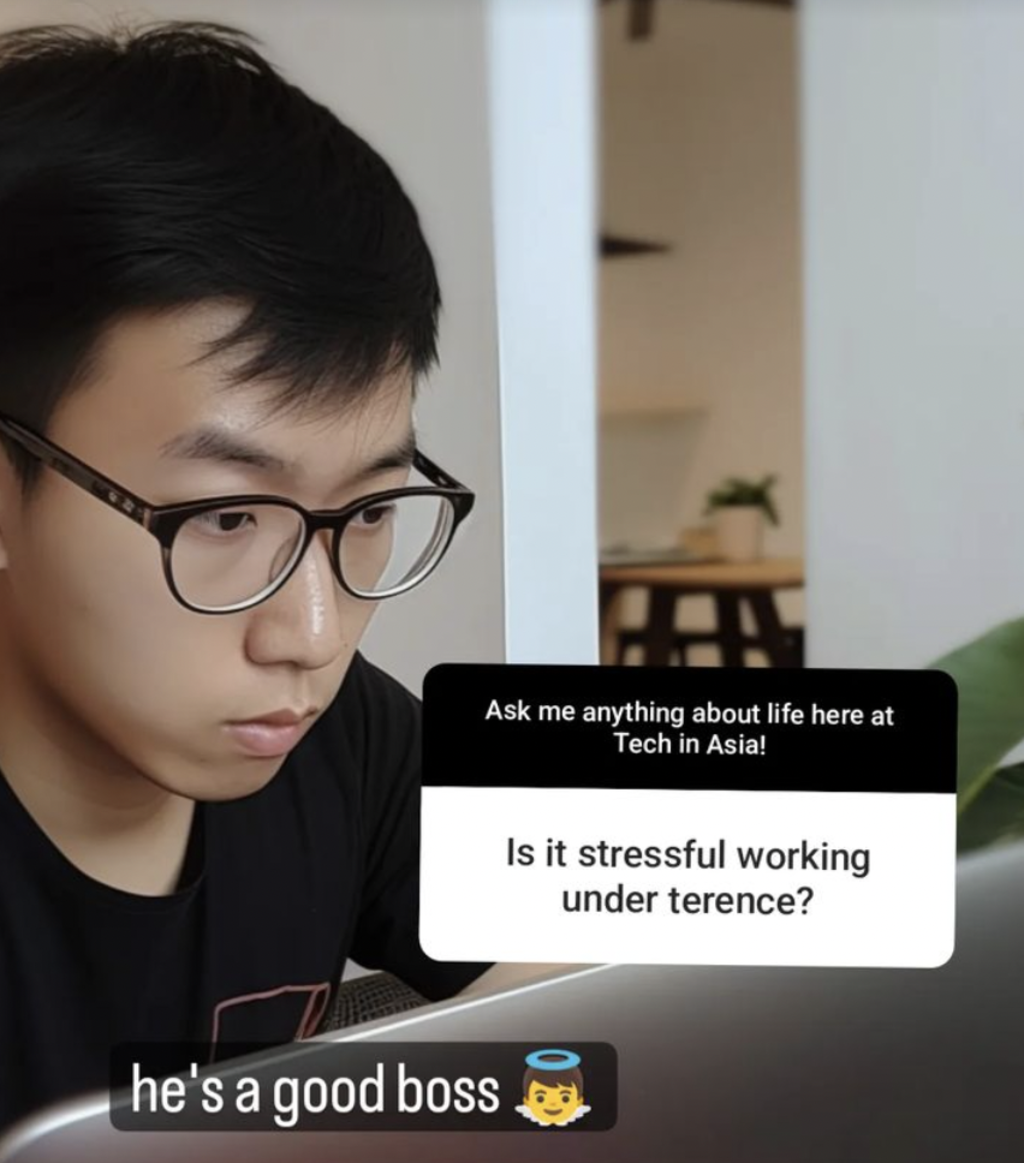
The photo was posted by our intern, Grace Priscilla Teo, who introduced herself to readers and took over our Instagram account for a day.
Then people found out that picture of me – or at least an imitation version of me – was actually generated by AI. But this wasn’t a classic “intern made a mistake on social media” moment. If it wasn’t already obvious, our intern was AI-generated too.
That photo and our intern’s profile picture below were created with Midjourney, an AI tool for generating images.

We’ve been experimenting with generative AI a lot this year. Actually, they’re more than experiments: As a company, we often make over 100 requests to AI tools on a weekday.
I would say they’re pretty indispensable for creating summaries, social media captions, translations, and transcriptions. It’s even useful in producing sentiment analysis.
However, we’re also bumping up against limitations. AI can’t write flawless journalistic pieces, and it frequently makes factual errors. It’s bad at telling jokes and writing satire.
Midjourney, in particular, can’t create consistent characters across different images – which is why Grace looks different from photo to photo.

The lack of consistency can limit the tech’s usefulness. But our constant tinkering has helped us find that sweet spot where the AI’s output becomes reliable enough to be used in a production setting.
We sometimes get surprised too. 😮 AI, for instance, does a pretty decent job of coming up with emojis for text. 🤖💡✨
I’ve no doubt we’ll continue to be surprised.
Of course, the ethical issues involving AI is something we’ll have to deal with. One step we’ve taken is to disclose if something is written via AI or with its assistance.
We’re also aware that large language models were trained with the help of underpaid contractors on works created by people who weren’t compensated for it.
On the flip side, we risk falling behind if we don’t harness AI. We’re finding that it’s great at being a “super intern” of sorts: It can work tirelessly on simple and repetitive tasks, at a fraction of the cost of hiring a human intern.
The quality of its work, however, is often just passable: It can’t write as well as the best journalists. And like actual interns, it will make mistakes, and therefore requires human editing, guidance, and correction.
Any fear that it will replace a significant chunk of white-collar work remains unfounded for now.
Stay updated on the go with our mobile app.
Get latest insights with smoother, more personalized experience through TIA mobile app.
Recommended reads
 OpenAI’s Codex head sees “incredible” adoption across Asia
 The web’s new landlord: Google
 Sam Altman: AI needs attention span, not higher IQ
 Why telepresence robots failed (and how bad UX killed it)
 Websites built for browsing are losing. Conversation is winning
 Asia enters the AI video chat
 Vietnamese startup gives AI coding agents a memory boost
 Why open source is the ‘missing brick’ for robot adoption
 IBM on AGI: bad math, wrong science
 AI to cart away ecommerce shoppers?





Editing by Eileen C. Ang
(And yes, we’re serious about ethics and transparency. More information here.)