Bree Chan · · 5 min read
Meet the cleantech innovators helping cut emissions, recycle water

When Mohammad Sherafatmand visited water treatment plants in Singapore in 2012, he saw how advanced technologies were being used to treat water for public use. But one question nagged at him: If such technologies existed, why were factories and construction sites still relying on chemical-heavy processes to treat their wastewater?
At the time, he was researching electrochemical technologies for his doctorate studies. The gap between what was possible and what the industry practiced became clear.
“At a global level, industries use twice the amount of water that municipalities are using,” he says. “But where do they get the water from? They are using the same sources as municipalities.”
That insight led him to found Hydroleap in 2016, bringing advanced water solutions to the industry. The company’s patented electrochemical technologies treat industrial wastewater without harsh chemicals, turning it into water that can be safely reused within the facility.
While Sherafatmand focused on industrial water, fellow cleantech founder and chemical engineer Eddy Wee was driven to act by the region’s seasonal haze.
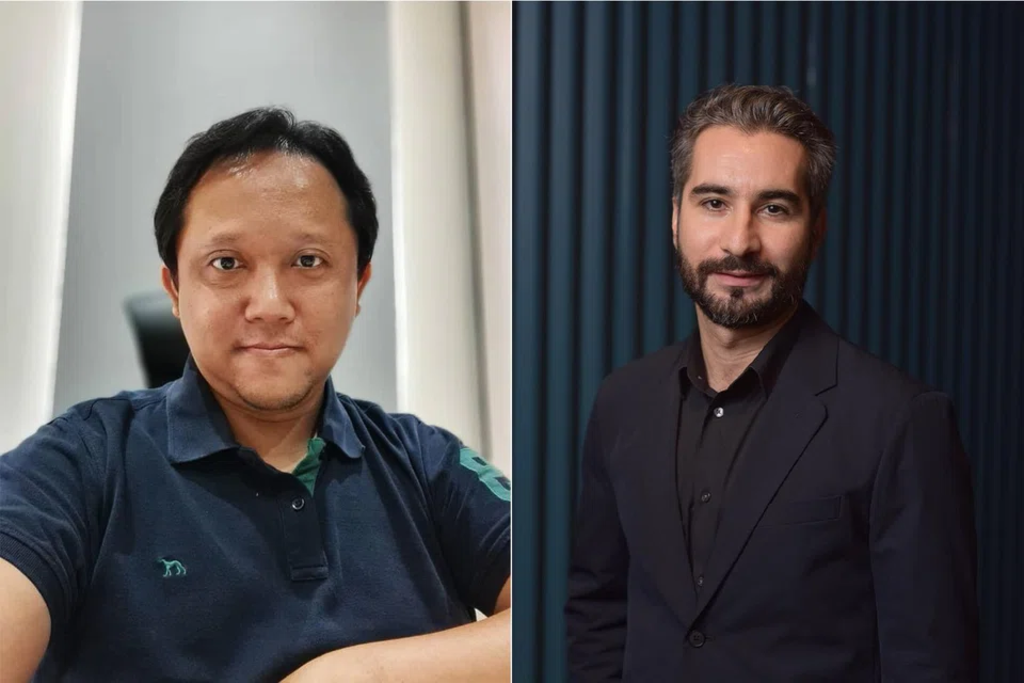
Eddy Wee (left), founder and managing director of Green Environmental Engineering; and Dr Mohammad Sherafatmand, founder and chief executive officer of Hydroleap / Photo credit: Green Environmental Engineering, Hydroleap
In 2016, Wee founded Green Environmental Engineering (GEE), which develops solutions to help heavy industries manage emissions more sustainably. GEE’s patented PureFlux system captures carbon dioxide from industrial exhaust and converts it into a stable, safe form, reducing environmental impact without overhauling existing processes.
Both Hydroleap and GEE were recognized with the Emerging Enterprise Sustainability Award by OCBC and The Business Times, highlighting their innovation and impact in industrial sustainability.
Hydroleap: Electrifying water cleansing
Hydroleap deploys two key technologies to treat wastewater: Electro-coagulation (HL-EC) and electro-oxidation (HL-EO).
HL-EC uses electrical currents and sensors to remove contaminants, automatically adjusting the treatment in real time based on water quality. Hydroleap claims that it can decrease oil and grease levels by nearly 95%.
HL-EO breaks down pollutants at a chemical level, deactivates microorganisms, and prevents scale build-up in water systems. It can remove up to 99% of effluent color in wastewater.
While electrochemical treatment is not new, it has traditionally been difficult to deploy in real industrial settings as it consumed too much energy or performed inconsistently. Hydroleap addresses these issues with its systems which are modular, energy-efficient, and designed to run continuously. They can also be added to existing treatment setups, helping companies upgrade their processes without major changes.
Hydroleap’s technologies are currently being used in manufacturing, food and beverage, palm oil, textiles, and mining industries. They also play a key role in data centers. For instance, the company’s technology has been adopted by Amazon Web Services for the latter’s data centers in Singapore.
“For the data centers, we are saving 70% to 80% of the water that is getting discharged and we are putting it back to the operation,” Sherafatmand says.
The market has responded positively. The founder shares that Hydroleap is now working on projects in Singapore, Indonesia, Malaysia, and Australia, and its revenue has grown 2x to 3x year on year over the past three years.
To fuel its growth momentum, Hydroleap secured over US$4.7 million (S$6.1 million) in July last year from strategic investors such as EDBI, Antares Ventures, and Woh Hup, bringing its total funding to nearly US$12 million to date.
“Winning the OCBC Emerging Enterprise Award is a testament to the impacts that we are making,” says Sherafatmand. “It has given us the visibility that we are delivering real-life, large-scale solutions to mission-critical infrastructures such as data centers and semiconductors.”
Building a critical bridge to reduce emissions
Before founding GEE in 2016, Wee, a chemical engineer by training, worked in oil and gas and environmental projects. The transboundary haze of the early 2010s got him thinking about how to tackle air pollution in heavy industries.
“In the fossil fuel industry – oil and gas, petrochemical, steel, cement plants – they release a lot of carbon dioxide, which is a greenhouse gas that causes global warming,” he says.
However, getting these companies to go green is not something that can be done overnight.
GEE’s flagship product is its proprietary PureFlux Carbon Capture and Storage System. As gases are produced in heavy industrial processes, PureFlux removes dust and harmful pollutants, then traps carbon dioxide and converts it into calcium bicarbonate that can be safely handled and stored.
This means industries can cut emissions at the source without overhauling existing operations. The result is cleaner gas, more efficient systems, and a practical path toward net zero for sectors like cement, steel, power generation, and waste incineration.
“Fossil fuels are still a very mature technology and we still need to use them. But it doesn’t mean that we have to continue using them in our future,” Wee says.
“I view the carbon capture and storage system not as a replacement for renewables but as a critical bridge and also a permanent necessity for the most hard-to-abate sectors.”
Wee says that GEE is currently collaborating with a publicly listed company in Malaysia to establish its first pilot plant and is also exploring deployment opportunities with ASTAR for the Singapore market.
“Winning this Emerging Enterprise Sustainability Award has been a strategic catalyst for my company’s growth, providing the market credibility and institutional recognition to scale this industrial environmental symbiosis model,” he says. “This accolade has granted me access to regional investors and green financing that I’m going to use to fund our capital-intensive turnkey projects.”
Recognizing bold ambition
Now in its 19th year, the Emerging Enterprise Awards – a joint initiative by The Business Times and OCBC Bank – continue to champion the innovation, resilience, and excellence of businesses under 10 years old. The awards celebrate emerging businesses from across Asia, reflecting a sustained commitment to highlighting entrepreneurial talent far beyond Singapore.
The Emerging Enterprise Sustainability Awards honor enterprises that embrace opportunities in the green economy – whether by embedding sustainable practices in their operations or leveraging technology and innovation to drive the transition to low-carbon economies.
Additionally, the Most Promising Sustainability Startup Awards celebrate businesses with unique, commercially viable ideas and significant long-term potential.
The application for the 2026 Emerging Enterprise Awards is opening soon. Learn more about the submissions here.
This story was republished with permission from The Business Times. It was moderately edited to reflect Tech in Asia’s editorial guidelines.
This content was produced by Tech in Asia Studios, which connects brands with Asia’s tech community. Learn more about partnering with Tech in Asia Studios.
Stay updated on the go with our mobile app.
Get latest insights with smoother, more personalized experience through TIA mobile app.
Recommended reads
 Alibaba’s capex isn’t the full story
 Forget startups. Buy the business running on Excel
 Life’s a game, and AI agents are Animoca’s new play
 Indonesian AI startup goes global
 Forrest Li on scaling Sea, building smarter bots, and founder grit
 An AI assistant that joins sales calls and scores team skills
 Beyond the check: Why VCs need more than capital
 SGX’s CEO says it doesn’t need a unicorn to win
 SMEs want AI too, but not the kind Big Tech is selling
 Oatside’s alt-milk rise hits a profitable gear




Editing by Jaclyn Tiu
(And yes, we’re serious about ethics and transparency. More information here.)