 Melissa Goh · · 4 min read
SG’s AI success not tied to local frontier model dev: minister
The world’s largest AI companies, from OpenAI to Nvidia, are setting up labs in Singapore. But what does this mean for the city-state’s ability to develop frontier models? How important is that know-how for Singapore?
In an email interview with Tech in Asia, Josephine Teo, minister for digital development and information, discusses the city-state’s evolving AI talent needs, along with topics like how small businesses should balance limited resources with experimentation.
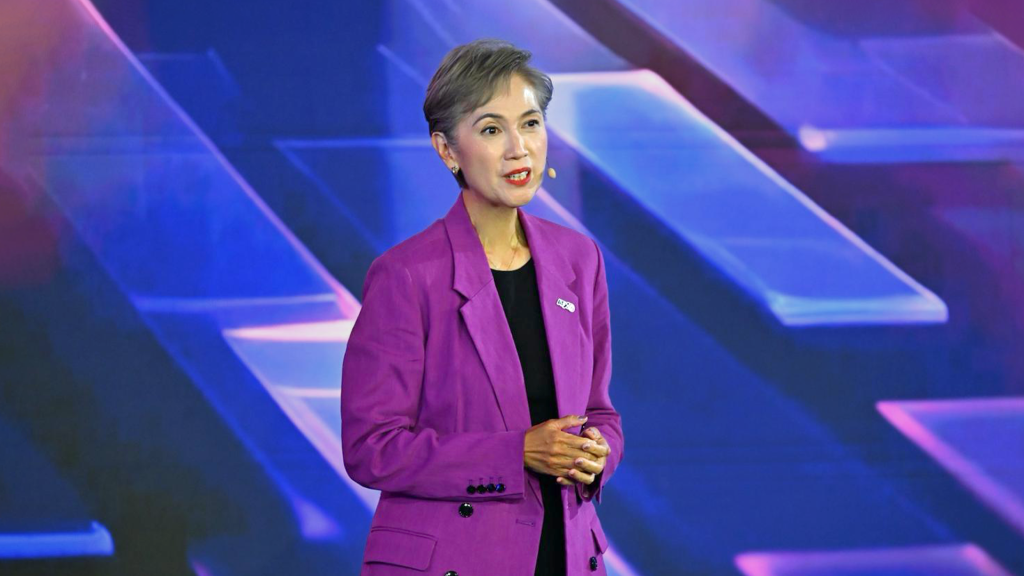
Josephine Teo, Singapore’s minister for digital development and information, delivering the opening keynote at ATxSummit 2026 on May 20, 2026 / Photo credit: MDDI
She also shares advice on how businesses should navigate geopolitical sensitivities at a time when model choices can become a lightning rod for controversy.
In May, OpenAI announced that it had chosen Singapore as its first applied AI hub outside of the US. The firm also unveiled its plans to hire 200 specialized AI professionals over the next few years as part of a US$300 million investment in the city-state. Nvidia, likewise, said last month that it would open an AI research center in Singapore to develop embodied AI.
Asked how such partnerships would ensure specialized skills are transferred between leading AI firms and local teams, Teo says that the city-state doesn’t “start with the assumption that the success of our AI Hub depends on frontier models being developed here.”
“It’s like in civil aviation; we don’t own aircraft technology or build them here,” she explains. “But we do have a very busy hub and aerospace industries.”
Teo adds that Singaporeans working in these companies, who are testing AI solutions in the city-state that can eventually be scaled to other parts of the world, will “likely gain skills that give them added mobility, even if they can’t take the proprietary knowledge with them.”
As part of the National AI Strategy 2.0, launched in December 2023, the Singapore government set a target of boosting “AI practitioners” in the city-state to 15,000 in five years.
See also: Cursor to hire over 200 in APAC as it makes enterprise push
However, industry watchers have cautioned against being singularly focused on building a city of practitioners and users of AI over the expertise to develop frontier knowledge.
Addressing trade-offs that come with prioritizing AI practitioners, Teo notes that Singapore has always “believed a vibrant AI Hub needs a workforce with both breadth and depth of skills.”
“At different times, some profiles may be in greater demand,” she says. “Some time ago, it was AI practitioners like machine learning engineers and data scientists; now, there’s more emphasis on forward-deployed engineers.”
Teo also shares that an ecosystem’s “needs evolve” over time and that as the city-state implemented the National AI Strategy, it also saw an opportunity for “AI bilinguals” – professionals who are already domain experts in a particular field – to acquire fluency in AI skills.
How small firms should be thinking about AI
Singapore’s “open and merit-based” approach





Stay updated on the go with our mobile app.
Get latest insights with smoother, more personalized experience through TIA mobile app.











📅 Upcoming Events
22 October 2026
Payoneer x CSPN Summit 2026