Stefanie Yeo · · 8 min read
Sea and OpenAI unite Singapore’s AI builders at Codex hackathon

Summary:
- Sea and OpenAI partnered to launch the inaugural Regional Codex Hackathon in Singapore. It brought together 144 developers to build real-world applications using OpenAI’s Codex tool and foster an AI-native culture in the region.
- During the intensive one-day competition, teams built a variety of autonomous and deep-domain AI solutions. The top builds included an adaptive AI co-host for live ecommerce, a comprehensive travel planner that builds itineraries and bookings from saved social media videos, and a transparent “white box” model designed to train and continuously evolve video game AI.
- The Sea x OpenAI hackathon series will later expand to Indonesia, Vietnam, Taiwan, and Malaysia to further drive innovation and support the region’s growing developer ecosystem.
- Check out the event highlights video.
Hackathons are a powerful platform for innovation, giving builders the opportunity to collaborate, experiment, and bring ideas to life. Through rapid prototyping and creative problem-solving, participants gain valuable experience and, in some cases, spark innovations that make a meaningful impact beyond the event.
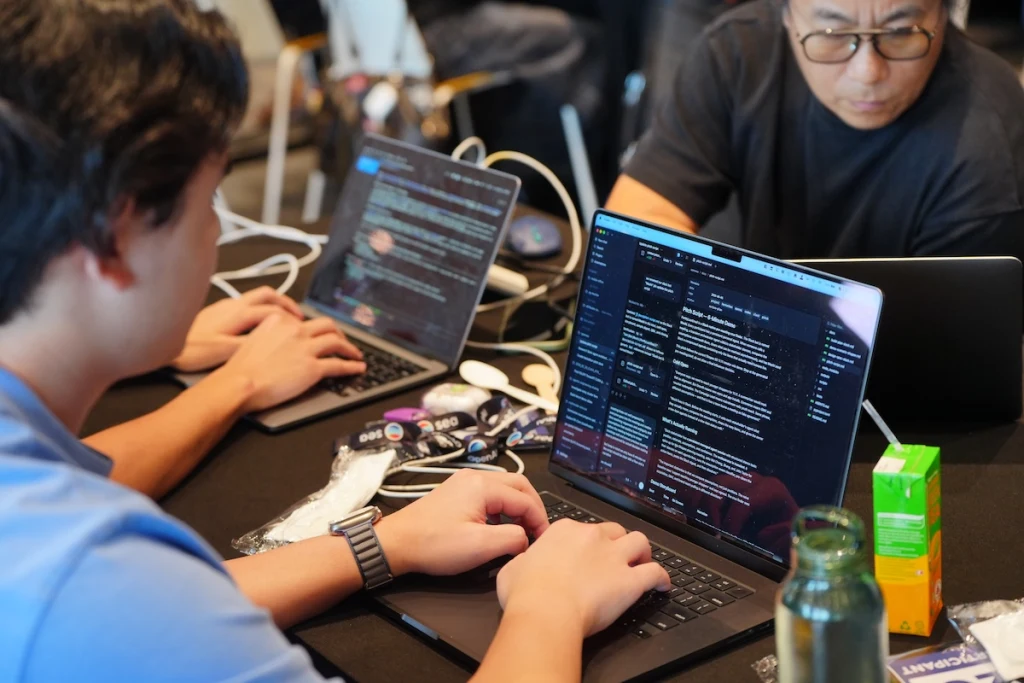
Hackathons are a key part of our tech ecosystem / Photo credit: Sea
As I pulled up to the Shopee Building in Singapore bright and early on June 6 for the inaugural edition of the Sea x OpenAI Regional Codex Hackathon series, I was curious to see what the event would hold. I wanted to find out what interesting solutions the participants would come up with and whether I would witness the birth of a future AI powerhouse.
Combining forces
Before we get into the event proper, here’s some background information.
The Sea x OpenAI Regional Codex Hackathon series is a joint collaboration between the two companies.
Founded in Singapore, Sea has established itself as the global technology company behind Shopee, Garena, and Monee. OpenAI, meanwhile, is the research and deployment company behind ChatGPT. The two coming together reflects a broader commitment to encourage the development of Southeast Asia’s growing AI ecosystem.
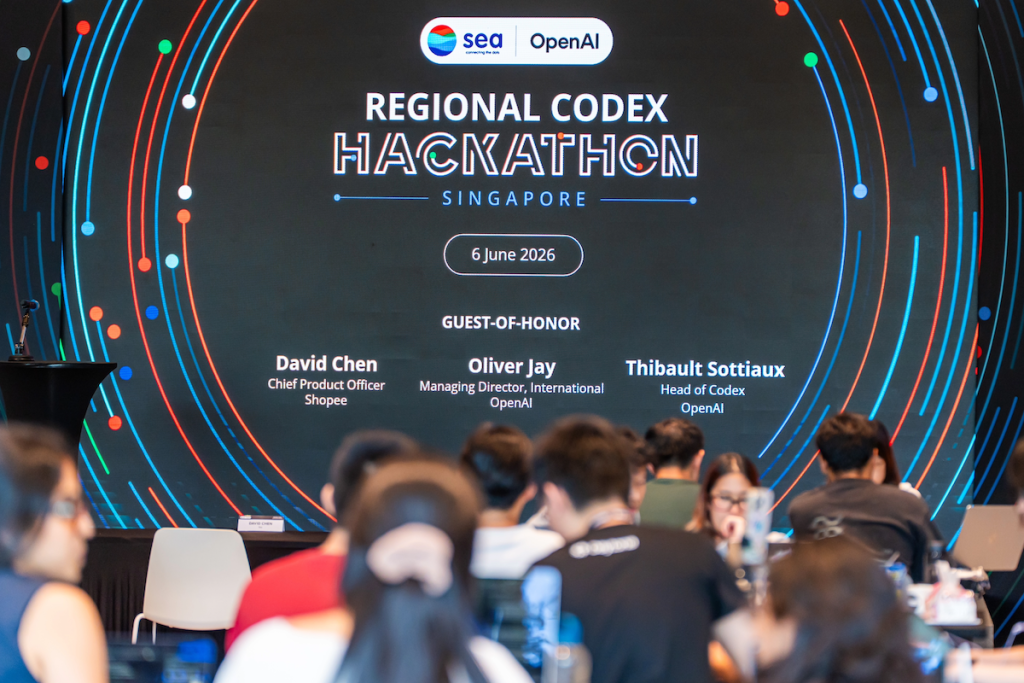
The inaugural edition of the Sea x OpenAI Regional Codex Hackathon / Photo credit: Sea Group
The event marks the first time OpenAI has partnered with a company on a regional hackathon initiative in the Asia Pacific.
Interest in the Singapore edition was strong from the outset, attracting more than 1,200 applications – roughly 8x the available spots. This culminated in a one-day competition where 40 shortlisted teams, made up of 144 builders and developers, created real-world AI applications using Codex, OpenAI’s coding agent that helps users build and ship with AI.
The projects that the participants had to work on were anchored on three main areas:
- Autonomous and adaptive AI: Agents that can be trusted to operate without constant human oversight
- AI-native products and operations: AI as the core feature of products and solutions, instead of being an add-on
- Deep domain AI: Building AI solutions for specific industries to address concrete needs
Building better together
The event kicked off at 9:30 a.m., with opening remarks from the three guests of honor: David Chen, co-founder of Sea and chief product officer at Shopee, Oliver Jay, managing director, International, at OpenAI, and Thibault Sottiaux, head of Codex at OpenAI who joined virtually.
“Today’s hackathon is not only about building demos. It is about helping every team to think about how we should build things in the new AI era,” said Chen in his speech. “It is about experimenting fast. It is about iterating fast. And ultimately, we want to build an AI-native culture in the builders in Singapore and across Southeast Asia.”
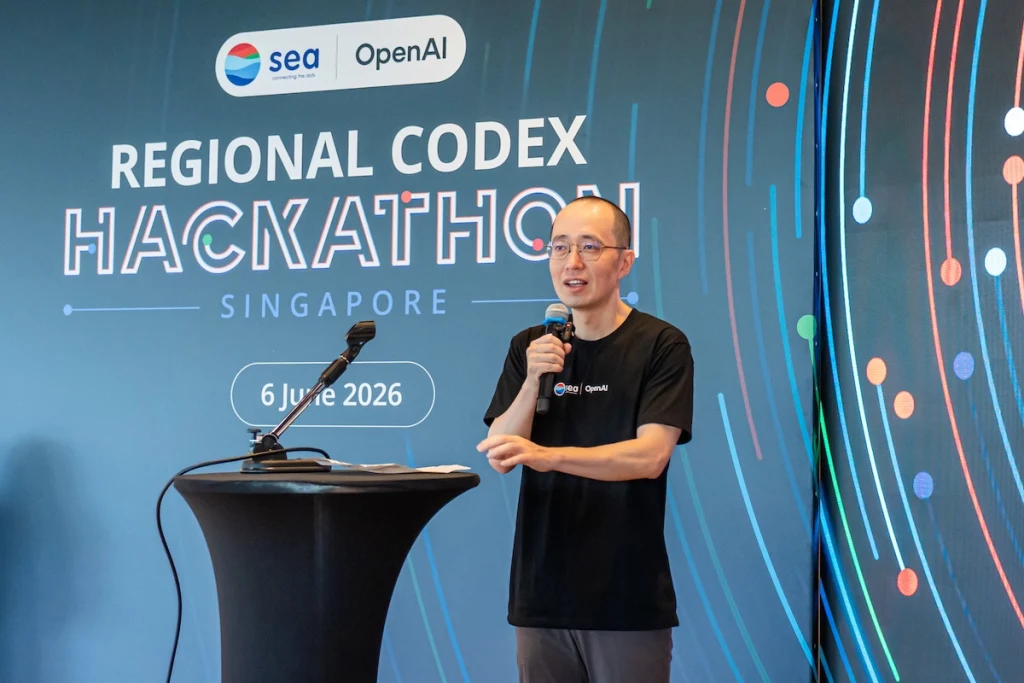
David Chen, co-founder of Sea and chief product officer at Shopee / Photo credit: Sea
This was followed by a short demonstration of Codex, which gave participants a look at how it worked and how they could use it in their projects. Throughout the day, OpenAI experts were on hand to provide technical guidance, answer questions, and help participants navigate challenges as they built their solutions using the platform.
The hackathon began at 10 a.m. sharp, and the teams were building all throughout the day.
As I walked through the venue at various intervals, it was a sight to see everyone hard at work, typing away furiously and having heated discussions. Sighs of frustration were just as common as cheers of triumph, and as the hours ticked by, the pressure ramped up.
The half hour before the projects had to be submitted proved particularly intense – I found myself on the edge of my metaphorical seat as teams raced to the finish line.
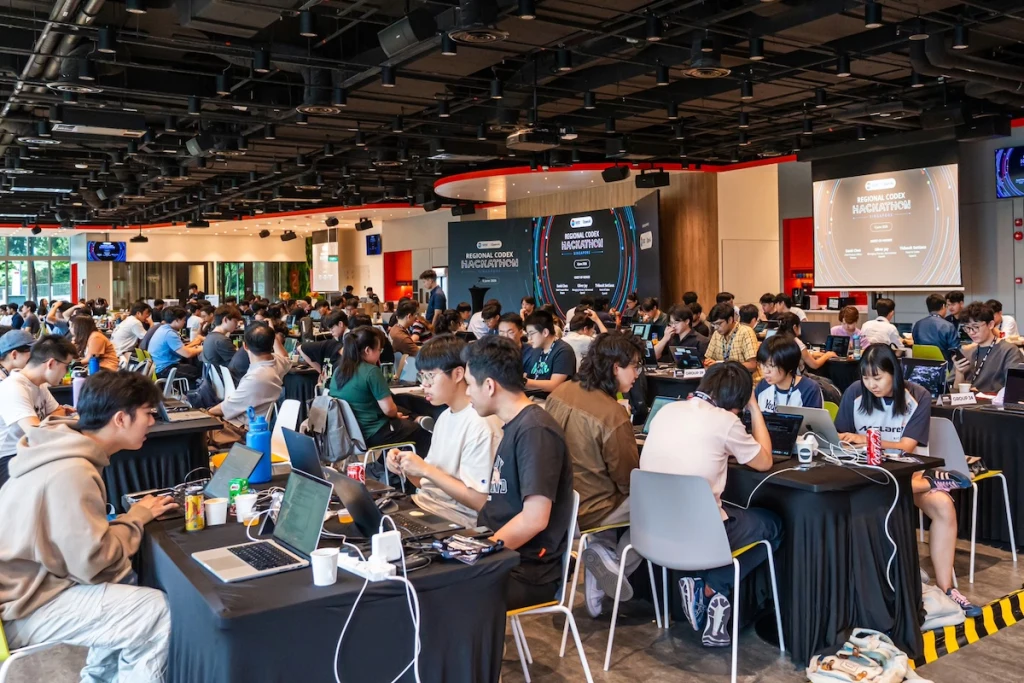
Hacking in progress / Photo credit: Sea
Once the projects were submitted at 5 p.m., there was a huge sigh of relief, but it was a temporary reprieve. As the participants broke for dinner, the judges began their work, assessing the teams based on the following metrics:
- Problem framing
- Quality of build
- Insight and originality
- Real-world value
- Alignment with the three areas of focus
- How effectively Codex was leveraged in the build process
The judging took place across two rounds. The first ran concurrently with dinner, where the teams took turns to present their solutions to a panel of judges, made up of representatives from Sea and OpenAI.
The judges went beyond the presentations and demos and also evaluated the builds at a deeper level. Alongside the above criteria, the panel examined how teams handled technical trade-offs such as latency, their approach to data privacy, and their thoughts on how the solutions could develop beyond the hackathon.
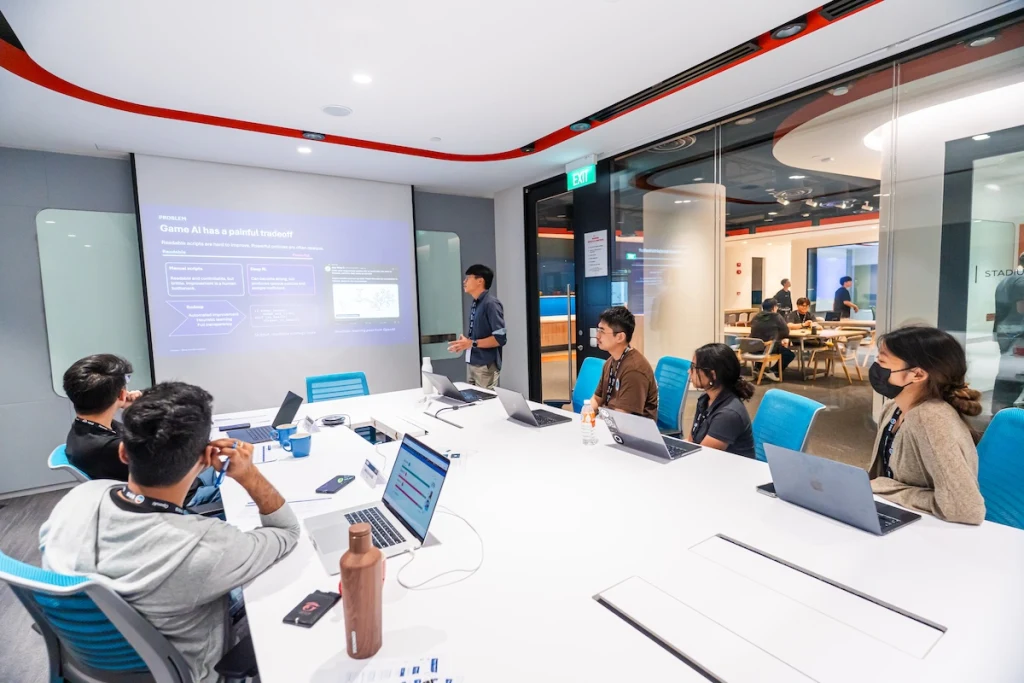
The first round of judging was intense, but insightful / Photo credit: Sea
The participants’ projects were truly fascinating, and I was intrigued at the breadth and depth of what had been built. I was particularly impressed that many teams were able to deliver real working demos within such a short build period and that they were often paired with polished, well-crafted presentations that made the ideas easier to appreciate.
I sat in on a few of the presentations, and I saw some of the builds. These included a cycling route planner that personalizes routes based on rider preferences, a “pre-check” solution to prevent AI agents from deploying erroneously, and a tool to create content optimized for AI search. It was genuinely cool stuff.
Winners all around
Once the first round was done, the judges convened to make their decision on which five teams would go on to the finals.
The five finalists then went up on stage to showcase their solutions to the panel.
These builds were particularly inspired, and the judges had a hard time making their decision – but they eventually did.
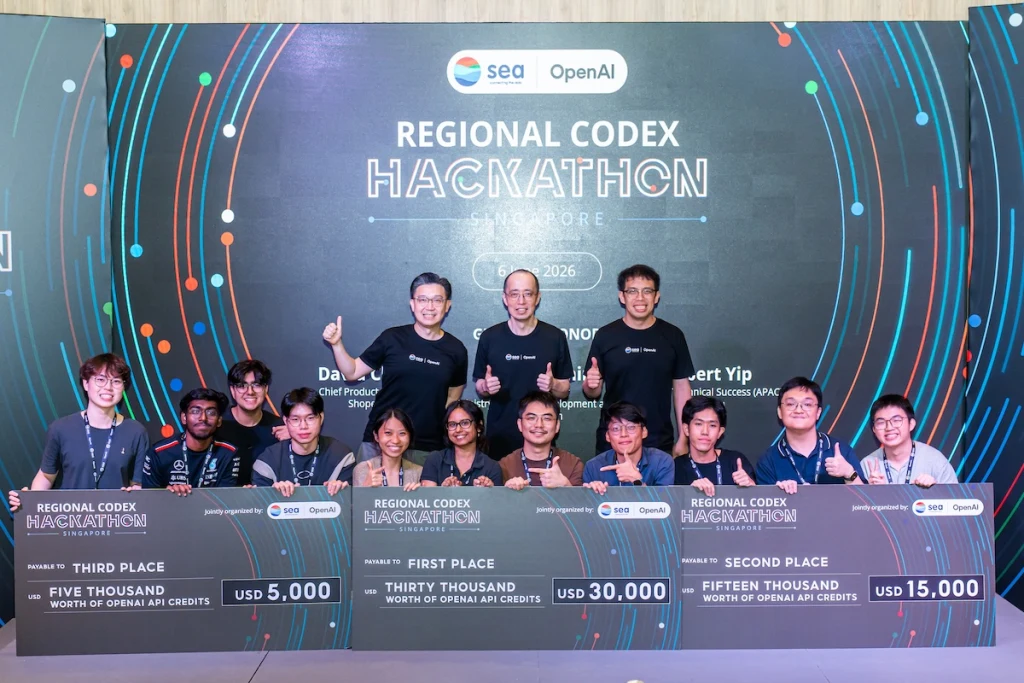
The winning teams / Photo credit: Sea
Third place went to Team Techbros, which developed an AI co-host for live selling, which could answer questions and moderate the chat. What made it stand out was its ability to learn. For example, if the host answered a question from a viewer about the product warranty, it would “retain” this information and be able to answer on the host’s behalf if the same question was asked later on.
In second place was Team TripCanvas, which built an AI-driven solution to plan a travel itinerary based on Instagram Reels or TikTok videos. On top of that, the platform could make flight and hotel recommendations and even make and pay for bookings. It certainly was a glimpse of the future of traveltech.
And the grand prize went to Team Untitled.ai. They built a product called Evoloop, which is a model for training game AI. If you’ve ever played against “the computer” in a video game, Evoloop’s solution enables the computer to learn and adapt as it plays, making it a more effective competitor.
Evoloop is unique as it is a white box solution – developers can actually see what changes were made to the code as the AI evolved. This is a capability that could make the tech applicable to other sectors, such as finance.
“One of the most encouraging outcomes of this hackathon was seeing the creativity and problem-solving spirit of Singapore’s developer community firsthand,” shared Sea’s Chen. “The event demonstrated how AI can help address real-world challenges when combined with a deep understanding of user needs.”
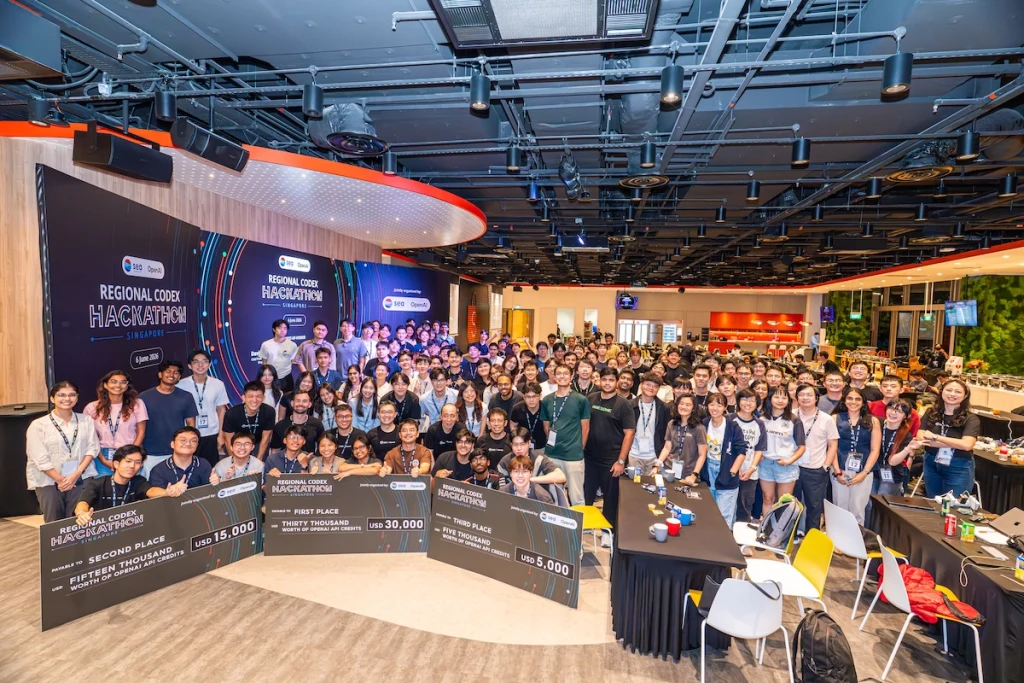
A massive group photo with all the hackathon participants / Photo credit: Sea
The top five teams received a one-year subscription to ChatGPT Pro. As the grand winner, Team Untitled.ai walked away with US$30,000 in OpenAI credits, with Team TripCanvas and Team Techbros receiving US$15,000 and US$5,000 in credits, respectively.
The event ended with the presentation of prizes and a massive group photo.
From Singapore to the region
Overall, the event was an insightful look into just what we, as a region, are capable of building. The sheer variety of ideas at play, the creativity I witnessed firsthand, and the infectious energy of everyone in the room was really encouraging and a strong indicator of Asia’s potential to build on the AI stage.
“As AI continues to shape the digital economy, it is important that builders have opportunities to learn, collaborate, and experiment with emerging technologies,” said Chen. “Together with OpenAI, we hope initiatives like this can bring the developer community closer together, inspire new ideas, and enable more people to create solutions that make a meaningful impact.”
And with the Sea x OpenAI Regional Codex Hackathon series expanding to Indonesia, Vietnam, Taiwan, and Malaysia in the months ahead, I’m hopeful that we’ll put the right resources in place to help Asia’s builders and developers make their ideas a reality.
Here’s to Asia’s AI community.
The Sea x OpenAI Regional Codex Hackathon series aims to support AI innovation and developer communities across the Asia Pacific.
Check out the highlights from its inaugural edition, held on June 6 in Singapore.
This content was produced by Tech in Asia Studios, which connects brands with Asia’s tech community. Learn more about partnering with Tech in Asia Studios.
Stay updated on the go with our mobile app.
Get latest insights with smoother, more personalized experience through TIA mobile app.
Recommended reads
 Automating premium hotel kitchens with sensors
 Who pays for AI in your language?
 MoneySmart grows revenue by 26% in 2025, but AI threatens margins
 The truth about AI language models: No one wants to pay for them
 Tracking AI hiring in Singapore: OpenAI, Anthropic, and more
 Korea’s physical AI ambitions meet the factory’s bottom line
 SEA financials tracker: Moladin’s revenue rises 6% in 2025
 On‑demand services lift Line Man Wongnai’s 2025 revenue to $544m
 Flipkart’s costly late push into quick commerce and food delivery
 Inside Singapore’s government team that kills its own products





Editing by Jonathan Chew and Jaclyn Tiu
(And yes, we’re serious about ethics and transparency. More information here.)