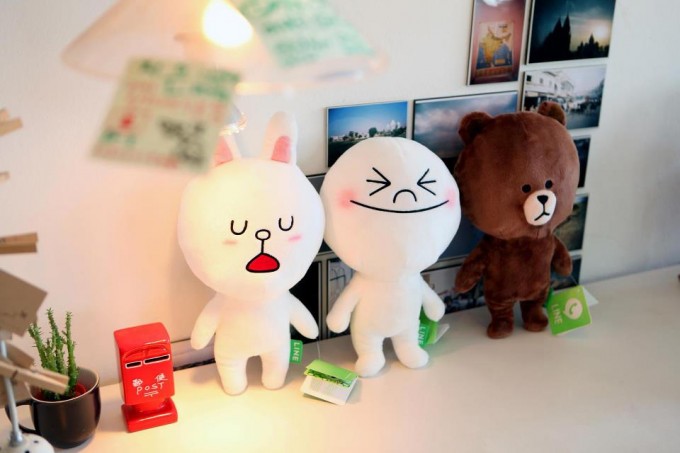
Line’s characters. From left: Cony, Moon, and Brown.
In the afternoons of May, Singaporeans young and old waited for their turn in the blistering heat to enter a pop-up store selling merchandise of the cartoony characters from Line, a chat app surging in popularity worldwide. The love affair reached an apex when a man, disguised as a mascot of Line character Brown, proposed to his girlfriend.
The event echoed other fads which happened in the sunny island just a year ago, and a decade before that. Queues would form outside McDonald’s outlets around the country as folks sought to buy some limited edition Hello Kitty dolls. Passions ran high, causing arguments between grown men and fast food workers who would struggle to contain the crowd.
While Line’s characters aren’t as influential as the venerable feline, the app has rapidly gained mainstream awareness in parts of Asia. Launched in Japan in 2011, the chat app has accumulated 470 million registered users, with a significant number of them coming from outside the country. An initial public offering valued upwards of US$9.85 billion has reportedly been filed.
But unlike Whatsapp and Viber, which function as utility apps laser-focused on fulfilling a user’s communication needs, Line is both a platform and content creator. It designs, produces, and sells its own creations, and it’s succeeding.
Line essentially repeated what Sanrio, the inventor of Hello Kitty, did in its early days. By adding a flower design to rubber sandals, Sanrio founder Shintaro Tsuji discovered that he could sell more of them. “If you attach added value or design to the product, they sell in a completely different way,” he said.
The discovery led Sanrio to a formula that would sustain it to this day. A review of a book documenting Sanrio’s history notes: “he began commissioning cartoonists to create designs, eventually hiring his own to avoid paying royalties. Tsuji also obtained Japanese rights to Snoopy from Peanuts for Japan and exclusive (money-losing) import deals on Barbie dolls and Hallmark cards.”
So, unlike Whatsapp, which views the chat app from a purely functional standpoint, Line sees it as a cultural artifact. The approach has worked out well for its balance sheet. Sanrio makes around US$759 million in annual revenue, while Line is already generating US$338 million a year.
How did Line thrive?
From a pure usability standpoint, Line’s chat app seems ordinary among the competition. But consider what came previously. Before a text on a phone involved Whatsapp or WeChat, it was simply sent via SMS. Sending SMSes costs money. But Line, paired with a wi-fi network and a data plan, fulfilled the demand for constant multimedia communication.
Line emerged at a time when smartphone penetration in Japan was low but on the verge of booming. Just before Line launched to the public in June 2011, the country had a 14.8 percent smartphone penetration rate. The figure jumped to 40 percent in less than two years. This was a sweet spot for Line since many consumers were about to discover chat apps for the first time.
Line’s characters helped too. Brown, Cony, and Moon share a similar minimalist aesthetic to Hello Kitty. The designs feature the classic traits of cuteness: big head, round profile, and a clumsy look.
The app’s rise could also have something to do with the widespread acceptance and association with kawaii – the Japanese word for cuteness – that transcends not just nationalities, but also age and gender. As Japan emerged from the second World War, embracing cuteness meant being infantile and immature. That changed in the past decades as the country grew wealthier and social pressure to be mature lessened, observes Obata Kazuyuki, a columnist at quarterly magazine Nipponia. Or, girls who liked Hello Kitty, Doraemon, and other icons of Japanese pop culture simply grew up still liking them.
Aside from WhatsApp, Line is probably the only other massively successful chat app to have sizable traction beyond the home market. In April this year, it counted over 50 million registered users in Japan – barely over 10 percent of its total user-base – and had over 10 million users each in Taiwan, Thailand, Malaysia, Indonesia, Mexico, Spain, and the United States.
In contrast, only 40 percent of KakaoTalk’s users live outside South Korea, while WeChat had 100 million registered users beyond China in August 2013 despite a grand total of 355 million monthly active users.
Line is its own animal





Stay updated on the go with our mobile app.
Get latest insights with smoother, more personalized experience through TIA mobile app.