J.T. Quigley · · 5 min read
Otaku dream: this smart anime body pillow responds to your caress

Japanese manga and anime are two of the country’s most recognizable pop culture exports, with the likes of One Piece and Attack on Titan attracting die-hard followers across the globe. Obsessed fans – often referred to as otaku – pay tribute to their favorite two-dimensional characters in a variety of ways. On the milder side are those with sprawling action figure collections, and others who play dress-up at cosplay conventions. Hardcore otaku take the obsession further: “marrying” their 2D crush, and even sleeping with objects bearing the character’s resemblance.
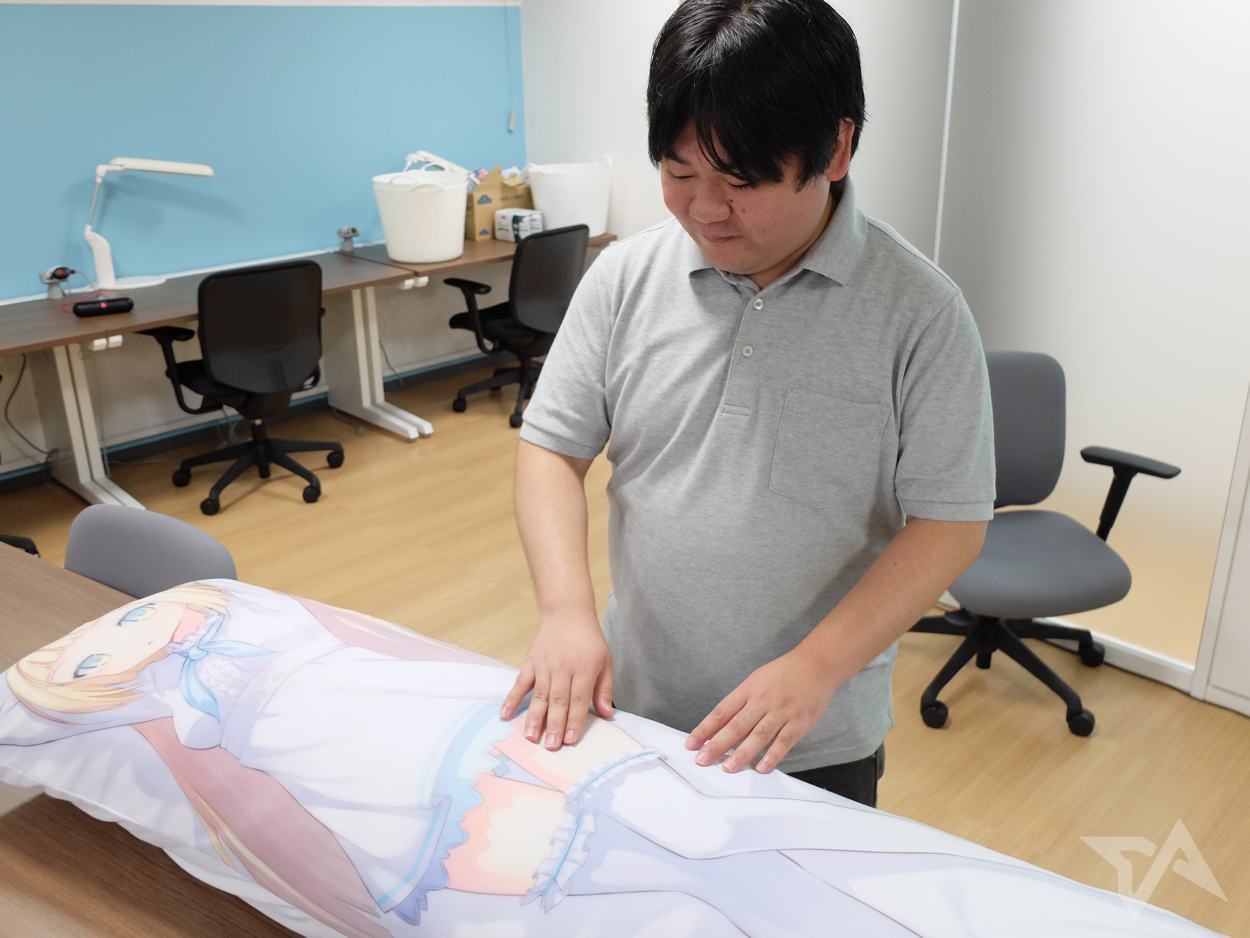
Japanese entrepreneur Koichi Uchimura (pictured above) falls into the latter category. When I met him at a co-working space for startups in Fukuoka, he introduced me to his significant other: Rina Makuraba, a 160-centimeter body pillow.
Rina, a portmanteau of makura (the Japanese word for pillow) and ballerina, is an original 2D character that Koichi created to resemble his “dream girl.” She’s blonde with blue eyes, and Koichi – who’s 33 – describes her as a 14-year-old junior high school student.
Koichi stands proudly beside her, with a hand on Rina’s waist. I ask him if she’s his girlfriend.
He lets out a laugh and tells me, with confidence: “She’s my wife.”
Turning his gaze back to Rina, who’s sprawled out on the table between us, Koichi gives her an excited pat on the thigh.
“Stop talking, you pig!” she shouts, via the smartphone sitting next to her.
Heavy breathing
Otaku have been fond of body pillows for quite some time, as printed pillowcases allow them to literally sleep with their favorite character. But Koichi is taking the craze a step further. His product, Itaspo, uses sophisticated sensors that – when touched – allow the pillow to talk.
Itaspo’s sensors were created at the Kyushu Institute of Technology, where Koichi worked as a researcher before founding his startup, Joyas, in May 2014.
“Typical touch sensors don’t work with a cloth over them,” he tells Tech in Asia. “They also can’t tell the difference between a hit, a stroke, or a soft touch.”
To give your dakimakura (the Japanese term for body pillow, or literally “hug pillow”) the gift of gab, simply insert Itaspo’s three sensors beneath the pillowcase and connect the device to your smartphone via Bluetooth. The sensors can be positioned “wherever a user wants,” says Koichi – who opted to stick one on Rina’s head, one beneath her breasts, and another on her left thigh. One small caveat is that the sensors are connected to a slightly bulky box that houses an Arduino board and battery, which could be uncomfortable to roll onto in your sleep. Koichi is working on scaling its size down as much as possible.
Consumer ready





Stay updated on the go with our mobile app.
Get latest insights with smoother, more personalized experience through TIA mobile app.