 Samantha Cheh · · 5 min read
How Huawei is enabling the success of deep-tech startups

Deep tech, which deals with cutting-edge and disruptive technology based on scientific discoveries, is fast becoming the cornerstone of a high-tech future. Without deep tech, for instance, we won’t have machine learning software or quantum computing.
Or, for a more tangible example, deep tech makes our dream of self-driving cars possible.
Investments in deep tech grossed almost US$18 billion between 2015 and 2018, while the Singaporean government committed nearly US$225.6 million to the segment in 2020.
In light of that challenge, Huawei Spark was established to offer opportunities for deep-tech startups to reach new markets and clients as well as co-create with Huawei.
Laying the groundwork
Traditionally, Huawei’s business-to-business partnerships have been with telecommunications firms and large enterprises. That said, Leo Jiang, Huawei’s chief digital officer for Asia Pacific, says the company also sees building up an ecosystem of digitally native startups as part of its growth strategy.
“We play an enabler role for the benefit of the startups,” he observes, adding that Huawei’s interventions can manifest in different ways. These include assisting startups with their finances and technology as well as opening up markets and new connections. The partnerships are driven by the startups themselves, allowing them to voice out their needs and leverage Huawei resources on multiple levels. Their successes then have a knock-on effect on Huawei itself.
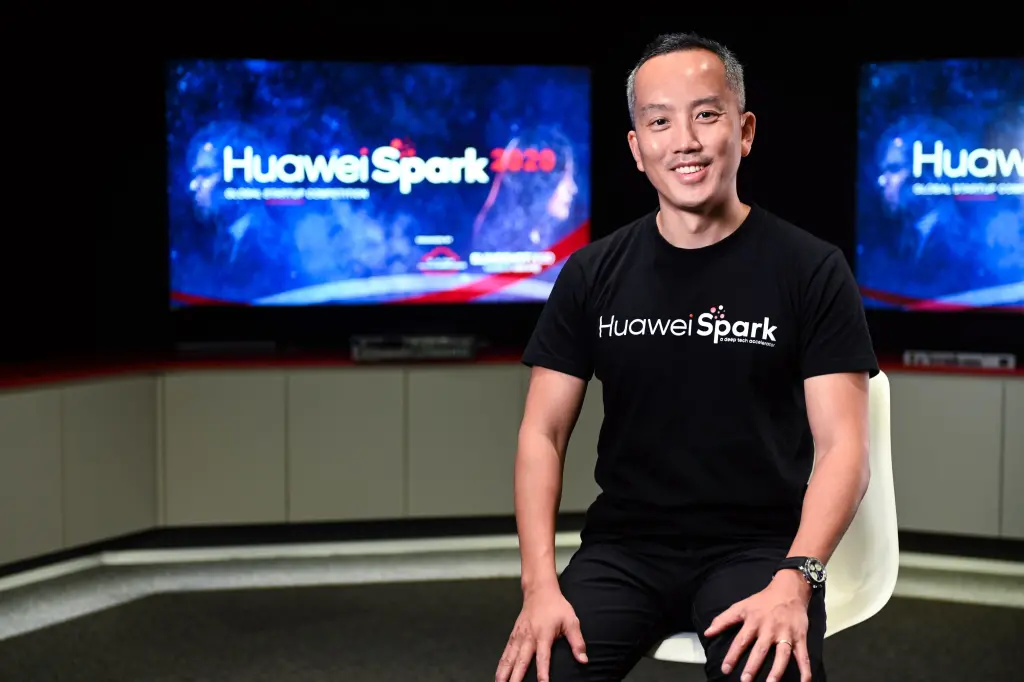
Leo Jiang, Huawei’s chief digital officer for Asia Pacific / Photo credit: Huawei
“We are doing this for the ecosystem that Huawei is building,” Jiang says, referring to the company’s efforts to connect and collaborate with a variety of partners. “We want people to come in and leverage the infrastructure we build.”
It’s not just all about startups, either. For years, Huawei has been cultivating tech talent by teaming up with universities, providing students educational and technical resources as well as networking opportunities. Aside from its long-standing relationship with the National University of Singapore, Huawei is supporting Republic Polytechnic students by giving access to AI technologies for lab experiments and organizing a hackathon collaboration where winners get to embark on an immersion program across China.
“This is definitely a long game for us,” Jiang says. “You can’t build a startup ecosystem until you have a developer community that understands and is willing to use the technology.”
Resources for scaling
In 2020, Huawei launched the first edition of Spark in Singapore as a hybrid accelerator. The accelerator leverages the company’s comprehensive tech stack, expansive network of business partners, and 700 million mobile subscribers for the participants’ benefit.
“We are probably the only company that provides end-to-end tech support, from the very basic hardware down to the chipset, to the firmware and software, including cloud, AI, and 5G connectivity,” Jiang says. “We started as an enterprise-level service provider, and now we look to offer our tech stack to startups.”
Spark participants get access to different levels of support, depending on the tier they fall under. All startups can also secure funding in the form of cloud credits, loans and grants as well as technical support and training to develop their products on Huawei’s cloud and its Atlas AI product suites.
For example, Huawei was able to help AiDA, an artificial intelligence firm that works closely with insurance companies and banks. Even though the company’s products are supported by innovative machine learning technologies, its growth was limited as it could only deploy its solutions physically and on-premise.
But with Huawei’s “deployment-as-a-service” offering – in which a team of specialists are attached to clients to help them make the transition to the cloud – AiDA gained access to the technical skills and training required to begin the process of building a scalable software-as-a-service version of its product on Huawei’s cloud.
“It’s not just moving to the cloud – it’s about designing an optimal cloud architecture to scale efficiently and in a cost-effective manner,” Jiang explains.
Helping companies go to market
Spark also offers more business-oriented support, such as mentoring and go-to-market opportunities for participating startups with already-viable solutions. As part of the program, they work with an advisory board of mentors comprising industry experts, Huawei executives, established founders, and VCs that help them refine their pitches and business models.
Jiang estimates that while “97% of startups will fail,” mentored startups are “three times” more likely to succeed compared to those that aren’t mentored. “That’s going to be key for deep-tech startups,” he observes.
Additionally, Spark helps startups get in front of potential customers and gain brand exposure in Asia Pacific through events like Huawei Developer Conference and its “Go China” program, which brings participants to China to meet investors, potential business partners, and clients.
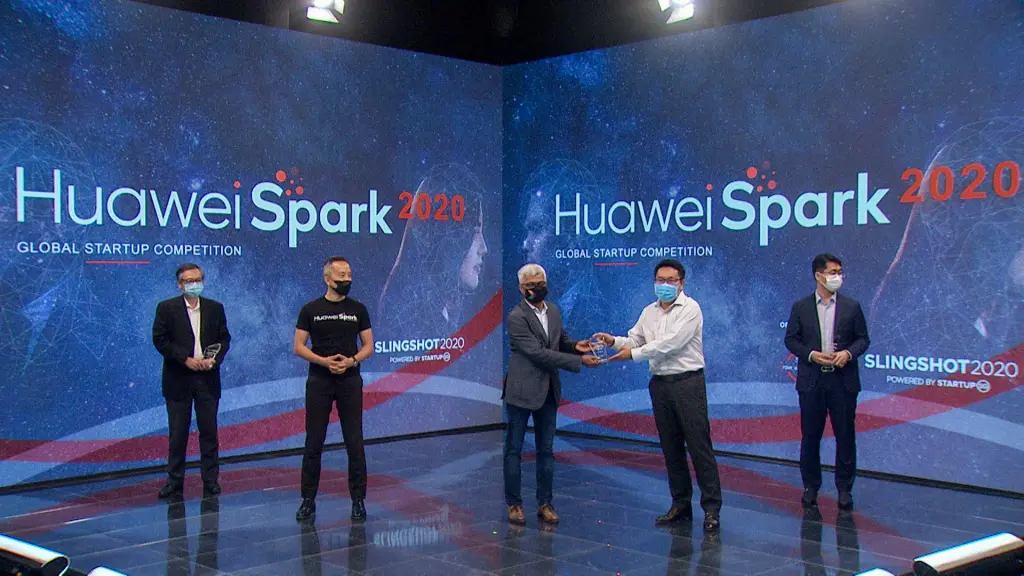
Photo credit: Huawei
Nestled within the Spark program is Spark Fire, a value proposition that opens up Huawei’s market to selected startups via three approaches: “Sell to,” “Sell with,” and “Sell through.”
Eligible startups undergo a six-month acquisition cycle, during which their products are studied from pitch to proof of concept before being pushed through to Huawei’s markets. Post-cycle, products can be sold to Huawei’s sales team or external clients via the “sell to” and “sell with” scenarios. With the “sell through” option, startups’ solutions are placed on Huawei platforms such as AppGallery, its app marketplace.
An example of a “sell-to” scenario is software firm Scantist, whose solution enables developers to quickly trace the origin of an open-source code to address and rectify vulnerabilities. The startup was introduced to Huawei’s research and development team and has since joined Huawei as a partner.
Alternatively, NextBillion, a Singaporean AI firm, is not only working to sell its mapping software to Huawei as a consumer phone integration, but it’s also selling with Huawei to a third party: logistics firm Ninja Van.
“When you marry these ideas and multiply them by the number of markets that we play in, then that’s a huge advantage,” Jiang points out. “Those are three things that really count: Access to clients who have a need, having the right type of support, and creating a platform they can really leverage the business network we are building.”
Selling the future
Huawei has plans to further develop Spark at the regional level, anchored in Singapore and Hong Kong and branching out to Indonesia, Thailand, Tokyo and Seoul. The goal is to recruit up to 100 startups, 20 of which will be growth-stage firms.
Through the next few iterations of Spark, Huawei will continue to run events like its Spark Global Startup Competition – a collaboration with Slingshot – and the Spark Founders Summit, a thought leadership platform which doubles as a networking opportunity for startups aiming to connect with VCs and corporates.
In order to fuel these activities, the company will be investing US$27 million over the next three years into the Spark program – with the aim of building the ecosystem and accelerating startups’ growth.
“I am very optimistic about what the future holds for this program,” says Jiang. “We can’t make this space work without startups and an ecosystem.”
The next edition of Huawei’s Global Startup Competition, Spark Ignite, is currently open for applications. Startups in fields such as education, mobile, and sustainability, among others, are invited to participate. Find out more about the competition and apply to participate on the competition’s website.
This content was produced by Tech in Asia Studios, which connects brands with Asia’s tech community. Learn more about partnering with Tech in Asia Studios.
Stay updated on the go with our mobile app.
Get latest insights with smoother, more personalized experience through TIA mobile app.
Recommended reads
 India-based VC debuts seed fund with $100m corpus
 SG biotech startup snags $4m seed funding from Elev8, Seeds Capital
 Singapore AI startup obtains $5m in Square Peg-led seed round
 Flipkart co-founder’s startup banks $25m in series A money
 Tin Men Capital injects $2.7m in AI software startup’s pre-series A round
 Oracle offers free AI training to 10,000 Singapore students, professionals
 Wavemaker-backed WasteX raises $450k to expand biochar solution across Indonesia
 Living Lab Ventures to help global startups enter Indonesia with new launchpad
 GSR Ventures exec says no to LLMs, opts for market-ready AI products
 Tepbac, Vietnam’s answer to eFishery, seeks to raise $20m





Editing by Winston Zhang, Nathaniel Fetalvero, and Eileen C. Ang
(And yes, we’re serious about ethics and transparency. More information here.)





📅 Upcoming Events
22 October 2026
Payoneer x CSPN Summit 2026