Terence Lee · · 6 min read
A quiet revolution is changing how the Singapore government builds apps
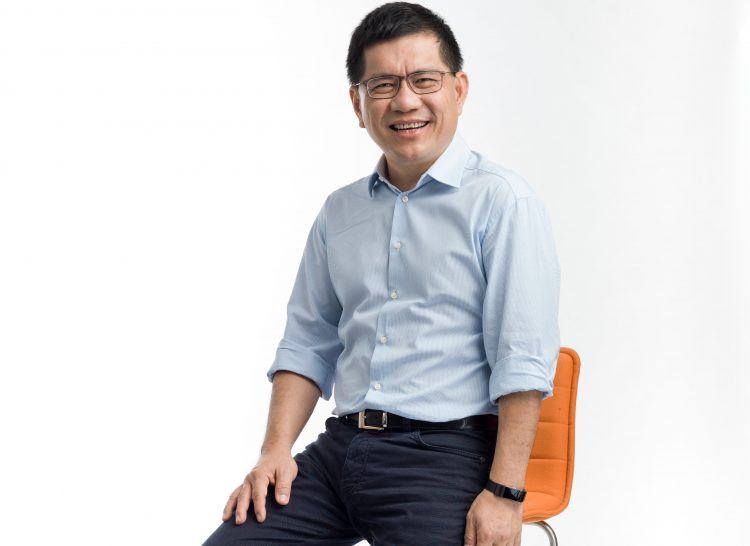
Singapore’s government chief information officer Chan Cheow Hoe / Photo credit: GovTech
Chan Cheow Hoe, Singapore’s government chief information officer, is a geek at heart, dabbling in programming languages like Python and R in his free time. And he’s not the lone techie at work: Prime Minister Lee Hsien Loong once showed off a sudoku-solving program that he wrote in C++. A week later, another minister translated the same program into Javascript.
But Chan’s geek credentials may be unrivaled. After all, his full-time job is to overhaul the way government websites are created and make them as user-friendly as possible. His solution is the Singapore Government Tech Stack (SGTS), a digital infrastructure that he hopes will eventually underpin all online government services.
The problem Chan is solving is real. Anywhere in the world, online government services tend to be backward. Because of a potent mix of bureaucracy and a lack of awareness or motivation to adopt modern software development practices, government websites have been not as user-friendly as their private sector counterparts.
All that is changing. In 2014, the US Digital Service famously rebuilt the failing Healthcare.gov at a fraction of the cost by implementing modern practices. The original version cost US$200 million to make and $70 million a year to maintain. The new version? Just US$4 million to make and US$4 million annually to maintain.
“We partner with agencies to identify and implement shared tools and services to address common technical issues and usability challenges across government,” it noted in its annual report to Congress.
A similar approach was taking root in Singapore that same year, which was also around the time when Chan was appointed to his current role. As he surveyed the government’s software development practices, he saw room for change.
For instance, deploying new software code was a hassle. A programmer would take a thumb drive, go to the data center, and then sign forms before being allowed to upload the code. The entire process could take two weeks. Also, instead of relying on commercially available solutions when building a new website, there was plenty of reinventing the wheel instead. This drove up costs.
“They would build everything, from the server room to the application itself,” Chan said in an interview with Tech in Asia, expressing his exasperation at old practices. As he put it, modern software development should be as convenient as going to the supermarket, getting canned food, and cooking it quickly. “Why try to farm the thing, grow the onions yourself, get the cow, and make the milk? Are you crazy?”
Enter the tech stack
The SGTS embodies the new mindset. Its various components are stitched together from commercially-available products and open standards. Chan adds, “Anything that’s bespoke, over time, will never catch up. The amount of work needed to keep something on par with industry standards is tough. What makes you think you’re better than Google or Docker in doing something?”
The platform-as-a-service (PaaS) layer, essentially a cloud computing service that removes the need for software developers to manage and maintain servers, is based on OpenShift. The Application Programming Interface (API) gateway layer – think of it as traffic control for the data that travels between government databases and apps – is built on Akana. This means that whenever these commercial solutions get updated, so will the tech stack.
Finally, on top of the PaaS and API gateway sits the microservices, which are functions that software developers can piece together like Lego to create a new app or website. Need a notifications or payments feature? Just plug-and-play from the microservices library. The end result is online services that can be launched for less money and at a shorter time frame.
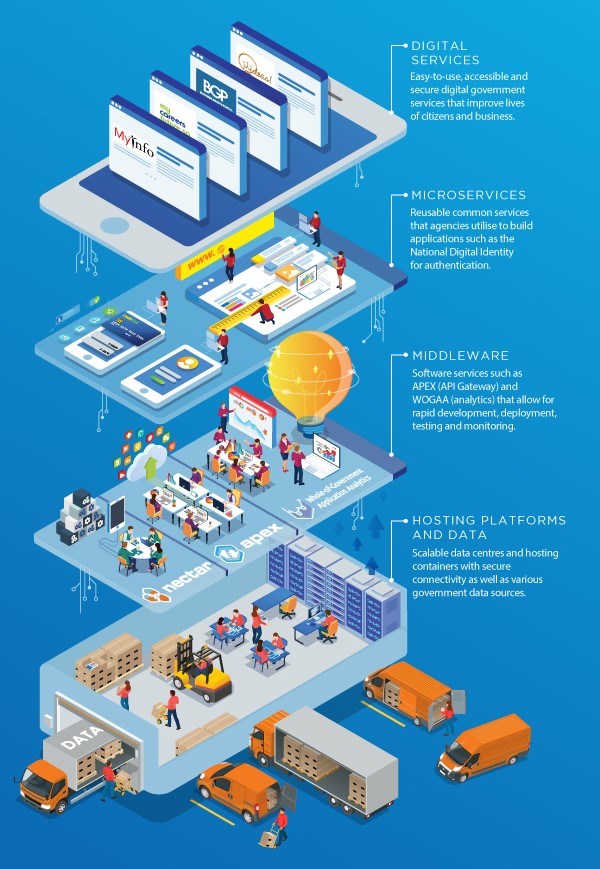
What the Singapore Government Tech Stack looks like / Image credit: GovTech
Evangelizing the stack





Stay updated on the go with our mobile app.
Get latest insights with smoother, more personalized experience through TIA mobile app.