Josh Horwitz · · 9 min read
5 ways China’s WeChat is more innovative than you think

Tech in Asia has been covering WeChat, China’s most popular mobile message app, before it even had an English name. Meanwhile, international tech media outlets (including ourselves) have also been following the evolution of other messaging apps such as WhatsApp, Line, Facebook Messenger, and many, many others. Over the past year or so there’s been lots of talk about how these messengers are maturing into “platforms” – or, apps that users will use to buy things, and that business and organizations can use to reach an audience.
However, as others have correctly pointed out, it’s not appropriate to lump China’s WeChat alongside these other chat apps. This is in large part because it’s simply far ahead of its like-minded competitors with respect to the “platform” side of things.
When a user opens up WeChat in any language other than Chinese, they’ll likely see a messaging app that, for the most part, looks and works just like Line or Viber. But for Chinese speaking users, WeChat is a rabbit hole – full of all sorts of features that apps like Line haven’t even come close to adding. Indeed, Tencent internally continues to refer to “WeChat in China” only as Weixin (its Mandarin name), while its international counterpart is referred to as WeChat.
With this in mind, below we’ve outlined five ways in which WeChat is already excelling as a platform within China – and how its likely to become even more relevant to Chinese consumers and businesses alike.
1. It’s not just a messaging app, it’s a mobile news reading app
This is one of WeChat’s most overlooked bright points. Countless Chinese media organizations operate subscription accounts on WeChat, through which they send out daily digests to subscribers. It’s quite easy to keep up with the Chinese news cycle just by following a few choice accounts. Moreover, these news organizations don’t just send out links re-directing readers to their official websites – instead, when readers press a link to a story, they’re moved to a standalone webpage under Tencent’s mp.weixin.qq URL, viewable within WeChat’s in-app browser. Users can also save articles and then view them later within WeChat (albeit not offline), in a clean format that’s uninterrupted by noisy ads and cluttered sidebars.
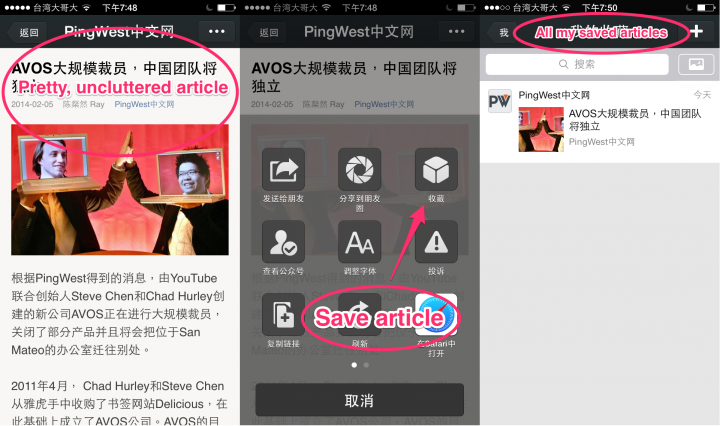
What’s the result here? While WeChat doesn’t offer the same degree of customization as apps like Readability or Flipboard, it has many of the functions of those social news-reading apps. It lets users read articles in a visually pleasing format, and users can then share those articles within WeChat and outside of WeChat. While a “read offline” function might not help WeChat earn extra money, the app is just a few lines of code away from turning into an outstanding reading service in the vein of Pocket.
It’s worth noting that this feature is also available in WeChat’s international versions. But what’s missing? A diverse range of media outlets that have public accounts on WeChat.
2. It’s not just a messaging app, it’s a blogging platform
WeChat’s international versions have thus far been very selective with regard to what entities qualify for a public account. But in China, nearly anyone can register for a public account. As a result, there are many bloggers in China who use WeChat as their primary channel for publishing posts. Much like your average Joe with a WordPress account, some of these bloggers write on specific themes and amass loyal followings, while others publish posts that read like a daily journal.
Right now, in addition to various brands, businesses, and media organizations, I’m following one public account called warfalcon. The online psuedonym of a thirty-something IT professional, warfalcon first earned online fame in 2011 when he set out to read one book every day. Since then he’s become a Tim Ferris-esque figure in China, and he’ll publish daily posts on his WeChat public account on habit-forming and time management. I’m also following XYshentucao, which is an account run by an ordinary university student in Taizhou who posts updates about campus life.
3. It’s not just a messaging app, it’s your new online storefront
Before we dive into this bit, let’s first clarify the different account tiers offered to owners of public accounts on WeChat.
Right now, WeChat offers two types of public accounts: “subscription accounts” and “service accounts.” It’s worth noting that WeChat itself is currently in the process of further refining and distinguishing its two different account types, so for now, overlap is quite common.
4. It’s not just a messaging app, it’s a mobile wallet
5. It’s not just a messaging app, it’s a resume
WeChat and the network effect





Stay updated on the go with our mobile app.
Get latest insights with smoother, more personalized experience through TIA mobile app.