Jack Ellis · · 5 min read
Chinese universities rule ‘most innovative’ list, but rankings don’t tell the whole story

Photo credit: National University of Singapore
Chinese institutions are cementing a dominant position as Asia Pacific’s most innovative universities, according to rankings put together by Thomson Reuters and Clarivate Analytics.
But the data, which draws heavily on the quantity of patents and academic papers that the schools produce, doesn’t necessarily tell the whole story.
The list of the 75 most innovative Asia-Pacific universities was topped by the Korea Advanced Institute of Science and Technology (KAIST), with the University of Tokyo and Pohang University of Science and Technology (POSTECH) taking second and third place, respectively.
The National University of Singapore (NUS) was Southeast Asia’s highest-ranked institution, coming in at 10th.
Over a third of the institutions named on the annually published list are in China, which claimed 27 spots – including all three new entrants to the rankings. Leading them was Beijing-based Tsinghua University, which placed sixth.
In terms of national representation, South Korea came in second with 20 universities, Japan in third with 19, Australia in fourth with five, and Singapore in fifth with two. and India and New Zealand both landed at seventh place with one institution each.
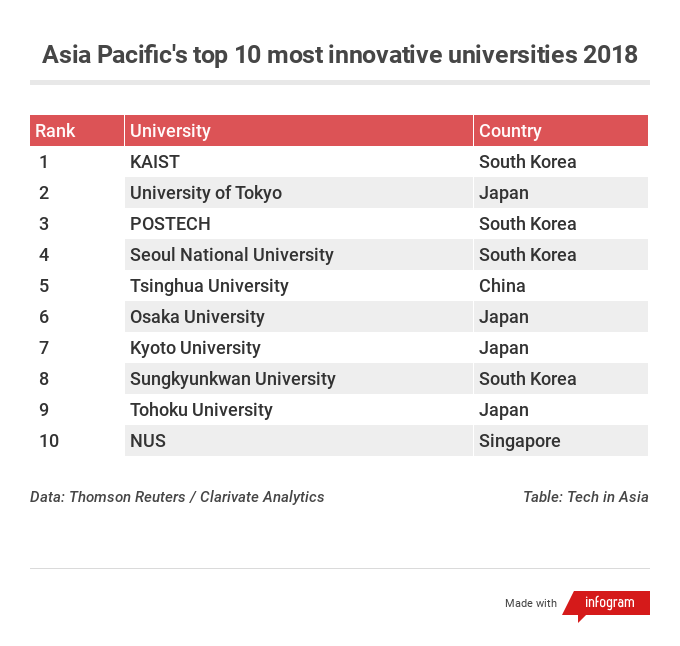
A closer look at the methodology behind the rankings, however, suggests that when it comes to technological innovation, some of the universities on the list may be punching far above or below their weight.
Exclusive rights
The methodology for compiling the rankings is based on several of each university’s “innovative” outputs – specifically, patent applications, patent grants, and published academic papers. The researchers also looked at things like how frequently these patents and academic papers were cited by later publications, and how often applications based on the same patents were filed by the university in additional jurisdictions.
Patents are legal instruments granted by governments that give inventors – or their employers, which in this case are universities – exclusive rights over their invention for a limited period of 20 years. This is intended to stop third parties from using an invention without the inventors’ permission during that period, and to give them an opportunity to secure a return on investment by commercializing their invention, or by selling or licensing it to a third party.
To obtain a patent, universities have to file an application with the relevant authority in the country where they’re seeking these protections. The applications will then be examined – a process which can take several years, depending on where the filing was made. At the end of this process, a patent may be granted if the invention meets patentability requirements.
Clearly, patents can be relatively expensive to file and are even more costly to maintain, as regular fees need to be paid to keep them in force over the course of their 20-year lifetime. Therefore, it would seem likely that universities only invest in filing patents on inventions that have future commercial potential. And in that sense, patent data can give us an idea of which inventions universities consider to be innovative.
Patents ≠ innovation
Useful innovation and startups





Stay updated on the go with our mobile app.
Get latest insights with smoother, more personalized experience through TIA mobile app.