C. Custer · · 4 min read
Why this fintech startup split its team across 3 countries
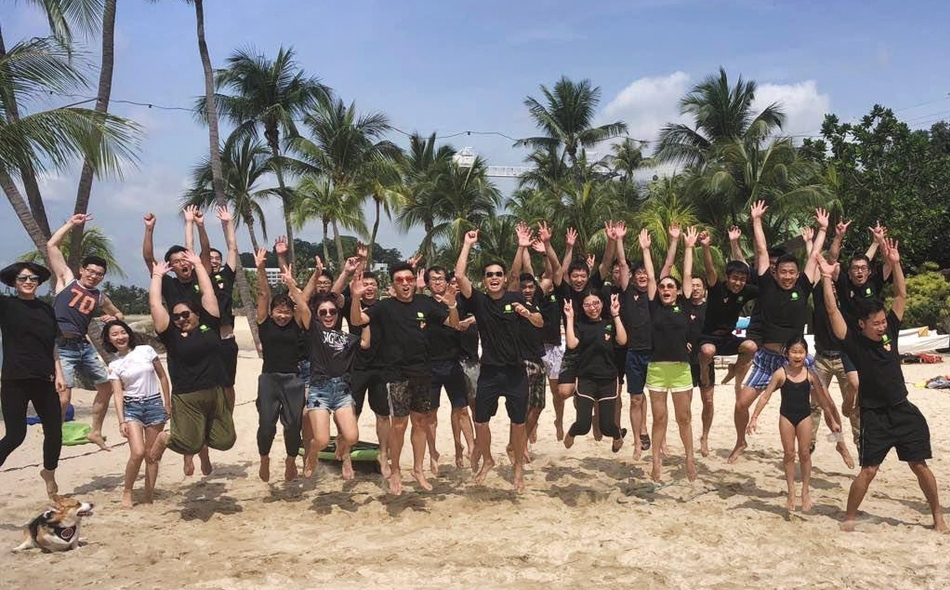
Photo credit: Advance.ai
Like most startups and their founders, Chun Dong Chau began with a problem.
When he and his co-founders looked at China’s financial tech industry, they saw a relatively mature market that was helping Chinese consumers and financial institutions alike. When they looked at Southeast Asia, they saw something else. They saw big problems.
“If you look at Southeast Asia and look at the interest rate, it’s very high,” Chun says. That makes accessing loan capital difficult for consumers. At its core, this is fundamentally a data problem. Interest rates in Southeast Asia are high because the loan default rate is high, Chun explains, and the default rate is high because it’s difficult for financial institutions to make informed lending decisions when there’s often little or no credit data to draw from.
That was the problem Chun set out to solve with Advance.ai. How could technology improve the lending cycle and give more people in Southeast Asia access to credit when they need it?
AI to the rescue
The Singapore startup’s solution was to seek data that is available for many Southeast Asians. They may not have credit histories, but they have smartphones, social media accounts, ecommerce purchase histories, and much more. Essentially, Advance.ai is an AI-powered system that allows lenders to connect with and analyze all of that data so that they can make more accurate decisions about any potential loan’s risk.
The company has made an array of specific services around this concept. There’s Advance Horus, for example, a facial recognition engine that’s designed to help businesses with the know-your-customer process and guard against fraudulent actors; Advance Guardian sifts through other available user data to do the same thing; Advance Booster and Advance Connect go a step further, helping businesses access and analyze data from a variety of providers for purposes like lead generation.
Regulatory challenges
Of course, any company that goes digging in user data faces regulatory hurdles, and Chun notes those challenges are ongoing. Advance’s facial recognition software, for instance, is 97 to 98 percent accurate compared to a trained human, who is generally 95 percent accurate, he says. Chun says that makes it more accurate than even a trained human (95 percent). But he also points out that human verification is still mandated by regulations in some areas like banking licenses, even though “data can prove that actually, technology is better than a human.”
As is so often the case in the fintech sector, regulations lag well behind what’s technologically possible.
There’s also the problem of explaining a loan application that’s been rejected by an algorithm. In a traditional, human-assessed loan, a declined application will often come with a reason – you need more income, your credit score isn’t high enough, etc. This kind of explanation is even mandated by law in some countries. But it’s difficult to account for AI-driven credit decisions, which could be based on advanced calculations and a deep well of data, including data points that might seem irrelevant to layman consumers or regulators, such as social media activity.
Chun thinks Advance.ai is uniquely positioned to navigate those waters. Since it was designed as a business tool for the regulations-heavy finance industry, it’s been built from the ground up with strict user-data privacy controls. In fact, Chun believes the current public concern about data privacy is ultimately a good thing. “It makes the public aware that they are giving data away,” he says. “I think the ultimate goal for data privacy is that you as a user decide who’s going to use your data.”
AI talent war
Advance.ai has also struggled with another big challenge that’s familiar to almost any entrepreneur in Asia: finding and retaining talent. According to Chun, when the startup identifies a good candidate, it’s often competing with Alibaba and Tencent – and sometimes even Google and Facebook – for the signature. “It’s a constant battle – a global talent war,” he observes.
Advance.ai’s solution has been to break its team into three parts. There’s the headquarters in Singapore, which Chun says was chosen because it abounds with data science talent, and also because two of the company’s three founders are based there.

More Southeast Asia shenanigans:





Stay updated on the go with our mobile app.
Get latest insights with smoother, more personalized experience through TIA mobile app.