- Premium Content It takes our newsroom weeks - if not months - to investigate and produce stories for our premium content. You can’t find them anywhere else.
 Putra Muskita · · 6 min read
How Indonesia’s healthtech startups aim to democratize access to healthcare
Much has been said about the lack of access to commerce or financial services for many Indonesians. But healthcare is another area that has long been neglected. Private sector players have the upper hand, leading to an imbalance in healthcare quality and accessibility, especially for people outside of major cities.
In recent years, a number of startups have popped up to address this deficiency. Based on Tech in Asia’s data, the current leaders in terms of funds raised are Alodokter and Halodoc. Both have secured growth-stage funding – US$33 million in series C funding for Alodokter and US$65 million in disclosed series B funding for Halodoc – while others in the space are mainly still at the seed-stage rounds.
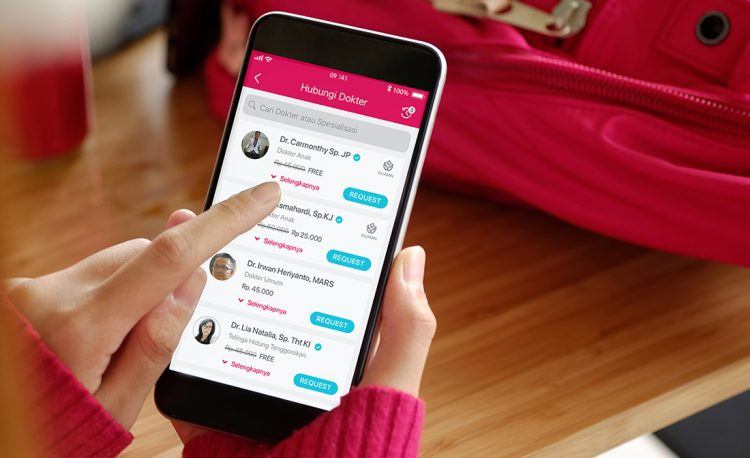
Photo credit: Halodoc
Two Southeast Asian unicorns have also ventured into the nascent industry. Since 2016, Gojek has been offering GoMed, a product that it now operates in partnership with Halodoc, while Grab more recently teamed up with Chinese insurance giant Ping An to launch a service called Good Doctor.
Though challenges remain, healthtech players say the opportunity is huge. The industry will grow to US$363 billion in value by 2025 from just US$20 billion in 2010, says Sony Radhityo, who oversees the GoMed product as Gojek’s head of third-party platforms, citing research from Roland Berger Strategy Consultants.
An ecosystem play
At their core, Alodokter and Halodoc have similar approaches: a platform play with an eye on building an ecosystem of healthtech services. Both companies started out by offering content on healthcare topics, allowing them to build a user base. Then they added features such as online consultations with doctors through their apps, priced at a fraction of what a typical face-to-face session costs.
“If you don’t solve with a horizontal approach, you’re not solving healthcare,” says Jonathan Sudharta, co-founder and CEO of Halodoc. “Our main theme is to put patients first and think from the patient’s point of view.”
Beyond consultations, Halodoc offers a medicine delivery service, which it operates in collaboration with Gojek, while Alodokter recently introduced an insurance product dubbed Proteksi Alodokter. Only 2% of Indonesians have health insurance, says co-founder and CEO Nathanael Faibis, and Alodokter wants to leverage its branding and performance (he claims that Alodokter, with its 24 million monthly active users, is “very advanced” compared to competitors in terms of bookings) to offer a user-friendly product.

Alodokter co-founders Suci Arumsari and Nathanael Faibis / Photo credit: Alodokter
“Insurance should be like an internet product: simple to understand, simple to buy, simple to pay,” he says. “It’s quite a different mindset compared to traditional insurance players, whose products are more complex.”
Faibis believes that the entry of unicorns is further proof of the healthcare sector’s potential. In addition to Gojek and Grab’s products, Tokopedia and Bukalapak have dedicated medicine pages on their platforms.
Initially a medicine delivery service, Gojek’s GoMed has since evolved into a partnership with Halodoc. When a user clicks the GoMed tile on the Gojek app, it redirects them to the Halodoc app.
“Our vision is to reach all Indonesians and bridge gaps in medical infrastructure [outside the big cities],” he says, noting that GoMed is available in 33 cities across Indonesia.
Going local
‘You cannot experiment as fast as traditional tech businesses’
New normal
Stay ahead in Asia’s tech landscape
This is premium content. Subscribe to read the full story.
Alodokter and Halodoc have emerged as leaders in the space as unicorns like Gojek and Grab have also gained ground.
We know this is not ideal. ⌛ Sign up in 20 seconds. Cancel anytime.
Our subscriber community includes professionals from these companies:





Stay updated on the go with our mobile app.
Get latest insights with smoother, more personalized experience through TIA mobile app.









📅 Upcoming Events
22 October 2026
Payoneer x CSPN Summit 2026