- Insights This article was written by a TIA community member. Insights pieces undergo the same rigorous editorial process that newsroom-produced articles have.
 Qin En Looi · · 7 min read
How Web3 can solve community building (part two)
This piece was written by Qin En Looi and Joash Lee of Saison Capital.
In part one of this series, we dove into why online communities on Web2 have so far failed to satisfy our desire for connection and looked at the flaws still plaguing many Web3 communities.
While these issues are significant, the strides being made by Web3 startups and projects hint at how close we are to overcoming them.
Three jobs in community management
Building and managing communities today is an onerous process, where leaders make decisions primarily based on intuition rather than data.
As a result, there is still a lack of understanding of who their community members are beyond superficial metrics like self-assigned Discord roles. This limits a community’s ability to deliver compelling experiences.
The challenges in managing Web3 communities have inspired a swathe of startups and projects attempting to improve the community management experience. As the importance of communities continues to grow among Web3-native projects and Web2 brands looking to leap into Web3, we believe the opportune moment for efficient and effective Web3 community management has arrived.
Broadly speaking, we think there are three key tasks in community management: understanding, engaging, and growing the community.
The first step that any community manager should take is to understand their community based on five key questions:
- Who are the members? (e.g., demographics, interests, affluence, affiliations)
- What do members want to participate in? (e.g., networking events, social hangouts)
- When is best to engage with members? (e.g., daily versus annually, time of day)
- Where can we engage members most effectively? (e.g., online versus offline, communication tools)
- Why are members here? (e.g., professional or social reasons)
Once they understand their community, managers must figure out how to engage them. Engagement is an ongoing battle: On Web2 community platforms like Facebook, more than 900 million users are in five or more communities (known as “groups”), with more than 10 million communities to select from.
The final stage is growth. As existing members churn, community managers need to bring in new like-minded individuals to participate in the community.
The graphic below is a non-exhaustive mapping of Web3-native tools available to fulfill the three jobs to be done – understand, engage, and grow. (Credit to Safary for creating the first version of the Web3 growth ecosystem map, available here.)
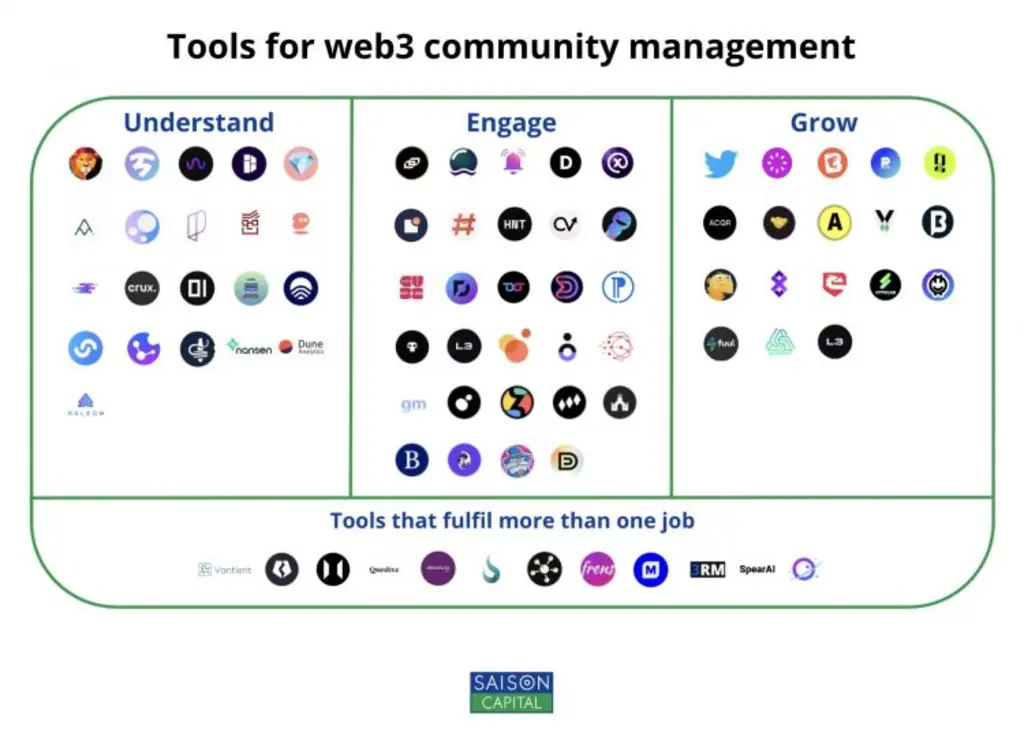
Image credit: Saison Capital
Understanding the community
This begins with aggregating and drawing patterns across members’ data. The depth of data and strength of pattern recognition correlates to the level of understanding.
Engaging with the community
Growing the community
Unlocking potential





Stay updated on the go with our mobile app.
Get latest insights with smoother, more personalized experience through TIA mobile app.











📅 Upcoming Events
22 October 2026
Payoneer x CSPN Summit 2026