Malavika Velayanikal · · 5 min read
Another shutdown. This time, it’s India’s first Tinder, after a 5-year run

Photo credit: Alex Bellink.
Cogxio and DateIITians, two dating apps with different business models and target audiences, have shut down. Layak Singh, founder of the startup that created these apps, admitted in a blog that mistakes were made along the way. “The challenge was in understanding Indian users and their behavior,” he said.
But before we go further into what went wrong, let’s look at how these apps came up.
Layak started working on DateIITians during his final year in IIT Kharagpur, one of India’s premier engineering colleges, back in 2011. That was long before Tinder or any of its Indian clones had made an appearance. The next year he founded a startup to launch the dating site, along with fellow IITian Kinshuk Bairagi and Sarit Prajna Sahu, an MBA graduate from the University of Warwick. It was an online dating portal exclusively for students and grads of the Indian Institutes of Technology (IITs) and Indian Institutes of Management (IIMs).
“In college it went viral and become one of the top five websites with Alexa rank of 507 in India. This made me excited that there is a market for the product on a massive level and so I did not opt for any corporate jobs and started it full time,” he explained in an AMA session on Tech In Asia.
Tech in Asia wrote about DateIITians in June 2012. At that point, it was a website and just beginning to work on its apps for Android and iOS. To register on the site, users needed to provide a valid legal ID, and the site claimed to vet and verify every user. Our writer C. Custer, who tested it out, hit a wall when he attempted to delete his profile. Nevertheless, he noted DateIITians as a startup to watch.
See: An idea whose time hadn’t come: app for startups to pitch to investors shuts down
Pre-Tinder days
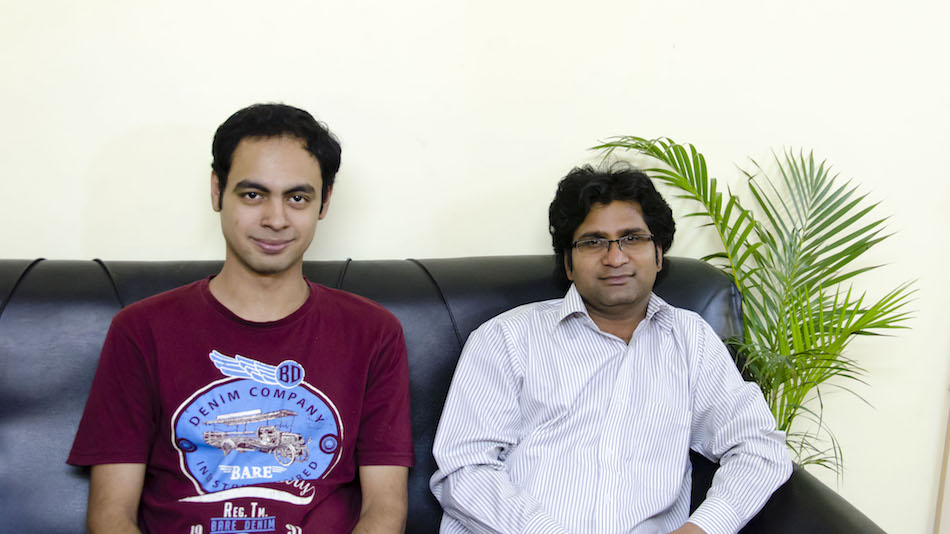
Kinshuk Bairagi and Layak Singh, co-founders of DateIITians and Cogxio. Photo credit: Cogxio.
It was a far from perfect product but remember, this was pre-Tinder times. Online dating was unheard of in India and the novelty gave DateIITians a boost. The site claimed to have received five million hits within three months and tens of thousands of verified users.
But that didn’t translate into a viable business. The young entrepreneurs realized that scaling up was hard in a niche market and funding was hard to raise with this model.
Then they came up with Cogxio. Here the idea was to use location intelligence to enable online connections to become real dates. Coupled with this online-to-offline scheme was an idea to tie up with internet consumer-facing platforms like Uber and Zomato.
Cogxio wanted to be the one-stop-shop for all things romantic. “It offers you ideas about the best places to go for a romantic dinner in your town, gift vouchers for your sweetheart, and so on, or an adventure trip to a destination of your choice with your loved one,” Layak told me during Cogxio’s launch in 2014.
But by now, there were several others in the online dating space and Cogxio didn’t get the reception DateIITians did at its launch. It also took too long to go mobile with an Android app, which was launched in May 2015. Even a year after its launch, Cogxio had only around 12,000 registered users.
Cultural barrier





Stay updated on the go with our mobile app.
Get latest insights with smoother, more personalized experience through TIA mobile app.