
Indonesia boasts the world’s largest Muslim population; more than 203 million, which is roughly 90 percent of the archipelago’s citizenship. For all you non-Muslims out there, the practice of Islam includes observing dietary laws, which come from religious teachings. Islamic dietary laws define foods that are “Halal,” meaning lawful or permitted. Muslims avoid food and drinks that are “Haram,” meaning not permitted. Devotion to eating strictly Halal food varies from person to person in countries like Indonesia. In other words, some people are conservative and others are liberal about what they munch on.
Regardless, the Halal label on food and restaurant windows is something a lot of Muslims actively look for in the capital.
Irawan Surya Kusuma is an Indonesian entrepreneur with no background in IT. He graduated with a degree in material engineering from the Bandung Institute of Technology (ITB) in 2010. Two years later, Kusuma went in a different direction and took his chances on a startup concept he called Opepper. Essentially, Kusuma and his team built a social media app for culinary recommendations. Shortly after, he was forced to disband his crew due to an evaporated financial runway. However, before Kusuma threw in the towel, he wanted to see if he could find an app developer to help run Opepper more efficiently.
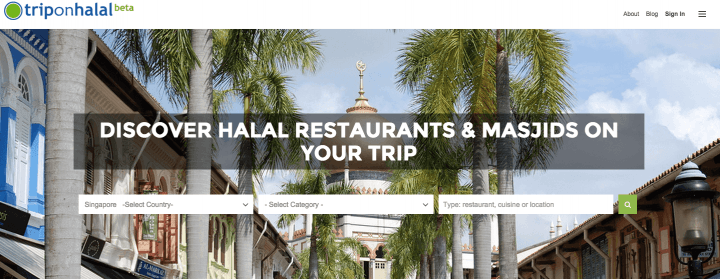
The foodtech business was heating up at that time. India-based Zomato had just launched in Indonesia, and in 2014, so did Jakarta’s now-largest online food startup Qraved. Kusuma bumped into Dondi Hananto and Fajar Anugerah of Kinara, an early-stage investment company and business incubator in Jakarta. After consulting with Hananto and Anugerah, and doing loads of market research, Kusuma decided to differentiate his startup by zeroing in on Halal dining options. In an effort to make his company crystal clear, Kusuma rebranded his product to something more obvious: Trip on Halal.
See: Muslim cuisine just got social. HalalTrip lets you spot and share Halal food
You’d better believe Muslims are travelling
The Muslim travel market was worth US$145 billion last year, with 108 million Muslim travelers representing 10 percent of the global travel economy, according to a recent report by CrescentRating and MasterCard. These numbers are set to grow to 150 million travelers by 2020, accounting for 11 percent of the global travel economy. Travel spending is expected to rise to nearly US$200 billion per year.
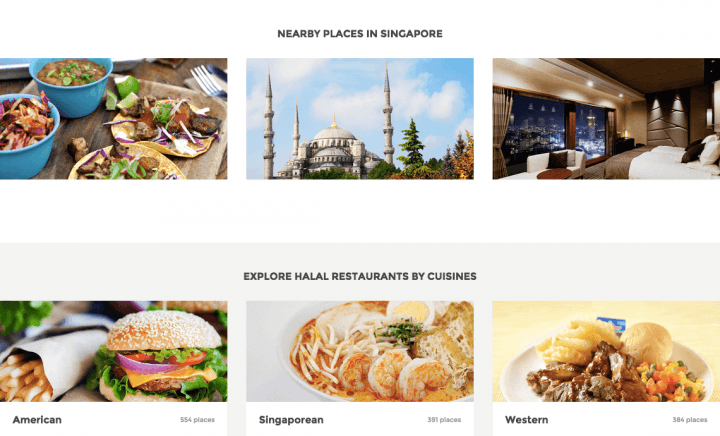
Trip on Halal is not just an Indonesian company, however, as the product takes a pan-Asia approach, with listings in Hong Kong, Taiwan, Singapore, Thailand, and Japan. It also has listings in the UK. For the past three months, the site has been running in beta form. Users can search for Halal food based on country or category, but they can also browse by restaurant if they know the name. Trip on Halal is also departing from strictly featuring food, as it also points to Muslim-friendly hotels as well as mosques near the traveller’s destination.
As Kusuma tells Tech in Asia, no player really dominates the global Muslim travel niche. However, there are a couple of other players in the region with the same focus as Trip on Halal. One of them is Singapore-based HalalTrip, a firm that lets Muslim consumers book flights, hotels, and travel packages. Kusuma claims Trip on Halal is different, however, as it acts as more of a directory service and a community for reviews, whereas HalalTrip’s business revolves around selling tour packages.
He also says there are several overseas competitors in the Muslim travel space. Japan has startups like Halal Gourmet and Halal Navi, while Anything Halal competes with Burpple for the lead in Muslim-friendly dining directory in Singapore. The site will soon also act as a social network, where users can follow each other and browse recommendations based on the people they follow. (Update: An earlier version said there’s a US iteration of the site, that users can validate a venue’s Halal credentials, and that the social network is launched already. Those three details are now corrected or removed.)
A mobile strategy and a bit of MaGIC





Stay updated on the go with our mobile app.
Get latest insights with smoother, more personalized experience through TIA mobile app.












📅 Upcoming Events
22 October 2026
Payoneer x CSPN Summit 2026