David Corbin · · 4 min read
Fewer outsiders and more CVCs – the future of Japan’s startup ecosystem?
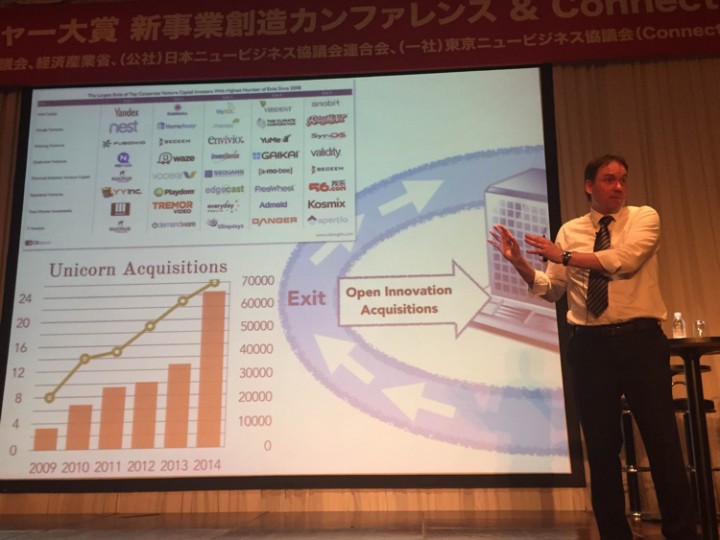
Erik Vermulen (Philips), making a point
Japan’s startup ecosystem gets stronger each year, but its corporate arm remains underdeveloped. Though some companies, most often those already in the tech sector, will invest in or work with startups, many more avoid associating with such seemingly unconventional and risky organizations.
Today, the Venture Business Creation Council, the Ministry of Economy, Trade, and Industry, and the Japan New Business Conference hosted an event attended by representatives from a wide swath of Japan’s top companies for the purpose of boosting their enthusiasm for startups. The push to educate the audience was most evident in a panel discussion regarding the roles and interactions of corporate venture capital (CVC) and regular venture capital (VC).
It started with Professor Kiyoshi Kurokawa, chair and founder of the Impact Japan Foundation, who did not mince words in his welcoming remarks. “Groupthink is one of the characteristics of Japanese institutions in general. That can be good but in a global setting it can be a weakness […] I hope you can learn and share and create a new value that the world is waiting for,” he said.
From there, a panel with Erik Vermulen (Philips), Akimitsu Degawa (Intel Capital), Hiroki Saito (BASF Venture Capital), and Tomotaka Torin (Rakuten), all of whom are leading the investment activities of their respective firms, took the stage.
The key lesson they tried to impart is that corporations looking to invest via CVC only for strategic, business purposes, are likely to be disappointed in the outcome. That is because those corporations are approaching startups from the perspective of “this startup has good tech so I should acquire it and keep the tech for myself and away from competitors” instead of “this startup has good tech so I should try to see just how big it can become.” The latter mindset is familiar to traditional venture capitalists, meaning CVCs run a risk of positioning themselves in opposition to VCs.
Whether as a limited partner in a fund or as a co-investor, a corporation’s reputation in the VC community will have a big impact on its ability to get access to the best startups. With that access, can come healthy investment returns and multiple, positive relationships with rising stars in various industries. “No VC will want to work with you if you kill companies,” Vermulen stressed.
Degawa added that interest in the long-term health of the startup is critical, in part, because the directions of corporations and industries can change from year to year. If a corporation acquires a startup with the intention of nurturing it, but senior management changes its mind about where the business is going, that startup is stuck in a very difficult position – limited resources and limited independence. In that scenario, the corporation would definitely have been better off just rolling the dice and seeing how far the startup could go on its own ability.
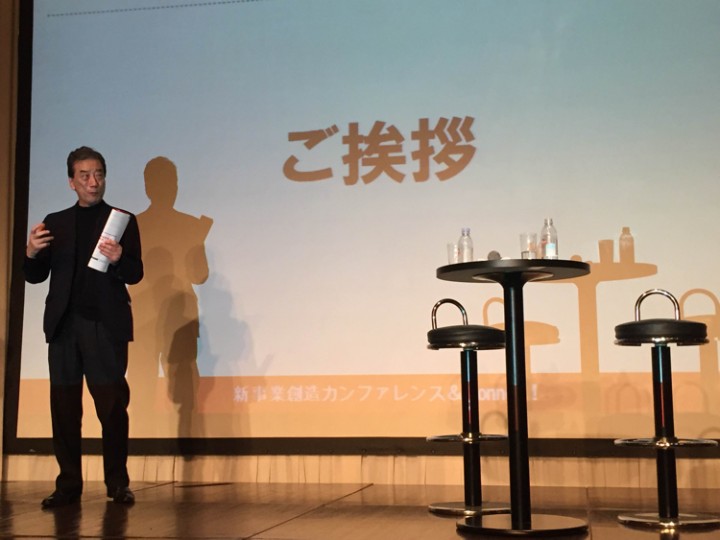
Professor Kiyoshi Kurokawa delivering his remarks
The other members of the panel agreed with that stance, but Torin offered a slightly different experience. Since 2013, Rakuten Ventures has been busy outside of Japan, but its parent company has done over 100 acquisitions and investments since its founding. Domestically, several of those acquisitions – MyTrip.net, eBank Corporation, and DLJdirect SFG Securities – are now better known as Rakuten Travel, Rakuten Bank, and Rakuten Securities. All three have become sturdy pillars of the Rakuten ecosystem, and their original management teams have been largely involved in that process.
That sort of track record is quite rare, and Torin noted that Rakuten only invests in startups if there is a strong relationship and mutual understanding at the management level. Rakuten’s strong interest in seeing its acquisitions grow as large as possible is a key reason for its successful run in Japan’s ecosystem.
Looking forward, the panel was optimistic on the future of investment in Japan. Vermulen observed that, while cross-border investments in Asia are rising, cross-border investments in Japan remain low and static. “Will that change? I’m pretty sure it will,” he said, citing companies like the Fukuoka-based Nulab for having the sort of global ambition that attracts outside funding.
Torin also sees reason for Japanese corporations to become more involved in the ecosystem. “Lots of very talented people are starting companies these days,” he said, also noting a rise in entrepreneurs who previously worked at large companies. “I’ve also been meeting more people who tell me they used to work for Rakuten.”





Stay updated on the go with our mobile app.
Get latest insights with smoother, more personalized experience through TIA mobile app.