
For years, Japan has been looking to restart the engine on its struggling tech economy. Now it’s actively looking to entrepreneurs to get its mojo back – and it’s a great thing for both local and foreign companies wanting to start up in the land of the rising sun.
Read on to find out why, and how you can explore this potential opportunity further.
1. Availability of top talent
Historically, the only acceptable path to success in Japan looked something like this: study hard, earn yourself a place at a prestigious university, graduate, and work at corporate giants Sony and Toyota until you retire.
Today, the tides are shifting and mindsets are changing – and it’s starting from the next generation of students and institutions. Top universities have set up incubators and launched funds to embrace entrepreneurship as a respectable career alternative. Results are already showing.
A recent count by the University of Tokyo, the most prestigious university in the country, numbered 240 startups affiliated with it – 16 of which have gone public with a total market capitalization of US$8 million.
On top of that, more students are launching their own startups while still in university.
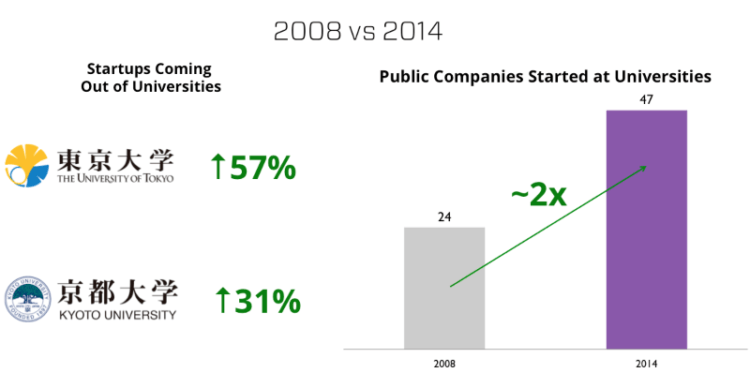
Credit: Nomura Research Institute. Graph by 500 Startups
Finding local top talent to work for your newly minted company was close to impossible in the past. Not today.
2. The government is on your side
Starting a new business venture is difficult. While moral support goes a long way, government aid is often the one that can make or break the deal. Good news: Japan’s government is on your side.
Prime Minister Shinzo Abe recently made a call to put startups in the center of the country’s growth strategy for 2015-2016, and to deregulate SMEs.
During his visit to Silicon Valley in May last year, he unveiled a new policy initiative known as the Bridge of Innovation – a Japanese entrepreneurship training program in Silicon Valley. On top of that, easing visa requirements provides great incentives for foreigners to start their own businesses.
Having the Abe Administration and the government rooting for the boom of entrepreneurship in Japan can only spell better times ahead for startups.
3. Gates are now open
Consequently, gates to Japan’s tech scene are now open wider than before. It’s not just Silicon Valley that Japan has started to establish strong connections with. Foreign entrepreneurs from across the world – even students – are increasingly launching their own companies. It’s a wider and more diverse pool of entrepreneurs, which translates into a larger market and increased opportunities for startups to cross-learn, resulting in more innovation.
Japan already has a solid infrastructure and broadband speed other countries can only dream about. Now that road ahead is clear, its startup tech scene seems ready for a revolution. Are you planning to be part of it?
Japan wants to meet startups. If the feeling is mutual, we have the perfect opportunity for you to explore this relationship and take it a notch further.
Tech in Asia Tokyo is back for its third run on September 6 and 7 and applications to exhibit at Bootstrap Alley have already begun pouring in!
If you would like to be part of the 170 startups that are getting some serious face time with the Japanese and Asian tech community, take five minutes to apply for your booth today.
All applications made by July 8 will enjoy a 20 percent discount.
Stay updated on the go with our mobile app.
Get latest insights with smoother, more personalized experience through TIA mobile app.
Recommended reads
 Indonesian AI startup goes global
 Forrest Li on scaling Sea, building smarter bots, and founder grit
 An AI assistant that joins sales calls and scores team skills
 Beyond the check: Why VCs need more than capital
 SGX’s CEO says it doesn’t need a unicorn to win
 SMEs want AI too, but not the kind Big Tech is selling
 Oatside’s alt-milk rise hits a profitable gear
 Alibaba’s financial health in 12 charts
 Asia’s telcos bundle AI into mobile plans. Will it pay off?
 M-Daq chases bigger clients as revenue falls, losses grow





Editing by Michael Tegos
(And yes, we’re serious about ethics and transparency. More information here.)