 Steven Millward · · 5 min read
Infosys’ billionaire founder: this winter will ‘separate men from boys’
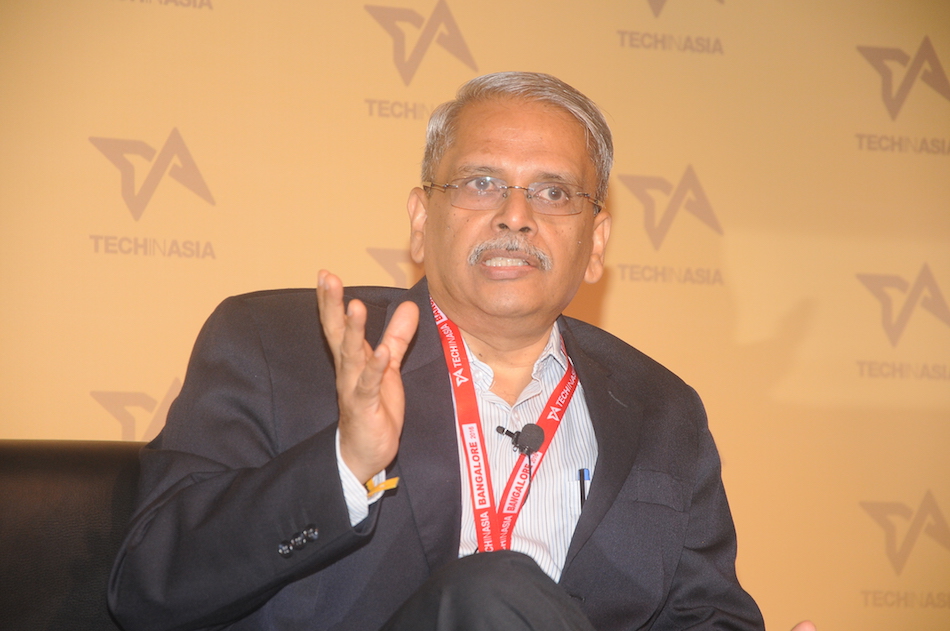
Kris Gopalakrishnan onstage this morning at TIA Bangalore 2016. He was CEO from 2007 to 2011.
Amidst all the talk of India’s new startup “unicorns” – like Amazon arch-rival Flipkart, or Uber challenger Ola – people less familiar with the country might not realize that all those are dwarfed by a tech company that started in India decades ago – and is now valued at US$40 billion.
Senapathy ‘Kris’ Gopalakrishnan is one of the seven people who co-founded Infosys in 1981, just two years after he first leapt into working life as a software engineer. It’s easy to overlook Infosys because the company doesn’t make trendy apps and its services aren’t the kinds of things you or I use. It does outsourced software development and maintenance work for huge firms like banks and manufacturers all around the world.
What Kris and his colleagues started up formed India’s first tech wave. What’s happening now is version 2.0.
“Today’s entrepreneurs are very different – they’re very optimistic and very adventurous,” said Kris this morning, speaking onstage at Tech in Asia Bangalore 2016. And of course they have the internet, which he couldn’t take advantage of back in the early 80s. The opportunities now are totally different – and so’s the speed at which everything moves.
“Times have changed – the expectation of how fast something will scale is much higher today. Not sure if that’s warranted or not,” he observed.
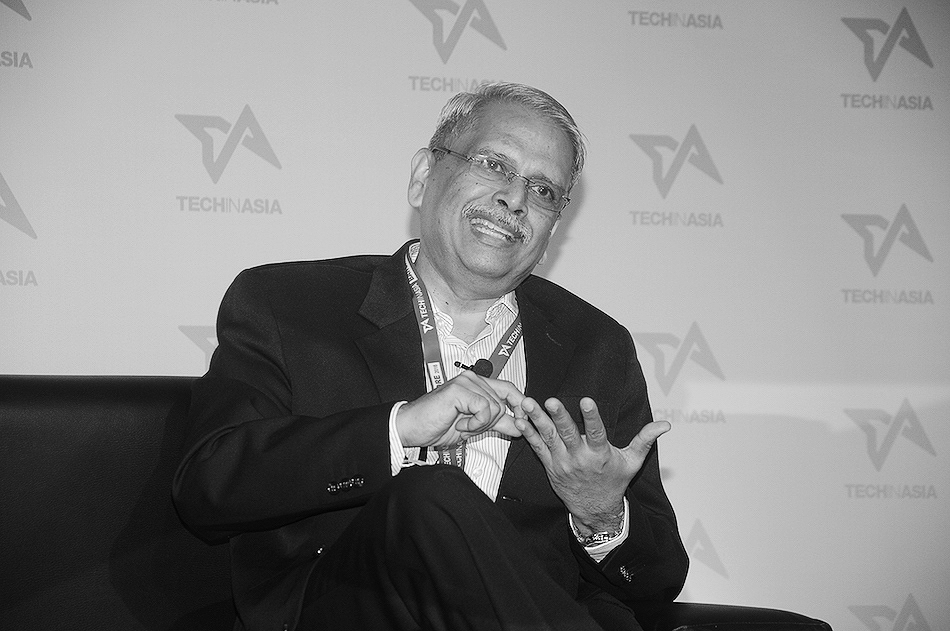
The billionaire is watching India’s second tech wave – the likes of Flipkart, Ola, Snapdeal, Housing, et al – very closely, especially when he’s investing some of his own cash in homegrown startups. He’s personally funded 10 so far. He took that a step further a few years ago when he co-founded a startup accelerator program called Axilor, which is now working with its third batch of startups in Bangalore.
Now Infosys’ executive vice chairman, he is also an adviser at IDG Ventures’ branch in India together with fellow titan of industry Ratan Tata.
New giants
Kris today affirmed his faith in India’s new tech titans at a time when many are cutting jobs and finding it a lot harder to raise funds than a few years ago.
“Every three years, five years, we’ll go through ups and downs. No doubt about that.
“If you look at Flipkart, Snapdeal, Myntra and the like – […] definitely I believe some will be there five years or 10 years from now. And then we’ll look back at this time and say this is when the men were separated from the boys,” he said. Or women from girls.
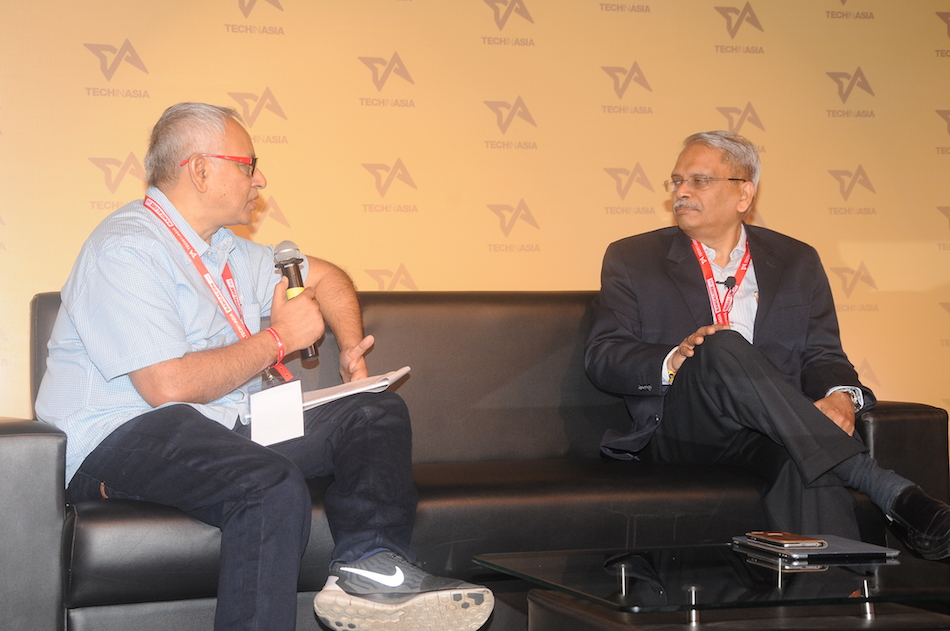
Tech in Asia blogger Sumit Chakraberty (right) interviews Kris in the opening session of our first Bangalore conference.
He advised the many entrepreneurs in the audience to be very careful with their cash – and to cement that ethos into the company culture.
“You have to build with certain qualities. Frugality is certainly one of them. Look at every rupee that is spent. Infosys definitely has that philosophy.”
“Every startup should have 12 months to 18 months of cash,” he advised, so that young businesses “can withstand pressures” that suddenly occur.
Aside from a squeeze in funding for startups in India – often referred to as a “winter” – Kris sees other factors putting new pressures on startups and major economies around the world. “The issue with the anti-globalization trend is that it can slow down global growth, which will impact everyone,” he said, responding to a question about Brexit, the UK’s proposed withdrawal from the European Union.
“Also, it’ll slow down the movement of professionals.” That could make it tougher for entrepreneurs to fly off to conferences and meetings at a moment’s notice.
Learning the hard way
After proffering some advice to the many starter-upper youngsters in the audience, the veteran explained how the company handled a huge crisis in 2008, when Kris was Infosys’ CEO. The firm had already signed up 25,000 new employees a year prior, mainly from some of India’s best universities, as part of a recruitment cycle that generally takes 18 months.
But by the time the new staffers were out of school and ready to join, the global economic recession had hit hard, causing his company’s global clients to make severe cutbacks. Infosys growth dropped from 11 to 3 percent, Kris explained. But the firm had already made commitments to those people.
Kris faced a heart-wrenching dilemma.
“Parents were calling me, asking what we will do,” he recalls. Some parents even told him about marriages that were on the line if the company failed to deliver on the offers. “My son is planning to get married, the marriage is fixed, what will you do about the job?” a woman asked him.
Kris and the company ended up honouring all the job offers by setting up a new university, diverting the recruits through courses until the firm’s growth was back on track. It’s now the “largest corporate university in the world,” he said onstage.
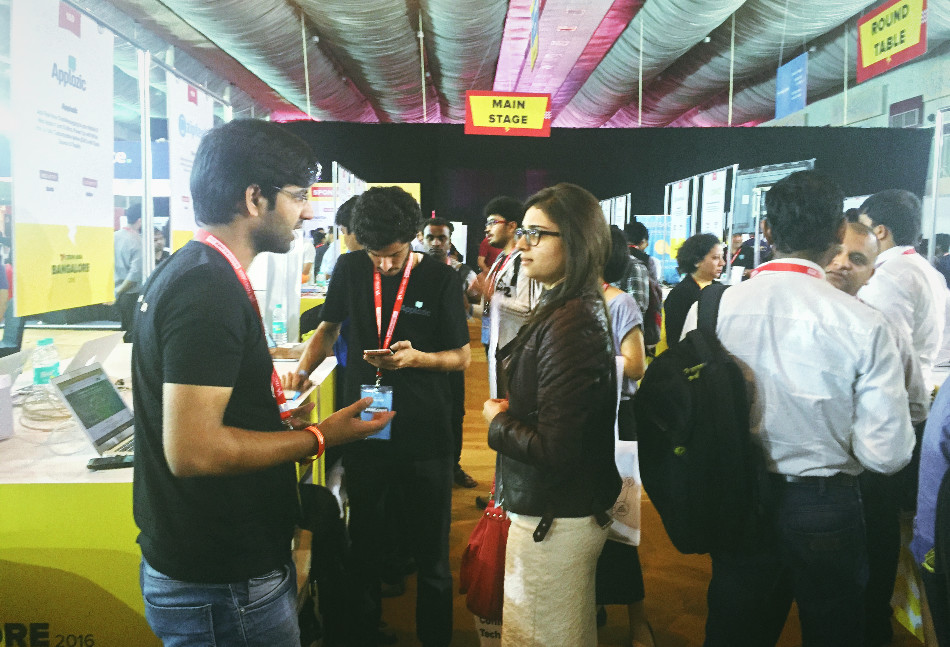
Entrepreneurs among the 1,500 attendees expected at the conference over two days.
That course of action was chosen, he said, because it was the right thing to do. “We could afford to do that,” he added.
I’m very optimistic about healthcare.
“Every company will have to decide how to manage these things,” he said, offering yet more advice to entrepreneurs while side-stepping a question about what Flipkart should have done during its own recent hiring crisis.
Despite the winter of disinvestment, Kris sees spaces where there are booming opportunities for tech startups to grow – mainly in tucked-away fields that not so many entrepreneurs venture into.
“I’m very optimistic about healthcare,” Kris exclaimed, referring to startups tackling medical and health-related services. “It’s a huge market in India, with good healthcare in limited supply while people are living longer.”
He’s also keen on preventative and predictive medicine using new tech – “a huge opportunity given the size of the country.”
That’s why his Axilor program is focusing on medtech, cleantech, and spaces far away from the usual spaces. “We wanted to focus on a couple of areas that are socially relevant,” he stated.
This is part of our coverage of TIA Bangalore, running on July 6 and 7.
Stay updated on the go with our mobile app.
Get latest insights with smoother, more personalized experience through TIA mobile app.
Recommended reads
 Indonesian AI startup goes global
 Forrest Li on scaling Sea, building smarter bots, and founder grit
 An AI assistant that joins sales calls and scores team skills
 Beyond the check: Why VCs need more than capital
 SGX’s CEO says it doesn’t need a unicorn to win
 SMEs want AI too, but not the kind Big Tech is selling
 Oatside’s alt-milk rise hits a profitable gear
 Alibaba’s financial health in 12 charts
 Asia’s telcos bundle AI into mobile plans. Will it pay off?
 M-Daq chases bigger clients as revenue falls, losses grow





Editing by Terence Lee and Michael Tegos
(And yes, we’re serious about ethics and transparency. More information here.)



