- Premium Content It takes our newsroom weeks - if not months - to investigate and produce stories for our premium content. You can’t find them anywhere else.
 Shihan Fang · · 9 min read
Move over UST, USDC’s the new face of crypto payments
As TerraUSD (UST) bites the dust, another stablecoin is taking its place as the de facto utility token for the digital economy. Say hello to USD Coin (USDC), the stablecoin that customers of three major fintech giants can now use to make payouts to merchants.
Image credit: Shutterstock/STEVLTH
Stripe is testing its USDC merchant settlement option with a small group of Twitter creators in the US. Meanwhile, WorldPay has made a similar feature available globally and secured Crypto.com, a leading crypto exchange, as its pilot customer.
Another fintech giant, Checkout.com, is part of a consortium supporting Solana Pay, a payments framework built on top of Solana, the world’s fastest public blockchain and a leading “Ethereum killer” that promises cheaper and quicker transactions. Solana Pay attempts to integrate the pay-and-settle flow entirely in digital dollar currencies such as USDC. So in an ideal situation, consumers can make payments and merchants can accept them immediately, with settlements costing only “a fraction of a penny.”
Since the collapse of UST over the past weekend, it’s clear that a “plain vanilla coin” such as the USDC may not be the most attractive for crypto investment, but it’s edging ahead as the de facto cryptocurrency for widespread adoption.
UST is just one of a handful of stablecoins pegged to the US dollar. And while UST isn’t backed by actual US dollars or US dollar-denominated assets, USDC is. These reserves are kept with leading regulated financial institutions in the US, including BlackRock and Bank of New York Mellon. USDC is issued by Circle, a US-based peer-to-peer payments company.
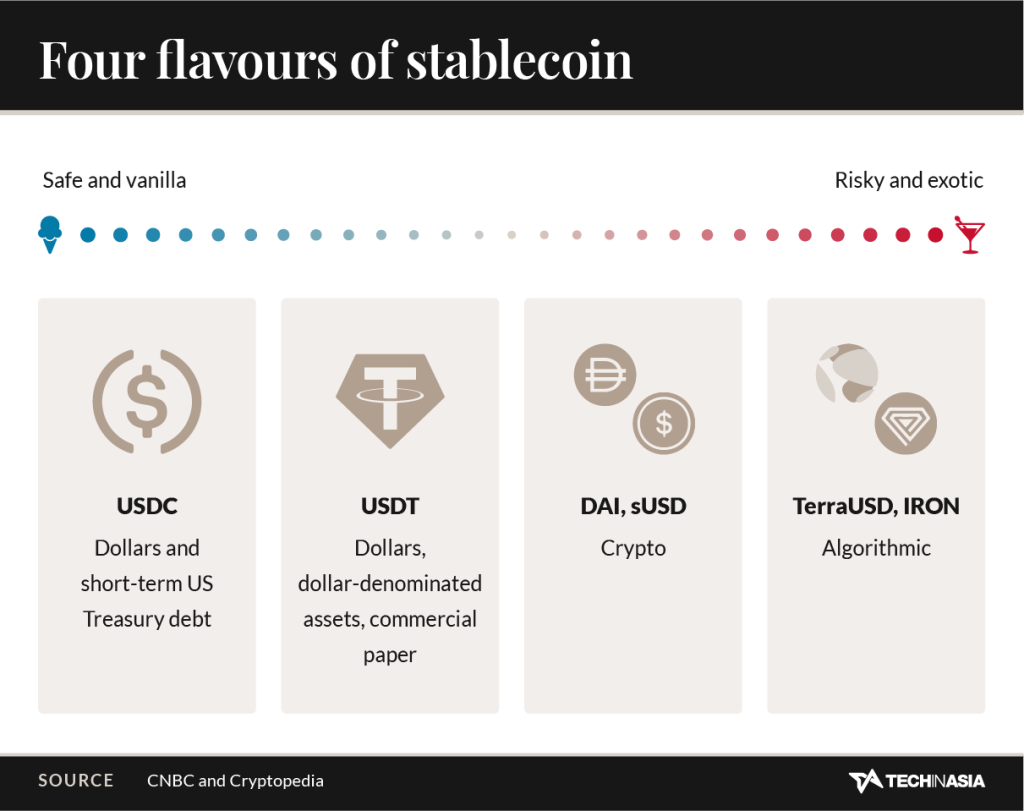
Image credit: Timmy Loen
Another stablecoin in the fiat-collateralized category is tether (USDT). Compared to USDC, tether is considered a riskier stablecoin due to its reliance on unsecured short-term corporate debt, or “commercial paper.”
Both tether and USDC are vital to the crypto economy as they are the third- and fourth-largest tokens by market value – behind only those of Bitcoin and Ethereum.
UST collapse has not affected ‘PayTech’ crypto plans
Industry watchers believe that the collapse of UST has created a contagion effect for all stablecoin-related businesses and will have a huge long-term impact on the entire crypto industry.
Investors of USDT, for example, have pulled out over US$7b from the stablecoin in a panic sell after it briefly depegged from the dollar about a week ago.
Korean payment app Chai was also forced to issue a statement on its website stating that it had ceased its collaboration with Terra in 2020 and had stopped supporting the TerraKRW stablecoin, which is pegged to the South Korean won, in March this year. Chai was originally established as a payment app for Terra in 2018, but subsequently pivoted to facilitating digital payments for the broader Korean market.
However, Stripe, WorldPay, and Checkout.com confirmed to Tech in Asia that despite the UST debacle, none of them had made any changes to their crypto plans.
Plain vanilla, please
Web3 vs. Web2 payment rails
License to act
Slow and stable wins the race?
Stay ahead in Asia’s tech landscape
This is premium content. Subscribe to read the full story.
When it comes to critical payment infrastructure, boring old USDC may be the best bet.
We know this is not ideal. ⌛ Sign up in 20 seconds. Cancel anytime.
Our subscriber community includes professionals from these companies:





Stay updated on the go with our mobile app.
Get latest insights with smoother, more personalized experience through TIA mobile app.










📅 Upcoming Events
22 October 2026
Payoneer x CSPN Summit 2026