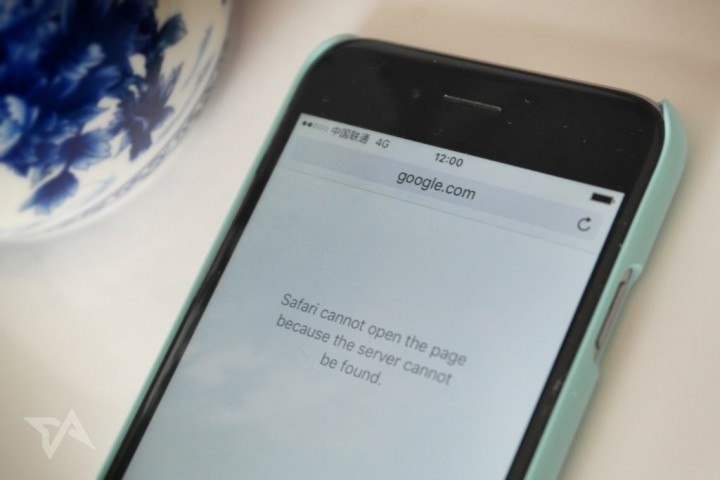
Welcome to the land where Google no longer exists.
Citizens of mainland China unexpectedly found themselves with unfettered access to Google search late last night, commencing a golden age of censorship-free searching that lasted all of 105 minutes.
For the duration of the film Edward Scissorhands, lasting from 11:30pm on Sunday to 1:15am on Monday morning, Google’s search – but not other services like Gmail or Youtube – was unblocked, according to the South China Morning Post.
This isn’t the first time that holes have appeared in China’s Great Firewall – or the first time they’ve been hastily filled in.
A welcome accident
When a blocked website unexpectedly slips China’s internet filter, it can usually be explained in two ways: either the Great Firewall changed, or the website did.
In July of 2014, for example, Facebook made a short-lived return to the People’s Republic – but it was only accessible in some cities, and just for a few hours. China’s censorship authorities don’t exactly post PR releases about the Great Firewall’s glitches, so it has never been clear what exactly happened.
Access to Google search coincided with the company’s launch of a series of new IP servers.
There is more evidence surrounding this most recent Google unblocking. The SCMP reports that access to Google search coincided with the company’s launch of a series of new IP servers in Asia to assist users of Google’s Vietnamese, Japanese, Indian, and other domains. The addition of these new IP servers seems to have confused China’s censorship apparatus, which did not recognize those new connections as linked to blocked services.
See: How the Great Firewall of China Works [INFOGRAPHIC]
It only took a bit more than an hour and a half for China to bring the ban hammer down on Google’s new servers, however. In the time when the website was accessible, there was a flurry of commentary on Chinese social media, namely Weibo and WeChat.
In posts circulating on WeChat, users shared screenshots of searches via Google’s .jp domain, accompanied with messages ranging from the utilitarian “Welcome back, Google!” to the more poetic: “It came back! A great feeling, like spring flowers in full bloom.” As of writing, those posts are still on WeChat’s Moments service (akin to the Facebook timeline).
It doesn’t look as though Google intentionally evaded censorship here. Launching new IP servers late on a Sunday night doesn’t exactly reek of subversive activity – it seems much more like planned server maintenance that had a pretty big accidental side effect.
But it does show that China’s Great Firewall is primarily a reactive – not a proactive – tool. All it takes is one routine IP update to poke holes in the system, and presumably force some Beijing bureaucrats and engineers to scramble into their offices on a Sunday night.
Editing by Michael Tegos





Stay updated on the go with our mobile app.
Get latest insights with smoother, more personalized experience through TIA mobile app.