
The Covid-19 pandemic has turned out to be an unexpected contributor to the growth of ecommerce in Southeast Asia. With more people staying indoors amid imposed lockdowns, downloads of shopping apps have increased in most markets across the region.
Ecommerce platforms now have an important part to play in helping people purchase essentials and do their shopping, and a key component to carry out this mission is logistics.
“Logistics plays a primary role in the customer’s perception of trust in an ecommerce platform,” says Ku Young Bae, the founder and CEO of Qoo10, one of Asia’s leading online marketplaces. “If an otherwise flawless platform uses a logistics partner that constantly falls short of expectations, it will not take long for customers to avoid using it.”
The current climate has brought this to the fore: Exponential increases in orders have led to delivery backlogs and items going missing. These issues affect not only customers but also sellers, who often face criticism for poor delivery processes that they don’t even manage.

Ku Young Bae, founder and CEO of Qoo10 / Photo credit: Qoo10
The challenges of cross-border logistics
As online shopping platforms become more globalized in their selection of products and merchants, the importance of logistics processes has also increased. This is particularly true in Asia, where there are varying levels of infrastructure development and a lack of unified customs processes. That said, affordable tiers of international delivery services can take anywhere from two to eight weeks to fulfill an order, making the wait for overseas products inconvenient.
“Customers would usually turn back to retail options or not make their purchases at all, and the opportunities of having overseas merchants selling on the platform will be wasted,” says Ku.
As a result, people tend to pay a lot more for faster delivery services, and cross-border logistics players are trying to balance speed, efficiency, and cost to meet consumer standards.
There are a few hurdles in combining these factors, though. At the big-picture level, international logistics requires huge amounts of foundational infrastructure to run smoothly across geographical borders, which undoubtedly costs a pretty penny.
Closer to the ground, other issues have cropped up: Inaccurate item declarations on logistics paperwork, unsecure packaging that leaves products susceptible to damage, and varying customs rules per country regarding prohibited items.
Often, these issues can result in delivery delays or, in some cases, cause parcels to go undelivered entirely, says Wilson Wong, group leader at Qxpress, the logistics subsidiary of Qoo10.
Lithium-based batteries and alcohol-based hand sanitizers, for instance, cannot be sent via air freight.
“If these are straightforward products, platforms like Qoo10 can always build logic into their purchase process to automatically prevent these kinds of sales overseas,” Wong says. However, if the prohibited items are undeclared components of larger parcels that are only discovered en route to a destination, it will fall on the logistics company to decide what to do, he adds.
Delivering satisfaction
Better synergy between ecommerce platforms and their logistics solutions providers would go a long way toward simplifying the fulfillment process and reducing potential points of failure.
For instance, Wong shares that by integrating Qxpress functions into the dashboards of Qoo10 sellers, logistical processes like waybill printing, tracking code updates, and shipping statuses can be seamlessly and automatically updated for the various parties involved.
Meanwhile, Qxpress’ last-mile delivery and selective warehousing capabilities adds another layer of convenience. By offering storage, inventory management, and fulfilment services for selected products, it minimizes certain risks for ecommerce firms.
The inventory management system, Wong says, intelligently orders a new batch of products based on the sales metrics from the previous batch, which makes the system more efficient overall. “It also allows for real-time updates of remaining product stocks,” he shares.
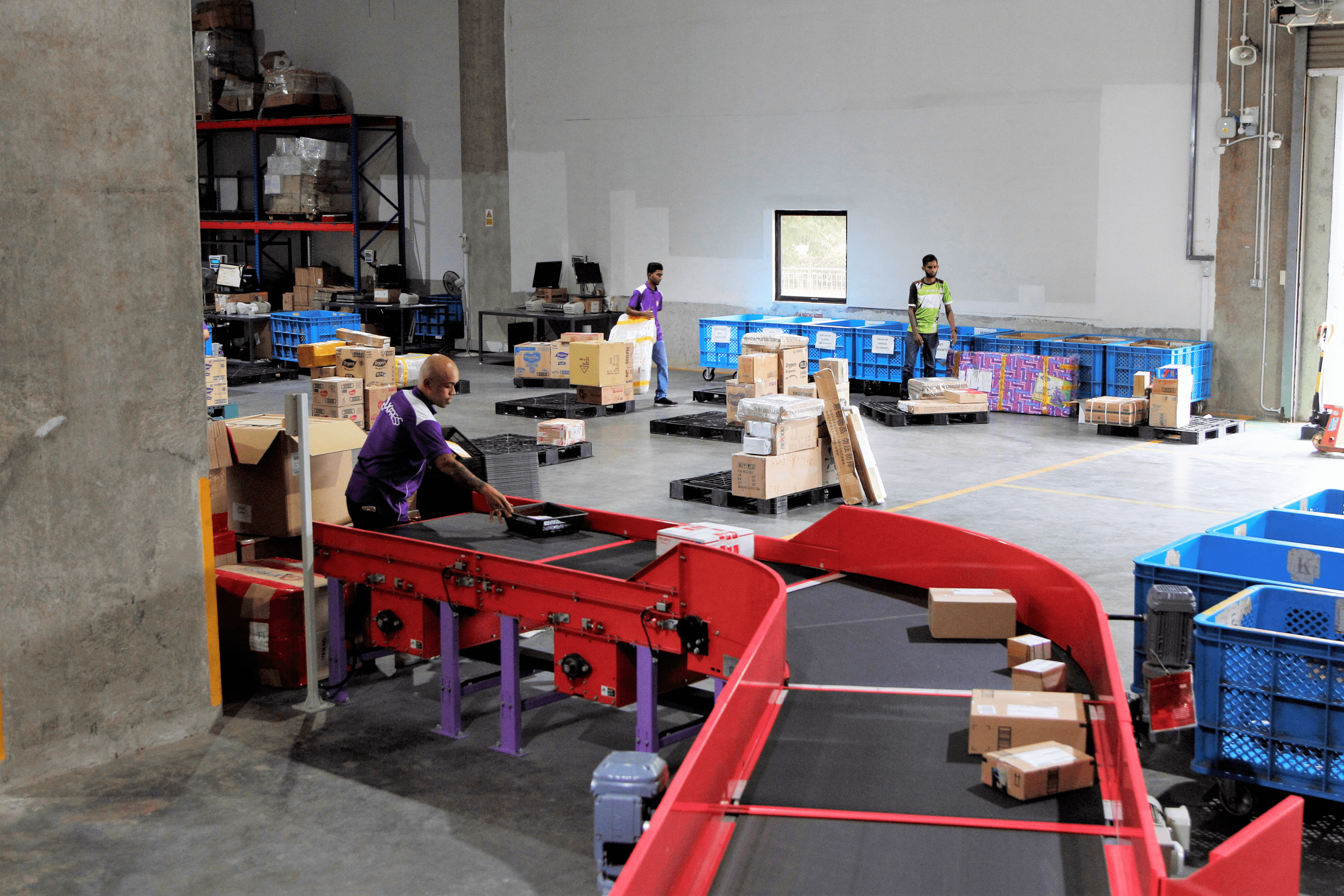
Photo credit: Qoo10
Selective warehousing, Ku adds, also enables the platform to react quickly to customer orders. After all, Qxpress’ sorting facility and warehouse are situated in the same building, which saves a lot of time in the fulfilment process.
“Ultimately, this allows customers to receive their purchases the next day or even on the same day,” he says.
To facilitate even international deliveries, Qxpress generates automated customs clearance reports, integrates with ecommerce platforms through APIs, and offers real-time delivery tracking, inventory management, and fulfilment services.
The platform seems to be largely successful, delivering 97.5% of all international parcels within five working days, says Ku. Its prices, he claims, are up to 60% lower than similar services.
Making the speed and cost equation work
Logistics firms operate on the principle that delivery speeds can only go up with higher costs. But that needn’t be the case. High-speed delivery at lower price points is possible, and the catalyst lies in raising job volumes to achieve maximum cost efficiencies.
“Contrary to popular belief, increasing job volume does not mean more delivery delays,” says Wong. “Rather, it allows for better fleet scheduling and overall efficiency by closing the distance between each delivery.”
With ecommerce in the region projected to continually trend upward in the next few years, larger parcel volumes are in the cards.
Logistics companies, such as Qxpress, that are actively working on the speed-to-cost equation are well-positioned to ride this wave.
Find out more about how Qxpress can help you with your logistics needs on its website.
Stay updated on the go with our mobile app.
Get latest insights with smoother, more personalized experience through TIA mobile app.
Recommended reads
 How financial infrastructure powers global startups
 Fave names ex-Touch ‘n Go exec as chief product officer
 With regulations sharply rising, Ant Group’s Asia investees are more important than ever
 Velo Labs partners with Lightnet, Visa for MSME payments solution in Asia
 How this YC-backed startup is making it easier for businesses to manage payments
 Decoding the rising retail opportunities and pitfalls for ecommerce businesses
 Pinduoduo-like platform in the Philippines bags $1m in seed round
 Philippine logistics scion wants to give Grab a run for its money
 Ovo, ZhongAn arm to launch insurtech JV in Indonesia
 Can Grab’s anti-fraud foray become its AWS?





Editing by Nathaniel Fetalvero and Jaclyn Teng
(And yes, we’re serious about ethics and transparency. More information here.)





